
Non-FictionSelf-HelpElectrical
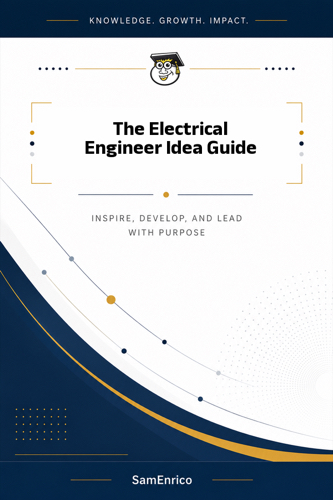
The Electrical Engineer Idea Guide eBook
Generate novel circuits and systems using componen
Generate novel circuits and systems using component hacking, signal mixing, and feedback loops.
Formats
Free sample
Chapter 1: The Component Lie...–- Every component is a liar. The resistor you hold is not a resistor. The capacitor you trust is secretly an inductor. The datasheet you worship is a work of fiction—a carefully curated set of lies designed to make you believe that components behave like their ideal symbols. This chapter is about learning to read between those lies, to see the parasitic soul inside every passive part, and to transform your relationship with electronics from consumer to hacker, from reader to writer, from engineer to alchemist.The Great Deception of Ideal Components When you first learned electronics, you were taught a beautiful lie.
The lie goes like this: a resistor has resistance. A capacitor has capacitance. An inductor has inductance. These are simple, single-number descriptions that fit neatly onto schematic symbols and into mathematical equations. The lie is convenient.
The lie allows you to design circuits on paper without worrying about the messy, physical reality of what you are actually soldering.But the lie has a cost.That 100Ω resistor on your breadboard? At DC, yes, it measures 100Ω. Feed it a 10 MHz signal, and it behaves more like a 100Ω resistor with a 50 n H inductor in series and a 2 p F capacitor in parallel. That 10 µF electrolytic capacitor you are using to filter power supply noise? It stops being a capacitor around 1 MHz.
Above that frequency, its internal inductance dominates, and it becomes an inductor—meaning it blocks high-frequency noise instead of shunting it to ground. That is the opposite of what you wanted.The first step toward becoming a component hacker—a true electrical engineer who can invent novel circuits rather than just assemble them—is to abandon the ideal. You must learn to see the parasitic elements hiding inside every component. You must learn to measure what components actually do, not what their datasheets claim they do under perfect laboratory conditions.This chapter teaches you that skill. By the end, you will never look at a capacitor the same way again.The Parasitic Zoo: What Lives Inside Your Components Every real component contains three types of parasitic elements: resistance (undesired), capacitance (undesired), and inductance (undesired).
The art of component hacking is learning which parasites you can ignore, which you must design around, and which you can exploit for novel behavior.Resistors: The Hidden Inductor A resistor is not a pure resistance. The most common resistor types—carbon film, metal film, and wirewound—each have characteristic parasitic behaviors.Carbon film resistors are made by depositing a thin layer of carbon on a ceramic core, then cutting a spiral groove through the carbon to increase the path length. That spiral is a coil. Coils have inductance. A typical 100kΩ carbon film resistor might have 20-50 n H of series inductance.
At audio frequencies (20 Hz to 20 k Hz), this is negligible. At radio frequencies (above 1 MHz), it becomes significant. At 10 MHz, the inductive reactance (XL = 2πf L) is about 3Ω—still small compared to 100kΩ. But at 100 MHz, it is 30Ω, and at 1 GHz, it is 300Ω. A resistor intended to be 100kΩ now looks like 100kΩ in series with 300Ω of inductive reactance.Metal film resistors have lower parasitic inductance (typically 5-15 n H) because their spiral is tighter.
Wirewound resistors are the worst: they are literally coils of wire wound around a core. A 10Ω wirewound resistor might have several microhenries of inductance, making it unusable above a few hundred kilohertz.The hack: You can deliberately use wirewound resistors as inductors in low-frequency circuits. Need a 10 µH inductor but only have a 10Ω wirewound resistor? Measure its inductance with a simple test jig (you will build one later in this chapter) and use it. The resistance is still there—you are getting an inductor and a resistor in one component.Capacitors: The Self-Resonant Liar Capacitors are the most deceptive components.
Every capacitor contains equivalent series inductance (ESL) and equivalent series resistance (ESR). The ESL is caused by the leads and the internal electrode structure. The ESR is caused by the dielectric material and the electrode resistance.The critical concept is self-resonant frequency (SRF) . A capacitor has capacitive behavior below its SRF (impedance decreases as frequency increases). At the SRF, the capacitance and inductance cancel, and the capacitor looks like a pure resistance (ESR).
Above the SRF, the inductor dominates, and the capacitor behaves as an inductor (impedance increases as frequency increases).Here are typical SRF values for different capacitor types:Electrolytic (10 µF, through-hole): SRF around 100-300 k Hz. Above 1 MHz, it is an inductor.Ceramic (0.1 µF, through-hole): SRF around 4-8 MHz.Ceramic (0.1 µF, surface mount 0603): SRF around 30-50 MHz.Ceramic (10 p F, surface mount 0402): SRF around 1-2 GHz.This explains a common beginner mistake: placing a 10 µF electrolytic capacitor on the power supply input of a high-speed digital circuit to "filter noise." At 50 MHz, that capacitor is an inductor. It is doing nothing to filter the noise—it might even be making things worse by creating a parallel resonant circuit with other capacitors.The hack: You can use a capacitor above its SRF as a narrowband inductor. A 0.1 µF ceramic capacitor with an SRF of 5 MHz will behave as an inductor between 5 MHz and about 50 MHz. This is useful for building simple LC filters without buying inductors.Inductors: The Inter-Winding Capacitor Inductors have parasitic capacitance between the windings (inter-winding capacitance).
This creates a self-resonant frequency just like capacitors. Above the SRF, an inductor behaves as a capacitor.A typical small toroidal inductor (100 µH) might have an SRF around 2-5 MHz. Above that, it is a capacitor. This is why you cannot use a single inductor to filter high-frequency noise—above its SRF, it stops blocking high frequencies and starts passing them.The hack: You can use an inductor above its SRF as a capacitor. The capacitance is tiny (picofarads), but this is useful for building very high-frequency oscillators or for canceling parasitic capacitance elsewhere in a circuit.The Harvesting Grounds: Where to Find Free Components Before you can hack components, you need components to hack.
The best source is not Digi Key or Mouser. The best source is the trash. Discarded consumer electronics are filled with high-quality components that cost you nothing and come pre-sorted by application.What to Harvest and Where to Find It CRT televisions and monitors (warning: high voltage!): If you know how to safely discharge the flyback transformer (or if you leave the device unplugged for several months), CRTs are treasure troves. You will find:High-voltage ceramic capacitors (useful for Tesla coils and stun guns)Power transistors and thyristors (often rated for 400V or more)Ferrite cores (the flyback transformer itself is a source of exotic ferrite shapes)Wire (the deflection yoke contains many meters of fine copper wire)Microwave ovens (extreme warning: do not open the magnetron!): The only safe parts to harvest from a microwave are already disconnected from the high-voltage section. Never touch the magnetron or the high-voltage capacitor (it can hold a lethal charge for months).The turntable motor (a small synchronous AC motor useful for rotating displays)Microswitches (the door interlock switches are high-quality snap-action)The power cord (thick, stranded copper)Fans (for cooling your projects)Inkjet printers: These are arguably the best source of mechanical and optical components.Stepper motors (the print head…
This is the end of the free sample. Get the eBook to keep going. Buy now
About this book
Details
- Author
- Rosenthal Logan
- Publisher
- SamEnrico
- Language
- English
- Genre
- Non-Fiction, Self-Help, Electrical
- Released
- 2026-06-07
- Pages (approx.)
- 156
- Available as
- eBook, Audiobook

Read better in the ZLOADR app
Your eBooks on your phone or tablet. Sign in with your SamEnrico account and start reading.
More by Rosenthal Logan
 Spouse Loss Appetite GuideRosenthal Logan$11.99
 Walking Meditation for CouplesRosenthal Logan$11.99
 The Jhansi Fort TodayRosenthal Logan$11.99
 Ayurvedic Detox GuideRosenthal Logan$11.99
 The Stress Wound HealingRosenthal Logan$11.99
 Sumiyoshi Kai Second SyndicateRosenthal Logan$11.99
 Anki Vs Other SRS ToolsRosenthal Logan$11.99
 Sickle Cell Crisis MeditationRosenthal Logan$11.99
 Blood and Blossoms: The Secret Garden of Empress Wu ZetianRosenthal Logan$11.99
 The Forgotten Codebreaker: Alan Turing's Secret War Against the NazisRosenthal Logan$11.99
 Colossal Mysteries: The Olmec Colossal Heads' Lost VoicesRosenthal Logan$11.99
 The Complete Guide to Eat This, Not ThatRosenthal Logan$11.99
You may also like
 Hong Kong Handover 1997Dunn Johnnie$11.99
 Zumba For Postnatal Recovery CourseNeal Christian$11.99
 Zumba for BeginnersLadner Nikia$11.99
 YouTube Comment Mining GuideHumes Pandora$12.99
 Worry Box MeditationCarlin Rudy$11.99
 Workplace Stress MeditationNguyen Lynn$11.99
 Workplace Stress and Sleep RepairHawley Ivory$11.99
 Workplace Perfectionism CureDelaney Jeffry$11.99
 Workplace Injustice Anger GuideWallen Isabelle$11.99
 Work Addiction and Burnout LinkGreenwood Ester$11.99
 Women in Yoga and WellnessBeattie Galina$11.99
 Women in Stand Up ComedyChun Evangeline$11.99