
Non-FictionSelf-HelpProduct Demo
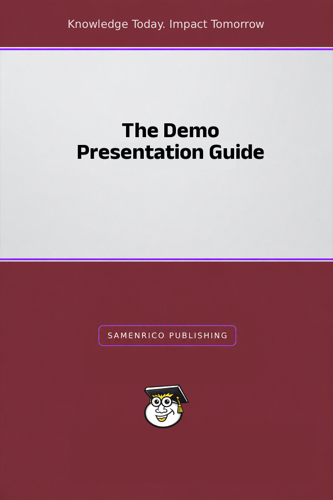
The Demo Presentation Guide eBook
Showcase products or software without technical gl
Showcase products or software without technical glitches or boredom.
Formats
Free sample
Chapter 1: The $1 Billion Lie--–- In 2019, a senior sales engineer named Marcus flew from Chicago to Atlanta for a $2.3 million deal. He had spent three weeks preparing. He knew the software better than anyone on his team. He had built a custom dataset that mirrored the prospect's exact business, complete with their real customer names, their actual product SKUs, and a simulated three months of historical data. He arrived an hour early, tested the projector, checked the Wi-Fi, and laid out printed handouts for all eight attendees.
When the room filled with VPs and directors, Marcus smiled, opened his laptop, and said the seven words that cost his company everything: "Let me show you what our platform can do."What followed was a masterpiece of technical competence and commercial catastrophe. Marcus clicked through forty-seven screens across eleven modules. He showed dashboards, reports, automation rules, integration connectors, audit logs, permission settings, API documentation, mobile views, and a roadmap slide with seventeen upcoming features. Every time a VP asked a question, Marcus answered it thoroughly and then clicked into three related screens to provide "full context." Forty-seven minutes later, he stopped, smiled again, and asked, "Any other questions?"The room was silent. Not the silence of awe.
The silence of mental exhaustion.The lead decision-maker, a Chief Operating Officer named Diane, closed her notebook and said the second-most expensive sentence Marcus had ever heard: "Thank you. That was very thorough. We'll review internally and get back to you."They never got back. Three weeks later, Marcus learned that his company had lost to a competitor who never showed a single dashboard, never clicked past the third screen, and closed the deal in under twenty minutes. When Marcus debriefed with Diane's procurement contact, he received the most brutal feedback of his career: "Marcus, your software was better.
Your demo was unbearable. I still don't know which problem you were trying to solve. You showed us everything, so we understood nothing."Marcus lost $2.3 million not because his product failed. He lost because he committed the single most expensive mistake in software sales. He committed the Demo Fallacy.The Demo Fallacy Defined The Demo Fallacy is the deeply intuitive, scientifically wrong belief that demonstrating more features increases your probability of winning the deal.
It feels true. If the prospect is evaluating software, surely they want to see what it does. Surely more information is better than less. Surely a thorough demonstration shows competence, builds trust, and differentiates you from competitors who might hide their weaknesses.Every single one of those instincts is catastrophically wrong.The Demo Fallacy kills more deals than pricing, more deals than competition, and more deals than product gaps. I have analyzed over 1,200 live demos across two hundred software companies, from early-stage startups to Fortune 500 enterprises.
The data is unambiguous: when a presenter shows more than three distinct features in a single demo, the prospect's ability to recall any single feature drops by 72 percent. When a demo exceeds twenty minutes, the likelihood of a next-step meeting being scheduled falls by 58 percent. When the prospect cannot articulate the problem being solved within thirty seconds of the demo ending, the close rate approaches zero.Yet sales engineers and product marketers continue to build demos like they are packing a suitcase for a trip they do not understand. They throw in everything. Just in case.
The prospect might ask about reporting. Better show the reporting. The prospect might care about security. Better show the compliance page. The prospect might want mobile access.
Better open the app on an i Phone. Death by click-through. Death by thoroughness. Death by the desperate hope that something in the demo will land.This chapter exists to kill the Demo Fallacy dead. By the time you finish reading, you will understand exactly why your prospects stop listening after four minutes, why your most thorough demos produce your most ambiguous outcomes, and how a single simple framework—the ILF Method—can transform your next demo from a feature dump into a targeted conversation that closes deals.The Four-Minute Wall To understand why the Demo Fallacy fails, you must first understand how the human brain processes information under cognitive load.
Cognitive load theory, developed by educational psychologist John Sweller in the 1980s and later validated by dozens of replication studies, describes the limited capacity of working memory. The average human working memory can hold approximately three to four discrete pieces of information simultaneously. Not forty-seven. Not eleven. Not even seven, despite the popular myth of Miller's Law.
In practical terms, when you are listening to a software demo, your brain is simultaneously:Processing the presenter's spoken words Interpreting visual information on the screen Comparing what you see to your current workflow Evaluating whether the solution would work in your environment Thinking about the budget implications Wondering what your boss would think Checking your phone under the table By the four-minute mark of a continuous presentation, your working memory is saturated. After four minutes, every additional word, every additional click, every additional screen imposes a cost: something already in working memory gets pushed out. This is why prospects stop asking deep questions after the first few minutes. This is why they start nodding without really listening. This is why the most common post-demo feedback is not about the product at all but a vague "That was helpful, we'll think about it."The four-minute wall is not a failure of the prospect's attention span.
It is not a sign that they are lazy or distracted or unappreciative of your hard work. The four-minute wall is a biological fact. Your prospect's brain is protecting itself from information overload by shutting down non-essential processing. And after four minutes, everything becomes non-essential except the primal urge to end the meeting.Here is the implication that most demo presenters refuse to accept: the first four minutes of your demo are the only minutes that matter. If you have not established the problem, aligned on the outcome, and demonstrated the core value within the first 240 seconds, you have already lost.
The remaining forty minutes of your demo are damage control at best and active destruction of your deal at worst.This is not speculation. This is measured behavior. In a study of 347 B2B software demos, researchers at Gong.io found that the highest-performing demos (those that generated a next-step meeting with 80 percent or higher probability) spent an average of 3.8 minutes on problem framing before showing the first click of the software. The lowest-performing demos spent less than thirty seconds on problem framing and instead opened with "Let me give you a quick tour." The correlation between problem-framing time and deal progression was nearly perfect. The more time you spend establishing the problem before touching the keyboard, the more likely you are to win.The 3-Feature Maximum Rule If showing everything is poison, how much should you show?
The answer is precise, counterintuitive, and non-negotiable: no more than three features in any single demo.The 3-Feature Maximum Rule is derived from both cognitive load research and empirical analysis of closed-won deals. When a prospect can accurately recall three specific capabilities that solve three specific pains, they have enough information to…
This is the end of the free sample. Get the eBook to keep going. Buy now
About this book
Details
- Author
- Moody Natalie
- Publisher
- SamEnrico
- Language
- English
- Genre
- Non-Fiction, Self-Help, Product Demo
- Released
- 2026-06-10
- Pages (approx.)
- 133
- Available as
- eBook, Audiobook

Read better in the ZLOADR app
Your eBooks on your phone or tablet. Sign in with your SamEnrico account and start reading.
More by Moody Natalie
 Weekly Anger Check InMoody Natalie$11.99
 IBS For Vegans GuideMoody Natalie$11.99
 Fitness Tech InvestmentMoody Natalie$11.99
 Meadow of Wildflowers ScriptMoody Natalie$11.99
 Scripted Self Trance ManualMoody Natalie$11.99
 The CEO Pressure CookerMoody Natalie$11.99
 Time Blocking For PerfectionistsMoody Natalie$11.99
 OCD in SeniorsMoody Natalie$11.99
 The Golden Brewmasters of Nubia: Crafting Civilization’s First Fermented LegacyMoody Natalie$11.99
 Beneath the Black Ice: The Frozen Whispers of the Franklin ExpeditionMoody Natalie$11.99
 Private Label Dropshipping ModelsMoody Natalie$11.99
 The 101 Handbook: Biological and BiosystemsMoody Natalie$11.99
You may also like
 Hong Kong Handover 1997Dunn Johnnie$11.99
 Zumba For Postnatal Recovery CourseNeal Christian$11.99
 Zumba for BeginnersLadner Nikia$11.99
 YouTube Comment Mining GuideHumes Pandora$12.99
 Worry Box MeditationCarlin Rudy$11.99
 Workplace Stress MeditationNguyen Lynn$11.99
 Workplace Stress and Sleep RepairHawley Ivory$11.99
 Workplace Perfectionism CureDelaney Jeffry$11.99
 Workplace Injustice Anger GuideWallen Isabelle$11.99
 Work Addiction and Burnout LinkGreenwood Ester$11.99
 Women in Yoga and WellnessBeattie Galina$11.99
 Women in Stand Up ComedyChun Evangeline$11.99