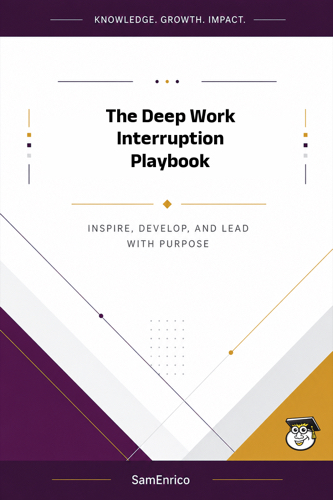
The Deep Work Interruption Playbook
Implements Cal Newport's principles with specific
by Shank Dona
Implements Cal Newport's principles with specific scripts, signs, and schedules to protect concentration.
Formats
About this book
Free sample
Chapter 1: The Attention Trap--–- It begins not with a phone buzz, a knock on the door, or a Slack notification. It begins with a feeling. You are deep in concentration, wrestling with a difficult problem—maybe a strategy document, a piece of code, or a creative brief. Your mind is fully immersed, the world outside has faded, and you are experiencing what psychologist Mihaly Csikszentmihalyi calls "flow." Then it happens. A colleague appears in your peripheral vision.
Your email icon flashes. Your phone vibrates against the desk. You glance away for just a moment. Two seconds. Three at most.
You answer the question, dismiss the notification, or say "sure, I’ll look at that in a minute." Then you turn back to your original task. And you cannot find your place. You read the last sentence you wrote. It makes no sense. You re-read the paragraph above it.
Still nothing. Your train of thought has derailed, and the wreckage is scattered across the tracks. You spend the next ten, fifteen, even twenty minutes trying to claw your way back to where you were. This is not a failure of willpower. This is not a sign that you lack discipline.
This is a predictable, measurable, and scientifically documented phenomenon called attention residue. And it is the single greatest thief of cognitive performance in the modern workplace.The Myth of the Quick Check Let us dispense with a dangerous fiction right now: the belief that you can "quickly" check something and return to deep work without cost. This belief is not just wrong; it is catastrophically wrong. It is the cognitive equivalent of believing you can slam on the brakes at sixty miles per hour and come to a stop in three feet. The physics do not allow it, and neither does the neuroscience.Sophie Leroy, a cognitive scientist at the University of Washington Bothell, coined the term "attention residue" after a series of experiments that should alarm anyone who cares about meaningful work.
In her landmark 2009 study, Leroy asked participants to perform a complex task—say, solving a set of word puzzles or…
This is the end of the free sample. Get the eBook to keep going. Buy now
Contents
- Chapter 1
- Chapter 2
- Chapter 3
- Chapter 4
- Chapter 5
- Chapter 6
- Chapter 7
- Chapter 8
- Chapter 9
- Chapter 10
- Chapter 11
- Chapter 12
Details
- Author
- Shank Dona
- Publisher
- SamEnrico
- Language
- English
- Genre
- Non-Fiction, Self-Help, Cognitive Performance
- Released
- 2026-06-08
- Pages (approx.)
- 149
- Available as
- eBook, Audiobook

Read better in the ZLOADR app
Your eBooks on your phone or tablet. Sign in with your SamEnrico account and start reading.
More by Shank Dona
 Procrastination Journal MethodShank Dona$11.99
 Nonprofit Board Experience Before TransitionShank Dona$11.99
 Keepsake Ideas After Child DeathShank Dona$11.99
 Opioid Neonatal AbstinenceShank Dona$11.99
 Payout Ratio Analysis GuideShank Dona$11.99
 Mindfulness for Dental VisitsShank Dona$11.99
 Burnout And Depression DistinctionShank Dona$11.99
 The Silk and the Sword: The Untold Story of Madame Bertin and Marie Antoinette's Fashion RevolutionShank Dona$11.99
 The Clockwork Genius of Benjamin Banneker: Astronomy, Algorithms, and the Birth of American PrecisionShank Dona$11.99
 How to Produce Wine FridgesShank Dona$11.99
 Summer Sale Slowdown in GulfShank Dona$12.99
 Need Based Scholarship for Africans HandbookShank Dona$12.99