
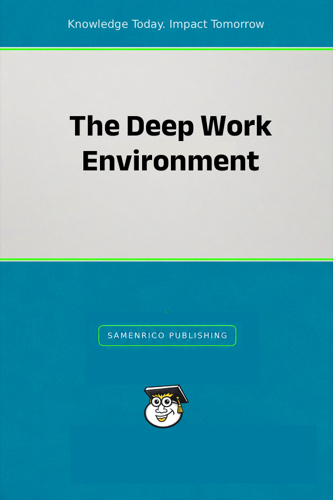
Non-FictionBusiness BriefEnvironment
The Deep Work Environment eBook
Design physical and digital spaces for concentrati
Design physical and digital spaces for concentration.
Formats
Free sample
Chapter 1: The Attention Trap--–- Every morning, billions of people wake up, reach for their phones, and begin the day by giving away their attention. Before they have brushed their teeth, before they have spoken a single word to another human being, before they have taken a conscious breath, they have already surrendered their focus to notifications, emails, news alerts, and social media feeds. The average smartphone user checks their device within fifteen minutes of waking. Many check it within five. Some never stop checking at all.This is not an accident.
It is not a failure of willpower or a sign of moral weakness. It is the design of the attention economy—a system in which human focus is the primary currency, and distraction is someone else's profit.Every app, every notification, every breaking news alert is engineered to capture and hold your attention for as long as possible. The longer you stay, the more data is collected, the more ads are shown, the more revenue is generated. Your distraction is not a bug in the system. It is the feature.
The attention economy does not want you to be focused, present, or deeply engaged. It wants you to be distracted, reactive, and endlessly scrolling. That is how it makes money.Here is the irony that should keep you awake at night: the companies that design these attention-capturing tools are staffed by engineers and executives who protect their own focus with ruthless discipline. They do not check email first thing in the morning. They do not keep notifications enabled on their phones.
They design for distraction while living in concentration. They have built a machine that fragments your attention, and they have built walls that protect their own.This book is about building those walls for yourself.The Deep Work Definition: A Unified Framework Before we can design environments for concentration, we need a clear, consistent definition of what we are trying to protect. Throughout this book, deep work will be defined by three essential characteristics that must all be present for an activity to qualify.First, deep work requires distraction-free concentration on a single cognitively demanding task. Your attention is not divided. You are not toggling between email and a spreadsheet.
You are not half-listening to a podcast while half-working. You are fully, exclusively, intensely focused on one thing.Second, deep work requires sustained duration. While the exact length can vary by task and individual, deep work typically requires blocks of at least sixty minutes. Some tasks demand ninety minutes or more. The key is that you cannot do deep work in five-minute increments between meetings.
Deep work requires the kind of sustained attention that allows your brain to settle into a state of flow, where ideas connect, problems unravel, and breakthroughs emerge.Third, deep work produces output that is valuable, improves your skill, and is hard to replicate. This is what separates deep work from mere concentration. You can concentrate intensely on organizing your email folders, but that is not deep work because the output is not valuable or hard to replicate. Deep work is how a writer completes a novel, how a programmer solves a complex bug, how a researcher develops a new theory, how a designer creates an elegant solution.The opposite of deep work is shallow work: non-cognitively demanding, logistical-style tasks often performed while distracted. Answering routine emails is shallow work.
Attending status meetings is shallow work. Scrolling through social media feeds is shallow work. These activities may feel productive—they create a sense of motion, of busyness, of clearing the decks—but they do not produce the kind of results that advance careers, create breakthrough ideas, or generate meaningful value.The distinction is not about moral superiority. Some shallow work is necessary. Emails need to be answered.
Meetings need to be attended. Administrative tasks need to be completed. The danger is that shallow work expands to fill the available time. It is easier than deep work. It feels productive.
It creates a false sense of accomplishment. The professional who spends all day on shallow work may feel busy, but they are not building skills, creating value, or advancing their career. They are treading water.The Deep Work Hypothesis Cal Newport, the computer science professor who coined the term "deep work," proposed a hypothesis that has only become more urgent with time. The Deep Work Hypothesis states that the ability to perform deep work is becoming increasingly rare at exactly the same time it is becoming increasingly valuable in our economy. As a consequence, the few who cultivate this skill, and then make it the core of their working life, will thrive.Consider the rise of artificial intelligence and automation.
The tasks most vulnerable to replacement are shallow tasks—routine information processing, basic customer service, standard report generation. AI can already draft emails, schedule meetings, summarize documents, and answer common questions. It cannot yet perform deep work. It cannot solve novel problems, generate breakthrough insights, or produce truly creative work. As machines take over the shallow work, human deep work becomes more valuable, not less.But here is the paradox.
At the same moment that deep work is becoming more valuable, the conditions for deep work are becoming more difficult to achieve. Open-plan offices have replaced private offices. Email and instant messaging have replaced uninterrupted work blocks. Smartphones have brought the office into every corner of our lives, blurring the boundaries between work and rest, concentration and fragmentation.The very technologies that enable knowledge work have also fragmented it. We have never been more connected, and we have never been more distracted.
We have never had more tools for productivity, and we have never been less productive in the ways that matter.This is not a personal failure. It is a design failure. Our environments have been designed for connectivity, responsiveness, and collaboration—all valuable things, but not the only things that matter. Deep work requires something else. Deep work requires sanctuary.
Deep work requires walls that protect attention from the endless demands of the attention economy.The Myth of Willpower You have probably been told that the solution to distraction is willpower. If you could just focus harder, ignore notifications more effectively, resist the pull of your devices, you would be able to work deeply. This belief is comforting because it puts the solution within your control. It is also false, and it is harmful.Willpower is not a limitless resource. Research in ego depletion theory, pioneered by Roy Baumeister, suggests that self-control draws on a limited pool of mental energy that can be exhausted.
When you spend the morning resisting the urge to check your phone, you have less willpower left for the afternoon's deep work. When your environment is filled with constant temptations—notifications, chat messages, open tabs, the hum of conversation—you are fighting an unwinnable battle. Your willpower will run out before the distractions do.The solution is not to try harder. The solution is to redesign your environment so that deep work requires less willpower—or none at all.Consider the example of a professional trumpet player who was struggling to practice. He knew he needed to put in hours of focused work…
This is the end of the free sample. Get the eBook to keep going. Buy now
About this book
Details
- Author
- Manuel Charmaine
- Publisher
- SamEnrico
- Language
- English
- Genre
- Non-Fiction, Business Brief, Environment
- Released
- 2026-06-06
- Pages (approx.)
- 112
- Available as
- eBook, Audiobook

Read better in the ZLOADR app
Your eBooks on your phone or tablet. Sign in with your SamEnrico account and start reading.
More by Manuel Charmaine
 Taekwondo Hypnosis WorkbookManuel Charmaine$11.99
 Virtual Offboarding CommunicationManuel Charmaine$11.99
 Senior Social Media ComparisonManuel Charmaine$11.99
 Floating on Still WaterManuel Charmaine$11.99
 Basketball Hypnosis GuideManuel Charmaine$11.99
 Rainforest Canopy GuideManuel Charmaine$11.99
 Affirmations for Body ImageManuel Charmaine$11.99
 The Phantom of the Seine: Paris' Luxury Car Killer (1920s)Manuel Charmaine$11.99
 The Last Swing: How a Legend Fell on the Golf’s Grandest StageManuel Charmaine$11.99
 Uguisu: Japanese Bush WarblerManuel Charmaine$11.99
 A Collector's Handbook to the Wolseley 45, ViperManuel Charmaine$11.99
 Weekly Marketing DashboardManuel Charmaine$12.99
You may also like
 Hong Kong Handover 1997Dunn Johnnie$11.99
 Zumba For Postnatal Recovery CourseNeal Christian$11.99
 Zumba for BeginnersLadner Nikia$11.99
 YouTube Comment Mining GuideHumes Pandora$12.99
 Worry Box MeditationCarlin Rudy$11.99
 Workplace Stress MeditationNguyen Lynn$11.99
 Workplace Stress and Sleep RepairHawley Ivory$11.99
 Workplace Perfectionism CureDelaney Jeffry$11.99
 Workplace Injustice Anger GuideWallen Isabelle$11.99
 Work Addiction and Burnout LinkGreenwood Ester$11.99
 Women in Yoga and WellnessBeattie Galina$11.99
 Women in Stand Up ComedyChun Evangeline$11.99