
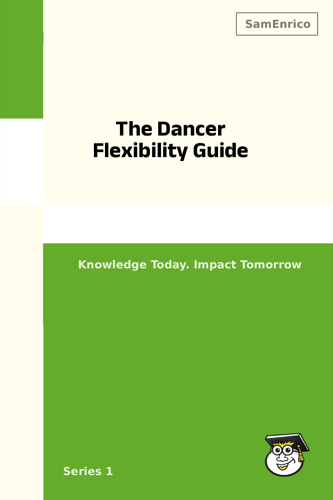
Non-FictionHealth & WellnessDance
The Dancer Flexibility Guide eBook
Achieve splits, backbends, and high extensions usi
Achieve splits, backbends, and high extensions using progressive stretching.
Formats
Free sample
Chapter 1: The Split Paradox--The dancer lowered herself into a perfect right split on the hardwood floor, her front leg straight, back leg extended, hips square. She held the position for thirty seconds, then lifted her torso upright and smiled at her reflection in the studio mirror. She had achieved what most people would call flexible. Her hamstrings were long, her hip flexors open, her groin relaxed. By any passive measure, she had mastered the front split.Then her teacher called for a développé à la seconde during center practice.
The same dancer lifted her right leg to the side. It reached perhaps seventy-five degrees before her hip locked, her standing leg wobbled, and her torso leaned dangerously to the left like a ship taking on water. She could not, for reasons that made no sense to her, hold her leg anywhere near the height she could reach when lying on her back with a strap.The room was full of dancers who could do the same thing. Flexible on the floor. Inflexible in the air.This is the split paradox, and it is the single greatest source of frustration and injury in every dance studio in the world.The Great Misunderstanding Most dancers believe that flexibility is a singular quality—a simple matter of how far a muscle can lengthen before it protests.
If you cannot touch your toes, you stretch your hamstrings. If you cannot do the splits, you sink deeper into the stretch every day and wait for gravity to do its work. This approach assumes that the body is like a piece of leather: pull it enough times and it will eventually stay stretched.This assumption is dangerously wrong.What you have just read in the opening scene is not a story about weak muscles or poor technique. It is a story about the difference between two entirely separate physiological abilities that most dancers—and even many teachers—treat as the same thing. The dancer in the mirror could perform a passive split because she had trained her tissues to tolerate lengthening while her body weight and the floor did all the work.
She could not perform an active développé because she had never trained her nervous system to lift and hold her leg at that same range using only her own muscle contractions.The first ability is called passive flexibility. The second is called active flexibility.Understanding this distinction is not merely helpful. It is the foundation upon which every single exercise in this book is built. If you ignore it, you will spend years stretching the same muscles, achieving temporary gains that vanish the moment you try to dance, and accumulating mysterious injuries that no one can explain. If you master it, you will transform not only your range of motion but your entire relationship with your body.The Anatomy of a Lie To understand why passive and active flexibility are so different, you need to understand a basic fact about your muscles that most flexibility books never mention.
Muscles do not have a fixed length. They are not like rubber bands that permanently stretch out when pulled. Muscles are dynamic, living tissues that constantly adjust their resting tension based on signals from your brain and spinal cord.When you stretch a muscle, you are not actually lengthening the muscle fibers themselves in any permanent way—at least not for many weeks or months of consistent training. What you are doing, in the short term, is training your nervous system to allow that muscle to relax further than it normally would. The muscle fibers themselves remain the same length.
But the brain reduces its protective firing to the muscle, permitting a greater range of motion.This is why you can make dramatic gains in passive flexibility in a single stretching session. Lie on your back, pull your leg toward your chest with a strap, and within minutes you will likely get your leg closer to your torso than when you started. You have not lengthened your hamstring. You have simply desensitized your nervous system to that particular stretch in that particular position.But here is the problem that the split paradox reveals. That desensitization is position-specific and context-dependent.
Your nervous system learns that it is safe to relax the hamstring when you are lying on your back, your pelvis is stabilized by the floor, and you are pulling with your arms. It has not learned that it is safe to relax the hamstring when you are standing on one leg, your pelvis is floating in space, and you are asking the hip flexors and quadriceps to lift the leg without any assistance from your hands.The dancer in the opening scene had trained her passive flexibility extensively. She had not trained her active flexibility at all. And because no one had ever explained the difference to her, she assumed that her body was simply "tight" or that she lacked some mysterious quality called dancer strength.She did not lack strength. She lacked a specific neurological skill: the ability to recruit the agonist muscles (the hip flexors and quadriceps) to lift the leg while simultaneously allowing the antagonist muscles (the hamstrings and glutes) to relax at end-range—all while maintaining postural stability through the core and standing leg.This is active flexibility.
And it is the only kind of flexibility that matters when you are dancing.The Stretch Reflex: Your Nervous System's Bodyguard Before we go further, you need to meet the neurological mechanism that makes all of this both difficult and trainable. It is called the stretch reflex, and it is one of the most powerful and misunderstood forces in the dancer's body.The stretch reflex is an automatic, involuntary contraction of a muscle that occurs when that muscle is stretched too quickly or too far. It is your body's built-in safety system. Imagine reaching down to pick up a pencil and accidentally grabbing a hot coal instead. Your hand jerks away before you even feel the heat.
That is a reflex—a hardwired circuit that bypasses your conscious brain to protect you from harm. The stretch reflex works the same way.Inside every muscle are tiny sensory receptors called muscle spindles. These spindles are constantly monitoring the length of the muscle and the speed at which it is changing length. When a muscle lengthens too fast or approaches what the nervous system judges to be the end of its safe range, the spindles send an emergency signal to the spinal cord. The spinal cord immediately fires a signal back to the same muscle, ordering it to contract.
This contraction is the stretch reflex, and its purpose is to prevent the muscle from being torn or overstretched.This reflex is why ballistic stretching—bouncing into a stretch—is not only ineffective but counterproductive. Each bounce triggers the stretch reflex, causing the muscle to tighten against the very movement you are trying to achieve. You are essentially fighting your own nervous system.But the stretch reflex also explains something more subtle. When you hold a static stretch for fifteen to thirty seconds, a different neurological mechanism begins to override the stretch reflex. This mechanism is called autogenic inhibition, and…
This is the end of the free sample. Get the eBook to keep going. Buy now
About this book
Details
- Author
- Nobles Wilhemina
- Publisher
- SamEnrico
- Language
- English
- Genre
- Non-Fiction, Health & Wellness, Dance
- Released
- 2026-06-06
- Pages (approx.)
- 137
- Available as
- eBook, Audiobook

Read better in the ZLOADR app
Your eBooks on your phone or tablet. Sign in with your SamEnrico account and start reading.
More by Nobles Wilhemina
 Disappointment Reprocessing GuideNobles Wilhemina$11.99
 The Remote Work Break ScheduleNobles Wilhemina$11.99
 Plant Based Heart Disease Prevention WorkbookNobles Wilhemina$11.99
 Franchising Your Local Brand Across Borders Culture GuideNobles Wilhemina$11.99
 Frozen Secrets: The Hunt for the Lost Franklin ExpeditionNobles Wilhemina$11.99
 The Last Transmission: The Mysterious Final Broadcast of S.O.S. TitanicNobles Wilhemina$11.99
 Seasonal Housekeeping Team MemberNobles Wilhemina$11.99
 Understanding CroupNobles Wilhemina$17.99
 Late Fee Penalty GuideNobles Wilhemina$12.99
 Low Ticket Sales ScriptNobles Wilhemina$12.99
You may also like
 Hong Kong Handover 1997Dunn Johnnie$11.99
 Zumba For Postnatal Recovery CourseNeal Christian$11.99
 Zumba for BeginnersLadner Nikia$11.99
 YouTube Comment Mining GuideHumes Pandora$12.99
 Worry Box MeditationCarlin Rudy$11.99
 Workplace Stress MeditationNguyen Lynn$11.99
 Workplace Stress and Sleep RepairHawley Ivory$11.99
 Workplace Perfectionism CureDelaney Jeffry$11.99
 Workplace Injustice Anger GuideWallen Isabelle$11.99
 Work Addiction and Burnout LinkGreenwood Ester$11.99
 Women in Yoga and WellnessBeattie Galina$11.99
 Women in Stand Up ComedyChun Evangeline$11.99