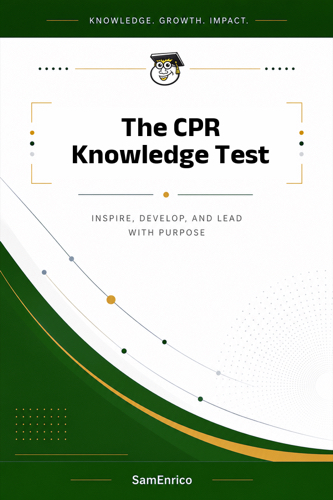
The CPR Knowledge Test
Quiz yourself on ratio, depth, rate, and sequence
Quiz yourself on ratio, depth, rate, and sequence before real emergencies.
Formats
About this book
Free sample
Chapter 1: The Three Numbers--–- The paramedic’s hands were still. That’s what the video review showed. Forty-five seconds of no compressions. Not because he was lazy. Not because he panicked.
Because he was counting breaths. He had been taught the old way—A-B-C. Airway, Breathing, Circulation. He opened the airway. He gave two slow breaths.
He checked for a pulse. Then he started compressions. By the time his hands finally met the man’s sternum, the brain had been without fresh blood for nearly a minute. The man survived, but with permanent memory loss. The paramedic quit six months later.That was 2010.
The guidelines changed the same year. But old habits, as they say, die harder than patients.Today, you hold in your hands a different kind of CPR book. It will not teach you anatomy. It will not walk you through the history of resuscitation. It will do one thing: drill the numbers into your nervous system so that when a body falls in front of you, your hands know what to do before your brain has time to be afraid.This is Chapter 1.
And these three numbers—rate, depth, and ratio—will decide whether someone walks out of a hospital or leaves in a bag.The First Number: Rate (100–120)Close your eyes. Hum “Stayin’ Alive” by the Bee Gees. Got it? That song plays at approximately 103 beats per minute. Now hum “Baby Shark.” That’s roughly 115 beats per minute.
Neither is perfect. But both are close enough to save a life.The official number range is 100 to 120 compressions per minute.Let me explain why this range exists. Beneath your hands lies a heart that has stopped pumping. Your job is not to restart it—that’s the defibrillator’s job. Your job is to be a temporary pump.
You are squeezing blood out of the left ventricle and into the brain. You are allowing the chest to recoil so that the right ventricle can fill with blood again. This is called perfusion.If you compress slower than 100 times per minute, not enough blood reaches the brain.…
This is the end of the free sample. Get the eBook to keep going. Buy now
Contents
- Chapter 1
- Chapter 2
- Chapter 3
- Chapter 4
- Chapter 5
- Chapter 6
- Chapter 7
- Chapter 8
- Chapter 9
- Chapter 10
- Chapter 11
- Chapter 12
Details
- Author
- Winfrey Katelynn
- Publisher
- SamEnrico
- Language
- English
- Genre
- Non-Fiction, Health & Wellness, Testing
- Released
- 2026-06-06
- Pages (approx.)
- 149
- Available as
- eBook, Audiobook

Read better in the ZLOADR app
Your eBooks on your phone or tablet. Sign in with your SamEnrico account and start reading.
More by Winfrey Katelynn
 Upholstery Fiber ForensicsWinfrey Katelynn$11.99
 Social Media And Sleep GuideWinfrey Katelynn$11.99
 The Micronutrient Absorption GuideWinfrey Katelynn$11.99
 Grief After Losing Only ChildWinfrey Katelynn$11.99
 Memorializing Your Lost BabyWinfrey Katelynn$11.99
 Bamako Colonial Capital HistoryWinfrey Katelynn$11.99
 Anki Sync TroubleshootingWinfrey Katelynn$11.99
 The Iron Masters of Great Zimbabwe: Forging an Empire in Stone and SteelWinfrey Katelynn$11.99
 How to Produce Scan ConvertersWinfrey Katelynn$11.99
 Havanese: Velcro & SmartWinfrey Katelynn$11.99
 Atlassian SAFe for Enterprise StartupsWinfrey Katelynn$12.99
 Amazon Vine Program GuideWinfrey Katelynn$12.99