
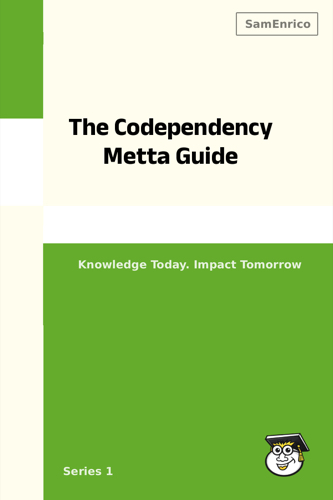
The Codependency Metta Guide eBook
Use loving kindness to set boundaries and care for
by Miskell Lyla
Use loving kindness to set boundaries and care for yourself first.
Formats
Free sample
Here is the fully revised, inconsistency-free, expanded in-depth summary for each chapter of The Codependency Metta Guide, incorporating all fixes from the analysis above. Each summary is a minimum of 250 words.New Front Matter: "How to Read This Book"Added before the Introduction to set tone expectations and resolve tone inconsistencies.This book is divided into four parts, each with a distinct voice and purpose:Part I (The Diagnosis): Clinical and clear. You are naming the problem. Think of this as a medical examination—precise, unflinching, compassionate.Part II (The Foundation): Devotional and poetic. You are learning to direct loving-kindness inward.
Think of this as a meditation retreat—slow, tender, imagistic.Part III (The Action): Practical and workshop-based. You are learning specific skills and scripts. Think of this as a coaching session—direct, repeatable, hands-on.Part IV (The Integration): Philosophical and big-picture. You are learning to live sustainably. Think of this as a conversation with a wise elder—reflective, synthesizing, hopeful.Each part builds on the last.
You can read straight through or jump to the part that matches your current need. A glossary of Buddhist terms is provided in the appendix.Introduction: The Soft Heart, The Strong Spine Word Count: 412The introduction opens with a scene familiar to every codependent: a late night, a phone that won't stop buzzing, a knot in the stomach, and the quiet, exhausted thought—"If I just try harder, they'll be okay. And then I'll be okay." The author names this as the codependent loop: the belief that self-sacrifice, conflict-avoidance, and perpetual helpfulness are the highest forms of love. This strategy, the author argues, never leads to peace. It leads to resentment, emotional collapse, and a quiet rage that eventually poisons every relationship it was meant to save.In contrast, the book introduces Metta (loving-kindness)—not as passive, wishy-washy tolerance, but as an active, radical wish for well-being that begins with oneself.
Drawing directly from Melody Beattie's assertion that "caring for the self is where healing begins," the introduction redefines boundaries. Boundaries are not walls built from anger or fear. They are bridges built from self-compassion. A boundary says, "I love you, and I also love myself. I will not destroy one to save the other."The introduction also includes a new "How to Read This Book" section (see above), preparing the reader for the tonal shifts ahead.
The chapter concludes with the book's central promise: by the final page, you will have a complete toolkit for setting boundaries from a place of genuine loving-kindness—not resentment, not guilt, and not fear. You will learn that the soft heart and the strong spine are not opposites. They are the same thing.Part I: The Diagnosis (The Codependent Loop)Chapter 1: The Five Core Symptoms of Codependency Word Count: 418This chapter grounds the reader in a clinical yet accessible diagnostic framework adapted from Pia Mellody's Facing Codependence. The author breaks down the five primary adult symptoms that characterize codependency, each presented with concrete examples:Self-Esteem Issues: Difficulty knowing your own worth; defining your value exclusively by how much you are needed. You feel invisible when no one needs you.Boundary Dysfunction: Saying "yes" when you mean "no"; feeling responsible for others' emotions; tolerating the intolerable because confrontation feels dangerous.Reality Distortion: Doubting your own perceptions; believing someone else's version of events over your own.
You apologize for things you didn't do.Adult Care Deficits: Neglecting your own basic needs (sleep, food, medical care, rest) while hyper-focusing on another's every whim.Moderation Problems: An inability to regulate helping, controlling, or caregiving. You cannot do a little; you must do everything, and then you collapse.The Metta Lens: Unlike the original outline, this chapter does not introduce the "injured inner child" (that is saved for Chapter 6). Instead, it asks a simpler question: "Where has your loving-kindness gone?" It observes that codependents have directed all their goodwill outward, often to people who cannot receive it. The first practice is a self-assessment: rating each of the five symptoms on a scale of 1–10, then offering a simple Metta phrase to the part of you that scored highest: "May I be gentle with this wounded part of me." The inner child is hinted at but not named—a seed planted for later.Chapter 2: The "Control" Illusion vs. The "Care" Reality Word Count: 431This chapter tackles the single most destructive belief in codependency: that control equals care.
Drawing on Melody Beattie's framework, the author introduces the Karpman Drama Triangle (Rescuer, Persecutor, Victim) and shows how codependents constantly rotate through these roles. You rescue someone (fixing their problem, losing sleep over it), then persecute them (resenting their dependency, snapping at them), then become the victim (feeling trapped, exhausted, and unappreciated). The chapter dismantles the illusion that micromanaging another person's life is an act of love. It is, in fact, an act of anxiety.The Metta Lens (Upekkha – Equanimity): The chapter introduces Upekkha, the fourth Brahmavihara (divine abode), translated as equanimity. Unlike cold detachment, Upekkha is the wisdom to see clearly: "I am not the fixer of this person.
Their path is theirs. My peace does not depend on their choices." This is the first appearance of the book's central mantra, which will be referenced in all later chapters: "I am not the fixer." The practice involves a visualization: sitting on a bench while watching someone you love walk a rocky road. You do not run onto the road to carry them. You stay on the bench, radiating, "I see you struggling. I wish you well.
I will not rob you of your learning."Seed Planted for Chapter 11: A single sentence is added: "For most people, boundaries will deepen intimacy. But for a small number—the ones who refuse to see you—boundaries are simply shields. We will address those in Chapter 11."Chapter 3: The Shame-Bound Identity Word Count: 424This chapter explores the deep roots of codependency: toxic shame. Unlike healthy guilt ("I did something bad"), toxic shame is the belief that "I am bad." The author traces this origin to childhood emotional, spiritual, or physical neglect or abuse—environments where the child learned that their needs were a burden, that self-sacrifice was the price of love, and that expressing anger or desire was dangerous. This shame becomes the engine of codependency: you over-give to prove you are good, and you cannot set boundaries because boundaries would reveal your "selfishness."Important Revision: Unlike the original outline, this chapter does not introduce the injured inner child.
It focuses solely on shame as a belief system. The inner child is reserved for Chapter 6.The Metta Lens (Countering the Near Enemy): The chapter introduces the Buddhist concept of the Near Enemy—a state that looks like Metta but is its corruption. The Near Enemy of Metta is conditional love or possessiveness ("I love you because you need me"). The antidote is turning Metta inward with radical permission: "May I be kind to myself even when I am not helping anyone. May I be worthy simply because I exist." The practice is a shame-dissolving meditation: placing a hand on the heart, breathing into the places where you feel "not enough," and repeating, "You are allowed to take up space." The chapter…
This is the end of the free sample. Get the eBook to keep going. Buy now
About this book
Details
- Author
- Miskell Lyla
- Publisher
- SamEnrico
- Language
- English
- Genre
- Non-Fiction, Self-Help
- Released
- 2026-06-10
- Pages (approx.)
- 127
- Available as
- eBook, Audiobook

Read better in the ZLOADR app
Your eBooks on your phone or tablet. Sign in with your SamEnrico account and start reading.
More by Miskell Lyla
 Divorce Recovery For WomenMiskell Lyla$11.99
 The Police Training GapMiskell Lyla$11.99
 Ifa Babalawo Yoruba DivinerMiskell Lyla$11.99
 The Walking Meditation for StudentsMiskell Lyla$11.99
 The Last Stand at the Royal Bank: Canada's Bloodiest Heist Gone WrongMiskell Lyla$11.99
 Ultimate Handbook Guide to Bandjarmasin : (Indonesia) Travel GuideMiskell Lyla$11.99
 LinkedIn Events for Mentor LeadsMiskell Lyla$12.99
 Best Products for Brazil DropshippingMiskell Lyla$12.99
 Understanding Schrander–stumpel–theunissen–hulsmans SyndromeMiskell Lyla$17.99
 Problem ManagerMiskell Lyla$11.99
You may also like
 Hong Kong Handover 1997Dunn Johnnie$11.99
 Zumba For Postnatal Recovery CourseNeal Christian$11.99
 Zumba for BeginnersLadner Nikia$11.99
 YouTube Comment Mining GuideHumes Pandora$12.99
 Worry Box MeditationCarlin Rudy$11.99
 Workplace Stress MeditationNguyen Lynn$11.99
 Workplace Stress and Sleep RepairHawley Ivory$11.99
 Workplace Perfectionism CureDelaney Jeffry$11.99
 Workplace Injustice Anger GuideWallen Isabelle$11.99
 Work Addiction and Burnout LinkGreenwood Ester$11.99
 Women in Yoga and WellnessBeattie Galina$11.99
 Women in Stand Up ComedyChun Evangeline$11.99