
Non-FictionForensic Psychology
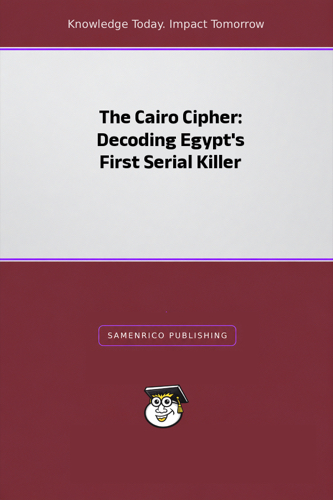
The Cairo Cipher: Decoding Egypt's First Serial Killer eBook
Unravels the chilling 1880s case of Egypt's first
by Paul Rodney
Unravels the chilling 1880s case of Egypt's first documented serial killer, a shadowy figure who targeted women in Cairo's back alleys, and how modern forensic psychology techniques are now re-examining the cold case through historical records and witness testimonies.
Formats
Free sample
Chapter 1: The Khedive's Paradox...--–- The morning call to prayer was still echoing off the limestone walls of Cairo when the body was found.The toub—a brickmaker named Yusuf, his hands stained red with Nile clay—had come to the cistern for water. It was a simple act, repeated a thousand times before. He lowered his bucket. It caught on something heavy. When he pulled it back up, the rope had left a deep groove in the flesh of the woman's wrist.She was floating face-down, her dark hair spread like ink across the water's surface.
Her hands were bound with a type of rope that Yusuf recognized immediately—the same coarse hemp used by the ghaffirs, the local guards who patrolled the wikalat at night. Her body had been arranged deliberately, posed so that her head faced east, toward Mecca, even in death.Yusuf did not scream. He did not run. He simply stood there, bucket in hand, and whispered a prayer for the dead. Then he walked to the nearest police post and told the clerk what he had seen.The clerk wrote down three lines in a ledger.
Then he closed the book and went back to his tea.That was May 12, 1887. The woman had no name. No one had reported her missing. No one would ever claim her body. She was buried in a pauper's grave outside the city walls, in a section of the cemetery reserved for the unidentified, the unwanted, and the forgotten.She was the first.But no one knew that yet.I.
The City of Two Worlds To understand how a serial killer could operate in Cairo for nearly two years without being caught, one must first understand Cairo itself in the year 1887. The city was a study in violent contradictions—a place where the glittering promise of modernity rubbed directly against the grinding poverty of the medieval past, and where the collision created shadows deep enough to hide a monster.The Cairo that greeted visitors arriving by train from Alexandria was a city transformed. The Suez Canal, completed in 1869, had turned Egypt from a distant Ottoman province into the crossroads of empires. Ships from Bombay to Marseille passed through Egyptian waters, and the merchants who followed them brought money, ambition, and a hunger for European luxury. The Khedive Ismail, who ruled from 1863 until his deposition by the British in 1879, had dreamed of making Cairo the "Paris of the East." He built grand boulevards modeled after the Rue de Rivoli.
He constructed an opera house that opened with Verdi's Rigoletto—and later commissioned Aida for the celebration of the canal's opening. He imported gas lighting, installed telegraph lines, and invited European architects to design palaces for his growing family of thirteen children.By 1887, under Ismail's son, Khedive Tewfik, the city's European facade was largely complete. The Ezbekieh Gardens bloomed in the heart of the city, surrounded by hotels that catered to English travelers. The new quarter of Ismailia, with its wide streets and apartment buildings, housed a growing population of Greek, Italian, French, and British merchants. The British Consulate, a formidable stone building on the Midan al-Isma'iliyya, flew the Union Jack above a permanent garrison of soldiers and administrators who effectively ran the country, even if the Khedive still sat on the throne.But the European city was a mask.
Behind it lay another Cairo entirely.Step through any unmarked doorway off the Boulevard Mohammed Ali, and you entered the Harat—the labyrinthine, unpaved alleyways where the vast majority of Cairo's 400,000 inhabitants actually lived. These were not districts that appeared on the maps the British consul distributed to visiting dignitaries. They were organic, chaotic, ancient. Narrow passages wide enough for only two people to pass. Walls of sun-baked brick and rotting wood.
Doorways that led to hidden courtyards where entire families lived in single rooms. Open sewers that ran along the edges of the streets. The smell of animal dung, rotting vegetables, and unwashed bodies hung in the air like a physical presence.The Harat were not policed. They were barely acknowledged. The British considered them the "native quarters"—a phrase that carried with it the implicit assumption that what happened there was of no concern to civilized authority.
The Egyptian ghaffirs who patrolled these alleys were poorly paid, poorly trained, and often corrupt. They carried batons and whistles, but no firearms. Their primary job was not to investigate crime but to prevent public disorder—to break up fights, to clear the streets at curfew, to keep the invisible poor from bothering the visible rich.Between these two worlds—the European boulevards and the native Harat—there existed a third space: the wikalat. These were caravanserais, ancient multi-story buildings that had once served as waystations for traveling merchants. By 1887, many had been converted into tenements: warrens of cheap rooms rented by the night or by the week to the city's most transient residents.
The wikalat sat literally in the gap between the two Cairos. Their ground floors often housed shops that faced the European streets. Their upper floors and rear courtyards opened onto the Harat. A person could enter a wikala from a grand boulevard and emerge in a slum alley without ever stepping outside.It was in these in-between spaces—these architectural cracks in the city's facade—that the killer found his hunting ground.II. The Forensic Void The legal system that governed Cairo in 1887 was a hybrid monstrosity, a Frankenstein's monster of Ottoman law, French codes, and British colonial expediency.
Understanding its failures is essential to understanding how a serial killer could operate with impunity.Egypt was not formally a British colony in 1887. It was an "autonomous province" of the Ottoman Empire, ruled by the Khedive, who owed nominal allegiance to the Sultan in Constantinople. But after the British invasion of 1882—launched to suppress the Urabi Revolt and protect British financial interests in the Suez Canal—the country had been effectively occupied. British officials controlled the army, the treasury, and the judiciary. The Khedive ruled only at their pleasure.The result was a legal system that combined the worst elements of every tradition.
Criminal procedure followed the French Parquet model: investigating magistrates worked independently of the police, gathering evidence and issuing charges. But the magistrates were Egyptian, appointed by the Khedive, while the police answered to British advisors. The two branches distrusted each other profoundly. Police officers suspected magistrates of protecting local interests. Magistrates suspected police officers of brutality and corruption.
Neither branch communicated effectively with the other.And beneath both lay the British Consular Court, which claimed jurisdiction over any case involving a European citizen. If a crime touched a foreign national—as a victim, a witness, or even a suspect—the entire investigation could be transferred to British control. The British judges had no patience for Egyptian procedures, no trust in Egyptian testimony, and no interest in Egyptian victims.This was the "Forensic Void"—a term the book introduces to describe the investigative dead zones created by the collision of these competing jurisdictions. The Void had three properties that made it ideal hunting ground for a serial predator.First, jurisdictional confusion. No one could agree who was responsible for investigating crimes that…
This is the end of the free sample. Get the eBook to keep going. Buy now
About this book
Details
- Author
- Paul Rodney
- Publisher
- SamEnrico
- Language
- English
- Genre
- Non-Fiction, Forensic Psychology
- Released
- 2026-06-03
- Pages (approx.)
- 154
- Available as
- eBook, Audiobook

Read better in the ZLOADR app
Your eBooks on your phone or tablet. Sign in with your SamEnrico account and start reading.
More by Paul Rodney
 Walking Everyday GuidePaul Rodney$11.99
 The Davi Kopenawa BiographyPaul Rodney$11.99
 Migraine Aura MeditationPaul Rodney$11.99
 Random Stimulus IdeationPaul Rodney$11.99
 Gut Brain Axis And TraumaPaul Rodney$11.99
 Decatastrophizing AngerPaul Rodney$11.99
 Student Procrastination GuidePaul Rodney$11.99
 Sports Betting CompulsionPaul Rodney$11.99
 The Raven Mockers: Cherokee Spirits of the DyingPaul Rodney$11.99
 Promotion Pitch Email TemplatesPaul Rodney$12.99
 Your First 30 Days Finding a Co-FounderPaul Rodney$12.99
 The Essential Guide to VocalPaul Rodney$11.99
You may also like
 Hong Kong Handover 1997Dunn Johnnie$11.99
 Zumba For Postnatal Recovery CourseNeal Christian$11.99
 Zumba for BeginnersLadner Nikia$11.99
 YouTube Comment Mining GuideHumes Pandora$12.99
 Worry Box MeditationCarlin Rudy$11.99
 Workplace Stress MeditationNguyen Lynn$11.99
 Workplace Stress and Sleep RepairHawley Ivory$11.99
 Workplace Perfectionism CureDelaney Jeffry$11.99
 Workplace Injustice Anger GuideWallen Isabelle$11.99
 Work Addiction and Burnout LinkGreenwood Ester$11.99
 Women in Yoga and WellnessBeattie Galina$11.99
 Women in Stand Up ComedyChun Evangeline$11.99