
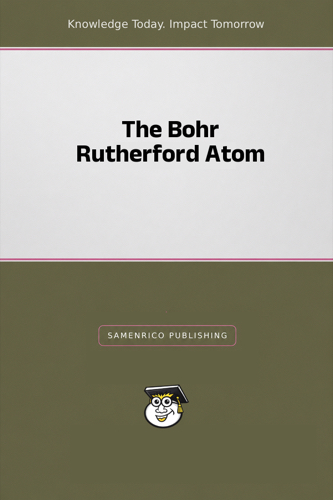
Non-FictionBiographyNuclear Physics
The Bohr Rutherford Atom
Follows their debates on atomic structure leading
Follows their debates on atomic structure leading to complementary Nobel Prizes.
Formats
About this book
Free sample
Chapter 1: The Clockwork Universe...--–- In the final years of the nineteenth century, the men who studied physics believed they were living at the end of history. Not the end of human history, of course, but the end of a particular kind of intellectual journey—one that had begun with Galileo’s telescopes and Newton’s apple, and that had reached, in the estimation of the most senior minds of the era, something very close to completion. The great clockwork of the universe had been wound, its gears had been exposed to view, and only a few minor adjustments remained. The future, they assumed, would be a matter of refinement, not revolution. They were wrong.
They were spectacularly, catastrophically wrong. And the place where their certainty would shatter first was the smallest place they could imagine: the invisible interior of the atom.The year was 1897, and the setting was the Cavendish Laboratory at Cambridge University, a sprawling complex of brick and glass that had become the cathedral of experimental physics. It was here that a brilliant but reserved physicist named J.J. Thomson stood before a glass tube from which most of the air had been removed, passing high voltage through electrodes at either end. The tube glowed with a mysterious green light—a phenomenon known as cathode radiation that had puzzled scientists for decades.
Thomson, however, did something his predecessors had not: he measured. By bending the mysterious rays with magnetic and electric fields, he calculated the ratio of their charge to their mass. The number he obtained was astonishingly large—nearly two thousand times larger than the equivalent ratio for a hydrogen ion. The conclusion was inescapable. Whatever was streaming through that tube was not a wave, as many had assumed.
It was a particle. And it was far, far lighter than the smallest atom known to science.Thomson had discovered the electron.The announcement sent ripples through the scientific community, but not the kind of seismic shock one might expect today. The discovery of a new particle was certainly interesting, but it did not yet threaten the foundational…
This is the end of the free sample. Get the eBook to keep going. Buy now
Contents
- Chapter 1
- Chapter 2
- Chapter 3
- Chapter 4
- Chapter 5
- Chapter 6
- Chapter 7
- Chapter 8
- Chapter 9
- Chapter 10
- Chapter 11
- Chapter 12
Details
- Author
- Nicholas Evia
- Publisher
- SamEnrico
- Language
- English
- Genre
- Non-Fiction, Biography, Nuclear Physics
- Released
- 2026-06-07
- Pages (approx.)
- 134
- Available as
- eBook, Audiobook

Read better in the ZLOADR app
Your eBooks on your phone or tablet. Sign in with your SamEnrico account and start reading.
More by Nicholas Evia
 Spending Urge Surfing TechniqueNicholas Evia$11.99
 The Metta Phrase LibraryNicholas Evia$11.99
 George Soros OpenNicholas Evia$11.99
 Parent Nursing Home GuideNicholas Evia$11.99
 Anapanasati for Needle PhobiaNicholas Evia$11.99
 The Reverse Mortgage AnxietyNicholas Evia$11.99
 Freudian Dream FAQNicholas Evia$11.99
 Beginner Body Scan MeditationNicholas Evia$11.99
 Caesar's Gambit: The Blood That Split RomeNicholas Evia$11.99
 The Midnight Code: How a 19th-Century Insomniac Invented Modern TimekeepingNicholas Evia$11.99
 Web Development Foundations: Frontend to BackendNicholas Evia$11.99
 How to Produce Bleaching MachineryNicholas Evia$11.99
You may also like
 Hong Kong Handover 1997Dunn Johnnie$11.99
 Zumba For Postnatal Recovery CourseNeal Christian$11.99
 Zumba for BeginnersLadner Nikia$11.99
 YouTube Comment Mining GuideHumes Pandora$12.99
 Worry Box MeditationCarlin Rudy$11.99
 Workplace Stress MeditationNguyen Lynn$11.99
 Workplace Stress and Sleep RepairHawley Ivory$11.99
 Workplace Perfectionism CureDelaney Jeffry$11.99
 Workplace Injustice Anger GuideWallen Isabelle$11.99
 Work Addiction and Burnout LinkGreenwood Ester$11.99
 Women in Yoga and WellnessBeattie Galina$11.99
 Women in Stand Up ComedyChun Evangeline$11.99