
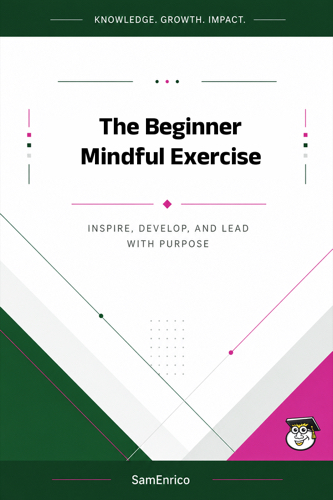
The Beginner Mindful Exercise eBook
Run or lift weights with attention to body rather
Run or lift weights with attention to body rather than playlist.
Formats
Free sample
Chapter 1: The Headphone Hangover--–- The first sign of trouble is never dramatic. It’s not a pulled hamstring or a blown-out knee or a herniated disc. It’s something far more subtle. You finish a run, peel off your sweat-soaked shirt, and realize you cannot remember a single step. You know you covered three miles—your watch says so—but the entire experience has vanished into a fog of bass drops and podcast voices.
Or you rack the barbell after a heavy set of squats, remove your earbuds, and feel a strange hollow silence. Your legs are shaking. Your heart is pounding. But you have no idea how you got from the bottom of the squat to the top. The music carried you there, and now that it’s gone, you’re not sure your body remembers the way.This is the Headphone Hangover.
It is not a physical injury. It is a perceptual one. And it is affecting nearly everyone who exercises with music, podcasts, or audiobooks playing in their ears.The Headphone Hangover has three distinct symptoms, and you’ve probably experienced all of them without ever giving them a name. First, there is sensory amnesia—the inability to recall specific physical sensations from your workout. You know you ran, but you cannot tell your physical therapist how your foot landed.
You know you lifted, but you cannot describe the pressure of the barbell across your palms. Second, there is form blindness—the gradual erosion of movement quality because no internal feedback reaches your conscious awareness. Your body learns to compensate, to cheat, to round its back or overstride, and you never notice because your attention is elsewhere. Third, there is injury lag—the dangerous delay between tissue damage and pain recognition. By the time you feel the sharp signal through your music, the injury has often been brewing for weeks.A 2019 study published in the Journal of Sports Sciences found that runners who listened to music while training were 34 percent more likely to sustain overuse injuries than those who trained in silence.
The researchers proposed a compelling explanation: music does not cause injuries directly, but it masks the early warning signs—the subtle asymmetry in foot strike, the gradual tightening of a hip flexor, the slight shift in pelvic tilt that precedes runner’s knee. By the time the pain breaks through the playlist, the damage is done.This chapter will do three things. First, it will show you, with neuroscience and real-world examples, exactly why your headphones are robbing you of your body’s most valuable data. Second, it will help you diagnose whether you are suffering from the Headphone Hangover (most readers will answer yes to at least five of the seven diagnostic questions below). Third, it will introduce the core promise of this entire book: that silence is not emptiness.
It is data. And that data can transform your exercise from a distracted chore into a precise, pleasurable, self-correcting conversation with your own body.The Neuroscience of Sensory Overload To understand why music harms movement, you need to understand a simple fact about your brain: it has limited bandwidth. The concept is called cognitive load theory, and it has been confirmed by hundreds of neuroimaging studies over the past three decades. Your brain can only process a finite amount of sensory information at any given moment. When you add a high-stimulus input like music, something else gets squeezed out.Specifically, when you put on headphones during exercise, your auditory cortex—the region of your brain responsible for processing sound—lights up with activity.
This is not a problem in itself. The problem is that your auditory cortex and your somatosensory cortex (the region responsible for sensing your body’s position, tension, temperature, and movement) share neural real estate. They compete for attention. When the auditory cortex is overwhelmed with a fast-tempo playlist, it literally steals resources from the somatosensory cortex. Your brain becomes less able to detect subtle changes in muscle tension, joint angle, foot strike, and breathing rhythm.Dr.
Helen Chen, a neuroscientist at the University of California, Irvine, conducted a simple but revealing experiment. She had experienced runners complete a 5-kilometer time trial under two conditions: once with their preferred high-tempo playlist and once in complete silence. After each run, she asked them to watch a video of their own running form and identify any asymmetries or inefficiencies. In the music condition, runners detected only 23 percent of their form errors. In the silent condition, they detected 68 percent.
When Chen asked why, one runner said, “Without music, I could feel my left foot slapping the ground differently than my right. With music, I didn’t feel anything.”This is not a matter of willpower or focus. It is a matter of neuroanatomy. Your brain literally cannot process high-fidelity body awareness while also processing high-fidelity music. Something has to give.
And what gives is your form, your safety, and your long-term joint health.The Seven Diagnostic Questions Before we go any further, take sixty seconds to answer these seven questions honestly. There is no judgment here. Most people who exercise with headphones will answer “yes” to at least five of them.Have you ever finished a run or lifting session and realized you cannot remember a single detail about your form, your breathing, or how your body felt?Have you ever been surprised by an injury that seemed to come out of nowhere—no acute trauma, no fall, just a sudden pain that your doctor called “overuse”?Do you find it difficult or uncomfortable to exercise without music, even for a short warm-up?Have you ever increased the volume of your headphones during a hard set or a steep hill because the music “helps you push through”?Do you check your phone or skip songs multiple times during a typical workout?Have you ever ignored a twinge, a pinch, or an asymmetrical sensation because your music distracted you, only to have that sensation become a real injury weeks later?When a coach or trainer has corrected your form, have you ever thought, “I had no idea I was doing that”?If you answered yes to three or more, you are experiencing mild Headphone Hangover. If you answered yes to five or more, the hangover is severe. And here is the good news: it is completely reversible.
The remedy is not to quit music forever. It is to learn how to exercise with attention instead of distraction, so that music becomes an occasional companion rather than a permanent crutch.The Stories of Silent Athletes Every year, I interview athletes who train without music. Some are world-class competitors. Others are weekend warriors who simply discovered that silence made them stronger, faster, and more resilient. Their stories all share a common arc: initial boredom or discomfort, followed by a period of intense body awareness, followed by a breakthrough where silence became more motivating than any playlist.Consider Marcus, a 42-year-old recreational marathoner who had run with music for fifteen years.
He was a classic Headphone Hangover case—chronic IT band syndrome, plantar fasciitis, and a mysterious low-back pain that shifted from left to right. His physical therapist…
This is the end of the free sample. Get the eBook to keep going. Buy now
About this book
Details
- Author
- Woody Chasity
- Publisher
- SamEnrico
- Language
- English
- Genre
- Non-Fiction, Self-Help
- Released
- 2026-06-08
- Pages (approx.)
- 143
- Available as
- eBook, Audiobook

Read better in the ZLOADR app
Your eBooks on your phone or tablet. Sign in with your SamEnrico account and start reading.
More by Woody Chasity
 Russian Hacking ElectionsWoody Chasity$11.99
 Shopping Addiction Recovery Milestones ManualWoody Chasity$11.99
 Name Recall for Networking EventsWoody Chasity$11.99
 TikTok Perfectionism Escape PlanWoody Chasity$11.99
 The Silent Senate: How Hiram Rhodes Revels Broke Barriers in a Divided AmericaWoody Chasity$11.99
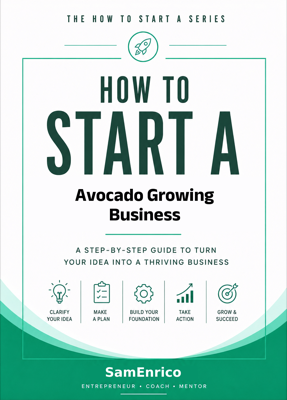 How to Start a Avocado Growing Business (Beginners Guide)Woody Chasity$11.99
 China Student Visa ExtensionWoody Chasity$12.99
 Health Product Fit BoPWoody Chasity$12.99
 Understanding Congenital Dyserythropoietic AnemiaWoody Chasity$17.99
 Nursing AssistantWoody Chasity$11.99
You may also like
 Hong Kong Handover 1997Dunn Johnnie$11.99
 Zumba For Postnatal Recovery CourseNeal Christian$11.99
 Zumba for BeginnersLadner Nikia$11.99
 YouTube Comment Mining GuideHumes Pandora$12.99
 Worry Box MeditationCarlin Rudy$11.99
 Workplace Stress MeditationNguyen Lynn$11.99
 Workplace Stress and Sleep RepairHawley Ivory$11.99
 Workplace Perfectionism CureDelaney Jeffry$11.99
 Workplace Injustice Anger GuideWallen Isabelle$11.99
 Work Addiction and Burnout LinkGreenwood Ester$11.99
 Women in Yoga and WellnessBeattie Galina$11.99
 Women in Stand Up ComedyChun Evangeline$11.99