
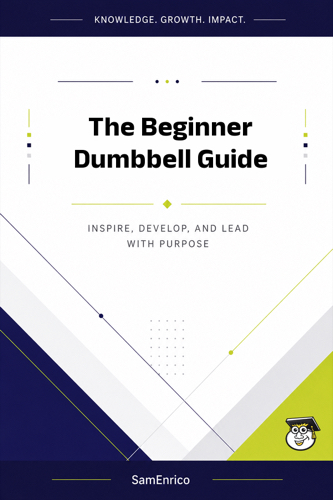
Non-FictionHealth & WellnessWeight Training
The Beginner Dumbbell Guide eBook
Light weights, proper form, and progressive overlo
by Wilks Cecile
Light weights, proper form, and progressive overload.
Formats
Free sample
Chapter 1: The Five-Pound Lie--–- The dumbbell felt cold and unforgiving in my palm. Twenty pounds. It wasn't heavy by gym standards—I'd watched a woman half my size shoulder press twice that without flinching—but to me, on that humid Tuesday evening in my cramped apartment, it might as well have been a boulder. I had bought the thing three months earlier, convinced by every fitness influencer I followed that "light weight won't build real muscle." I needed to suffer. I needed to strain.
I needed to feel the burn of something heavy enough to make me grunt like the guys in those dramatic before-and-after reels.So I grabbed the twenty. I pressed it overhead. My right shoulder clicked. My lower back arched. My left arm wobbled like a bent flagpole.
On rep number four, something deep in my shoulder blade screamed—not the good kind of scream, the kind that makes you drop the weight and stand very still, waiting to see if you've just broken something expensive. I hadn't. But I'd come close. And the worst part? I'd felt this exact same story unfolding for months, in different bodies, with different weights, in different rooms.
My friend Mark, who tried to bench press thirty-pound dumbbells on his first day and couldn't lift his arms above his shoulders for a week. My neighbor Sarah, who bought "beginner" fifteen-pound weights and quit after three sessions because her elbows hurt every time she tried to curl them. My own father, who at fifty-seven decided to get "back into shape" and ended up with a strained rotator cuff from swinging twenty-pound dumbbells like they were axes.We had all fallen for the same lie. And it was a lie so pervasive, so deeply embedded in fitness culture, that most people never stop to question it. The lie is simple: heavier is better.
More weight equals more strength. If you're not struggling, you're not growing. Pain is progress. Suffering is success.None of that is true. And in this chapter, I'm going to prove it to you—not with motivational quotes or gym bro anecdotes, but with the actual science of how muscles grow, how strength develops, and why the most effective dumbbell workouts for beginners look almost embarrassingly easy.
By the time you finish reading, you will never look at a five-pound dumbbell the same way again.The Myth That Keeps Beginners Stuck Let me be direct: the fitness industry has a vested interest in making you believe that you need to lift heavy. Heavy weights mean expensive equipment, gym memberships, personal trainers, and a constant cycle of purchasing heavier dumbbells as you "progress." Heavy weights also create dramatic content—videos of people grimacing under massive loads get clicks, shares, and likes. A video of someone doing perfect, controlled bicep curls with eight pounds doesn't go viral. It looks too easy. It looks like they're not trying hard enough.But here's what the viral videos don't show you: the thousands of people who tried to lift heavy too soon and quietly quit.
The rotator cuff tears. The lumbar strains. The tennis elbows. The crushed motivation that comes from failing rep after rep because the weight is simply too heavy for your current level of neural adaptation and muscular stability.I want you to hear a name: Dr. Stuart Mc Gill.
He's one of the world's foremost experts on spine biomechanics, and he's spent decades studying how backs get injured and how they heal. One of his most important findings is that most training injuries don't happen because someone was lifting "too much weight" in an absolute sense. They happen because someone lifted more weight than their current stability system could handle. Your muscles might be strong enough to move a weight, but your stabilizers—the tiny, deep muscles around your joints that you've never trained—might not be. When those stabilizers fail, the load transfers to your ligaments and bones.
And that's when things tear, crack, or wear down over time.The solution isn't to strengthen those stabilizers by lifting heavy. That's like trying to teach a toddler to run by entering them in a marathon. The solution is to lift light—light enough that your stabilizers can keep up, light enough that you can feel which muscles are supposed to be working, light enough that you can complete every rep with the kind of perfect form that builds durable, lifelong strength.The Science of "Ghostly Gains"There's a concept in exercise physiology that rarely makes it into mainstream fitness content. It's called neural adaptation, and it's the single most important factor in beginner strength gains. Here's what it means: when you first start lifting, almost all of your early progress—the first six to twelve weeks—comes not from growing bigger muscles, but from teaching your nervous system to fire your existing muscles more efficiently.Think of it like learning to play the piano.
On day one, your fingers are clumsy. You press the wrong keys. Your timing is off. But you haven't grown new finger muscles. You've simply taught your brain to send signals more precisely to the muscles that were always there.
The same thing happens with lifting. When you first pick up a dumbbell, your nervous system is like a beginner pianist—sloppy, uncoordinated, recruiting the wrong muscles at the wrong times. After a few weeks of practice, those neural pathways become smooth and efficient. You get stronger without adding a single ounce of muscle tissue.This is where light weights become a strategic advantage. Neural adaptation requires repetition and precision.
You need to perform the same movement correctly, over and over, until your brain hardwires that pattern. Heavy weights sabotage this process in two ways. First, they fatigue you too quickly—you might get five or six reps before form breaks down, which isn't enough repetition to teach your nervous system anything useful. Second, heavy weights force your body to recruit "helper muscles" to compensate for the load, creating messy, inefficient movement patterns that your brain will then hardwire as the default. Good luck unlearning that later.Light weights, on the other hand, let you perform twenty, thirty, even fifty perfect reps.
They let you feel exactly which muscles are supposed to be working. They give your brain the clean, repeatable input it needs to build efficient neural pathways. That's what I call "ghostly gains"—strength that appears not from bigger muscles, but from a smarter nervous system. And ghostly gains are where every beginner should start.Time Under Tension: The Real Driver of Growth Let me introduce you to a term that will change how you think about every rep you perform: Time Under Tension, or TUT. TUT is exactly what it sounds like—the amount of time your muscle spends under strain during a set.
And decades of research have shown that TUT is often more important for muscle growth than the actual amount of weight on the bar.Here's a concrete example. Imagine two people doing bicep curls. Person A uses a twenty-pound dumbbell. They swing it up quickly, drop it down quickly, and complete ten reps in about fifteen seconds. Person B uses…
This is the end of the free sample. Get the eBook to keep going. Buy now
About this book
Details
- Author
- Wilks Cecile
- Publisher
- SamEnrico
- Language
- English
- Genre
- Non-Fiction, Health & Wellness, Weight Training
- Released
- 2026-06-05
- Pages (approx.)
- 137
- Available as
- eBook, Audiobook

Read better in the ZLOADR app
Your eBooks on your phone or tablet. Sign in with your SamEnrico account and start reading.
More by Wilks Cecile
 Mexican Restaurant Chain FounderWilks Cecile$11.99
 Emotional Intelligence for InmatesWilks Cecile$11.99
 Stress PMS Symptom WorseningWilks Cecile$11.99
 The Fire and the Flame: The 2010 Chile Mine Disaster and the Runner Who Defied the DarkWilks Cecile$11.99
 How to Become a Linter TenderWilks Cecile$11.99
 Learn to Play the GopuzWilks Cecile$11.99
 Remote Performance Review Best PracticesWilks Cecile$12.99
You may also like
 Hong Kong Handover 1997Dunn Johnnie$11.99
 Zumba For Postnatal Recovery CourseNeal Christian$11.99
 Zumba for BeginnersLadner Nikia$11.99
 YouTube Comment Mining GuideHumes Pandora$12.99
 Worry Box MeditationCarlin Rudy$11.99
 Workplace Stress MeditationNguyen Lynn$11.99
 Workplace Stress and Sleep RepairHawley Ivory$11.99
 Workplace Perfectionism CureDelaney Jeffry$11.99
 Workplace Injustice Anger GuideWallen Isabelle$11.99
 Work Addiction and Burnout LinkGreenwood Ester$11.99
 Women in Yoga and WellnessBeattie Galina$11.99
 Women in Stand Up ComedyChun Evangeline$11.99