
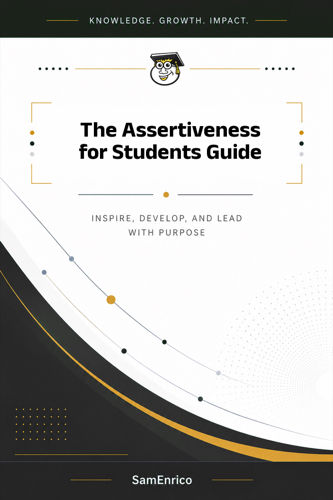
The Assertiveness for Students Guide eBook
Speak up in class, ask for grade reviews, and hand
by Haag Kirstin
Speak up in class, ask for grade reviews, and handle peer pressure.
Formats
Free sample
Chapter 1: The Four Masks--–- Every student wears a mask. Some know they are wearing one. Most do not. The mask is not made of cloth or plastic. It is made of habits, fears, and rehearsed responses that have become so automatic they feel like personality.
You might believe you are simply “shy” or “direct” or “easygoing” by nature. But what if the way you communicate in the classroom, in office hours, and with your peers is not who you are but rather a role you learned to play so long ago that you forgot it was a performance?This chapter will ask you to look directly at that mask. Not to judge it. Not to tear it off violently. But to recognize it for what it is: a strategy you adopted to survive social and academic situations.
And here is the liberating truth that every best-selling book on assertiveness confirms: strategies can be changed. The quietest student in the room can learn to speak with clarity. The student who constantly interrupts and dominates discussions can learn to listen. The student who rolls their eyes and mutters sarcastic comments can learn to state their needs directly. None of these shifts require you to become a different person.
They only require you to understand which mask you have been wearing and to practice putting on a more effective one.This chapter introduces the four communication masks that students wear: the Ghost, the Bulldozer, the Eye-Roller, and the Compass. You will take a self-assessment to identify your dominant mask. You will see each mask in action through classroom scenarios that will feel uncomfortably familiar. And you will be introduced to The Student’s Bill of Rights, a set of ten non-negotiable truths that form the foundation of genuine assertiveness. By the end of this chapter, you will not be transformed.
But you will see yourself clearly for perhaps the first time. And clarity, as every therapist and coach will tell you, is the first and most essential step toward change.The Cost of Your Current Mask Before you identify which mask you wear, you need to understand what that mask is costing you. This is not a moral judgment. The Ghost is not a “bad” student. The Bulldozer is not a “bad” person.
These masks emerged for a reason. They protected you. They helped you survive difficult classrooms, awkward social situations, or family dynamics where speaking up felt dangerous. But survival strategies that worked at age twelve often stop working at age twenty. The mask that kept you safe in high school may be the very thing keeping you silent and stuck in college.Consider the research.
A longitudinal study of over 3,000 university students found that students who identified as “passive communicators” (the Ghost) received participation grades that were, on average, 11 percent lower than their actual knowledge of the material would predict. They knew the answers. They simply did not offer them. Students who identified as “aggressive communicators” (the Bulldozer) received lower collaboration scores on group projects, which affected their final grades even when their individual work was excellent. And students who identified as “passive-aggressive communicators” (the Eye-Roller) were rated by professors as less likable and less trustworthy, which had a direct impact on their access to research opportunities, recommendation letters, and mentorship.The mask you wear is not neutral.
It shapes how professors perceive your competence, how peers treat you, and how you feel about yourself at the end of each semester. The good news is that masks can be changed. But first, you have to see yours clearly.The Self-Assessment: Which Mask Do You Wear?Read each of the following ten scenarios. For each one, choose the response that most closely matches what you would actually do, not what you wish you would do. Be honest.
No one will see your answers except you.Scenario 1: A professor mispronounces your name during roll call on the first day of class. The mispronunciation is clearly wrong, and you know the professor will repeat it all semester if you do not correct it. Do you:A) Say nothing. The professor has thirty other names to learn. You do not want to be difficult.
(Ghost)B) Interrupt loudly: “It’s pronounced [correct pronunciation]. You said it wrong.” (Bulldozer)C) Say nothing in class but complain to the student next to you about how professors never bother to learn names correctly. (Eye-Roller)D) Raise your hand and say calmly: “Excuse me, my name is actually pronounced [correct pronunciation]. Thank you for checking.” (Compass)Scenario 2: A peer in your study group asks to copy your homework assignment because they “ran out of time.” The assignment is worth a significant portion of your grade, and you know that sharing it could be considered academic dishonesty. Do you:A) Send them the homework.
You feel guilty saying no, and you do not want them to be angry with you. (Ghost)B) Say: “Are you serious? Do your own work. I’m not your personal answer key.” (Bulldozer)C) Say: “Sure, I’ll send it,” then send a corrupted file that cannot be opened. Or say nothing and ignore their messages.
(Eye-Roller)D) Say: “I can’t share my homework. That would violate the academic integrity policy. But I can study with you for the next exam if you want help.” (Compass)Scenario 3: A professor asks a question in a large lecture hall. You know the answer. Your hand is partially raised, but the professor calls on someone else.
This happens repeatedly across several classes. Do you:A) Lower your hand and stop trying. The professor clearly does not want to call on you. (Ghost)B) Shout out the answer without being called on. (Bulldozer)C) Stop attending the class because the professor is “unfair” and “plays favorites.” (Eye-Roller)D) After class, approach the professor and say: “I know the answer to many of your questions, but I notice you rarely call on me.
Is there something I should do differently to get called on?” (Compass)Scenario 4: A group project teammate misses the third deadline in a row. Your group is now behind schedule. Do you:A) Do their work yourself. It is easier than confronting them. (Ghost)B) Send them an angry message: “You are useless.
We are all carrying you.” (Bulldozer)C) Complain about them to the other teammates but say nothing directly to the absent teammate. (Eye-Roller)D) Send a message: “In our last meeting, you agreed to complete slides 3-5 by yesterday. They are not done. What is your plan to finish them by tomorrow?” (Compass)Scenario 5: You receive a B on a paper. After reviewing the rubric, you believe you deserved an A because your paper met all the criteria for the highest score.
Do you:A) Accept the B. You do not want the professor to think you are entitled or annoying. (Ghost)B) Storm into office hours and demand a regrade immediately. (Bulldozer)C) Post about the unfair grade on social media, tagging the professor’s department. (Eye-Roller)D) Email the professor: “I reviewed my paper against the rubric and believe I met the criteria for an A on sections 2 and 3.
Could we meet to discuss this?” (Compass)Scenario 6: A friend pressures you to skip class and go to a party.…
This is the end of the free sample. Get the eBook to keep going. Buy now
About this book
Details
- Author
- Haag Kirstin
- Publisher
- SamEnrico
- Language
- English
- Genre
- Non-Fiction, Self-Help, Education
- Released
- 2026-06-08
- Pages (approx.)
- 155
- Available as
- eBook, Audiobook

Read better in the ZLOADR app
Your eBooks on your phone or tablet. Sign in with your SamEnrico account and start reading.
More by Haag Kirstin
 Leaves on a Stream PracticeHaag Kirstin$11.99
 The Aggressive Driver RewindHaag Kirstin$11.99
 Imposter Syndrome Anger LinkHaag Kirstin$11.99
 The Postpartum Urinary Incontinence GuideHaag Kirstin$11.99
 The Calculus of Power: Leibniz and the Birth of a Mathematical DynastyHaag Kirstin$11.99
 SWOT Analysis on One PageHaag Kirstin$12.99
 Green Energy Developer MapHaag Kirstin$12.99
 Understanding Philadelphia-negative Chronic Myeloid LeukemiaHaag Kirstin$17.99
 How to Start a Cabinets for Kitchens Business (Beginners Guide)Haag Kirstin$11.99
 World War II: The Last Living MemoriesHaag Kirstin$11.99
You may also like
 Hong Kong Handover 1997Dunn Johnnie$11.99
 Zumba For Postnatal Recovery CourseNeal Christian$11.99
 Zumba for BeginnersLadner Nikia$11.99
 YouTube Comment Mining GuideHumes Pandora$12.99
 Worry Box MeditationCarlin Rudy$11.99
 Workplace Stress MeditationNguyen Lynn$11.99
 Workplace Stress and Sleep RepairHawley Ivory$11.99
 Workplace Perfectionism CureDelaney Jeffry$11.99
 Workplace Injustice Anger GuideWallen Isabelle$11.99
 Work Addiction and Burnout LinkGreenwood Ester$11.99
 Women in Yoga and WellnessBeattie Galina$11.99
 Women in Stand Up ComedyChun Evangeline$11.99