
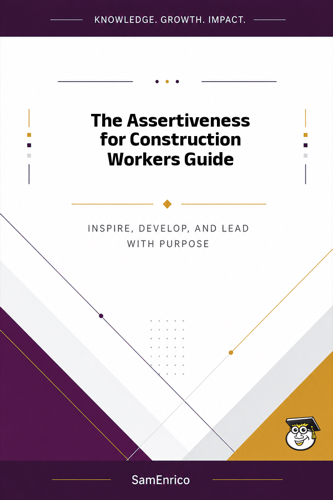
The Assertiveness for Construction Workers Guide eBook
Enforce safety protocols and communicate clearly o
Enforce safety protocols and communicate clearly on noisy job sites.
Formats
Free sample
Chapter 1: The Weight of Silence--The rebar bundle weighed just under four hundred pounds. Marcus had watched the crane operator swing it over the concrete formwork for three hours that morning, each pass smooth and predictable. But at 10:47 AM, something changed. The nylon sling on the far side slipped two inches. Not enough to drop the load, but enough to make it sway.
Marcus saw it. He was standing forty feet away, stacking form pins, and he saw the rebar shift. His throat tightened. His hands stopped moving. He knew—with the absolute certainty that comes only in the split second before disaster—that the load was no longer secure.He didn't speak.The crane operator, whose name was Darrell, had twenty-three years on the job.
He was a good man. He coached Little League. He brought donuts on Fridays. And he was rushing because the concrete truck was already circling the site, waiting to pour. Darrell swung the load over a laborer named Javier, who was bent over tying rebar, his back to the crane.
Marcus opened his mouth. A word formed on his tongue. But then he thought: Darrell knows what he's doing. I'm just an apprentice. If I say something, everyone stops.
The concrete will harden in the truck. The foreman will be furious. They'll call me a safety rat.The bundle slipped again. This time, it swung like a pendulum, arcing toward Javier's spine. Marcus shouted—but too late.
The warning came out as a strangled yelp, not a command. Javier turned his head at the last second, which saved his life. The rebar caught his right hand instead of his skull. Four fingers were crushed beyond repair. Javier spent six weeks in the hospital and never returned to construction.
Marcus told the OSHA investigator, "I thought someone else would say something."No one else had seen it.The Mathematics of Silence Every year, the Occupational Safety and Health Administration collects data on near-misses—those moments when an accident almost happens but doesn't. The reports are filed by safety officers, foremen, and sometimes workers themselves. And buried in those reports is a number that should keep every construction worker awake at night: over 60 percent of reportable accidents were preceded by at least one worker who noticed the hazard but remained silent.Let that sink in. Six out of ten times, someone saw it coming and said nothing.The construction industry talks endlessly about hard hats, harnesses, guardrails, and lockout/tagout procedures. We spend millions on personal protective equipment.
We laminate safety cards and post them on trailers. We hold toolbox talks and sign JSA forms. And yet, the single most effective safety device on any job site costs nothing, weighs nothing, and fits in every worker's mouth. It's your voice. And according to the data, most of you are leaving it in your pocket.This chapter is not about safety equipment.
It is not about OSHA regulations or company policies. It is about the gap between what you see and what you say—and the price we all pay for that silence.The Macho Code: How Construction Culture Trains You to Stay Quiet If you have spent more than a week on a construction site, you know the unwritten rules. They are never posted on a bulletin board. No foreman has ever read them aloud at a safety briefing. But they are enforced ruthlessly, every single day, by every single crew.Real construction workers don't complain.
Real construction workers don't snitch. Real construction workers don't show fear. Real construction workers don't correct senior crew members. Real construction workers don't stop work because something "looks wrong."Let's call this what it is: the Macho Code.The Macho Code is a set of beliefs that confuses aggression with strength and silence with toughness. Under this code, the worker who speaks up about a loose guardrail is a "worrywart." The worker who stops a crane lift because the load is unbalanced is a "safety Sally." The worker who reminds a foreman about lockout/tagout is a "rat." And the worst label of all?
The worker who goes home in one piece at the end of the day is, somehow, "not a team player."Let me tell you about a framing crew in Texas. The senior guy—let's call him Rick—had been working without a harness on a second-story deck for three days. The apprentice, a nineteen-year-old named Miguel, noticed that Rick's lanyard was clipped to a guardrail post that wasn't secured to the deck. The post could pull out with forty pounds of lateral pressure. Rick weighed two hundred.
Miguel opened his mouth three times. Each time, he closed it. On the fourth day, Rick leaned against the post. It pulled out. He fell eighteen feet onto a pile of rebar.
He survived but will never walk without a cane. Miguel quit the trade six months later. He told a counselor, "I couldn't look at another site. I saw his face every time I picked up a hammer."The Macho Code didn't kill Rick. Gravity did.
But the Macho Code silenced the one person who could have prevented the fall.The Three Faces of Silence Not all silence looks the same. Based on interviews with construction workers who witnessed near-misses, safety researchers have identified three distinct patterns of silence. You have probably used all three.The Mumbled Warning This is the worker who says something but makes it so soft, indirect, or hedged that it cannot possibly be heard or taken seriously. Examples include:"Uh, hey, maybe that doesn't look quite right?""I'm not an expert, but...""You might want to check something, I guess?"The mumbled warning is a performance of speaking up. It allows the speaker to tell themselves, "I said something," while ensuring that no actual safety action will result.
The recipient hears a suggestion, not a command, and files it under "annoying background noise." Safety is not achieved. But the speaker's conscience is temporarily salved.The Delayed Intervention This is the worker who sees a hazard and decides to address it later—after lunch, at the end of the shift, or "when the rush is over." Examples include:"I'll mention it at the toolbox talk tomorrow.""I'll pull him aside when no one else is watching.""It's probably fine for now."The delayed intervention is a bet. The worker is gambling that the hazard will not cause an accident in the next hour, or the next shift, or the next day. Sometimes the bet pays off. Sometimes it doesn't.
And when it doesn't, the worker lives with the knowledge that they had a chance to act and chose to wait.The Complete Withdrawal This is the worker who says nothing at all. They see the hazard. They feel the adrenaline. They imagine the worst. And then they turn away.
Examples include:Looking at the ground and walking faster.Pretending to check their phone or their tool belt.Convincing themselves that someone else will handle it.Complete withdrawal is the most honest form of silence—and the most dangerous. The worker knows they are choosing not to act. The only question is whether they can live with that choice.Marcus, the apprentice…
This is the end of the free sample. Get the eBook to keep going. Buy now
About this book
Details
- Author
- Courtney Dillon
- Publisher
- SamEnrico
- Language
- English
- Genre
- Non-Fiction, Self-Help, Construction
- Released
- 2026-06-08
- Pages (approx.)
- 138
- Available as
- eBook, Audiobook

Read better in the ZLOADR app
Your eBooks on your phone or tablet. Sign in with your SamEnrico account and start reading.
More by Courtney Dillon
 Mantra Repetition for SafetyCourtney Dillon$11.99
 Creative Starvation ProtocolCourtney Dillon$11.99
 The Postpartum Anemia GuideCourtney Dillon$11.99
 Politics Office Anger GuideCourtney Dillon$11.99
 The Last Healer of the Silk RoadCourtney Dillon$11.99
 Understanding Phosphoglucomutase Deficiency Type 3Courtney Dillon$17.99
 Online Travel Agency MapCourtney Dillon$12.99
 Test Tasks for VA CandidatesCourtney Dillon$12.99
 How to Start a Hobby in TurtlesCourtney Dillon$11.99
 Administrative SecretaryCourtney Dillon$11.99
You may also like
 Workaholism in ConstructionGlaser Krystle$11.99
 Financial Stress for Construction WorkersHilton Cheyenne$11.99
 Construction Site Stress SafetyDraper Chasidy$11.99
 Construction Site Anger GuideWheaton Kalyn$11.99
 Construction Site Manager StressBeauregard Maragret$11.99
 Construction Safety SignalsLuke Eugene$11.99
 Compulsive Spending for ConstructionCostello Sherell$11.99
 Financial Stress for ConstructionWyatt Maryanne$11.99
 Failure Fear in ConstructionWhitman Millie$11.99
 Morning Routine for ConstructionCromwell Angeline$11.99
 Construction Project Manager StressOrtega Ramon$11.99
 Construction Innovation GuideWilke Kylie$11.99