
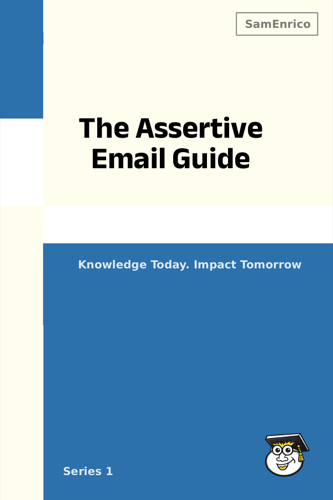
The Assertive Email Guide eBook
Write firm professional emails that don't cross in
by Knox Sheena
Write firm professional emails that don't cross into aggressive territory.
Formats
Free sample
Chapter 1: The 90-Second Pause...--–- Let me tell you about the email that almost ended my career. I was thirty-two years old, five years into a management role at a mid-sized marketing firm, and I thought I understood email. I had sent thousands of them. I had received tens of thousands. I prided myself on being responsive, on clearing my inbox by 6 PM, on never leaving a question unanswered for more than twenty-four hours.
I was, by every external measure, good at email. Then came the Tuesday afternoon that proved I understood nothing at all.The trigger was mundane, almost laughably small in retrospect. A vendor had missed a deadline. Nothing catastrophic—a logo file delivered three days late for a client presentation that wasn't due for another week. But I was tired.
I had slept four hours the night before. I was already fighting a war with our IT department over server access, managing a junior employee who seemed to need hand-holding for every task, and trying to finish my own quarterly report. The vendor's email arrived at 2:17 PM, a cheerful "Here's that logo you needed! Sorry for the delay!" as if three days of silence had never happened.I lost my mind for approximately ninety seconds.I typed fast, my fingers hammering the keyboard with the kind of fury reserved for parking tickets and customer service chatbots. "I'm extremely disappointed in your team's performance.
This is completely unacceptable. Three days late with no communication? I expect much better from a vendor we pay this much money to. You need to tell me exactly what happened and why I should continue working with you." I hit send before my brain could catch up with my fingers. Then I sat back, heart racing, adrenaline pumping, feeling momentarily powerful.That feeling lasted about four minutes.
Then the dread set in.What had I just done? I had sent an aggressive, emotional, blaming email to a vendor we needed for a major upcoming project. I had used the word "disappointed," which is corporate code for "I think you're incompetent." I had threatened the relationship without offering a path to repair it. I had made their lateness about my anger rather than about the project. And worse, I had copied my boss on the thread, because in my rage I thought she needed to see how firmly I was handling the situation.
She did need to see it—just not in the way I imagined.The vendor's response arrived forty-seven minutes later, copied to their boss and our mutual account manager. It was a masterpiece of bureaucratic defensiveness: "We understand your frustration. However, per our contract, standard turnaround is five business days. We delivered on day four. We also attempted to reach you by phone on Monday and Tuesday to discuss the timeline but did not hear back.
Please let us know how you would like to proceed."They had documented everything. They had called me. I had missed the calls because I was in back-to-back meetings. They had followed the contract. And I had just publicly embarrassed myself in front of my boss, their boss, and a neutral account manager who now had written proof that I was the unreasonable one.
The only thing missing from the vendor's email was a velvet rope and a bouncer. They had professionally, politely, and devastatingly handed me my own stupidity on a silver platter.My boss called me ten minutes later. She didn't yell. She didn't need to. "That was not your best moment," she said quietly.
"We need these people for the Q4 launch. You might want to send a follow-up." I wrote an apology—a real, groveling, humiliating apology—and spent the next six months rebuilding trust with a vendor who had every right to bill me an asshole tax on every future project.That was the day I learned that email is not a communication tool. It is a weapon, a mirror, and a time machine. A weapon because the words you type can wound relationships in seconds. A mirror because every email you send is a photograph of your emotional state at that moment.
And a time machine because unlike spoken words, which evaporate into air, your emails will exist forever, searchable, forwardable, and usable as evidence against you.This book exists because I spent the next several years studying what I did wrong that Tuesday afternoon—and what I continued to do wrong for years after, in smaller ways, until I finally understood the underlying principles of assertive communication. I read the top business communication books. I interviewed executives, HR professionals, and legal counsel about the emails that had cost people promotions, clients, and jobs. I analyzed thousands of real workplace emails, from passive apologies that lost million-dollar contracts to aggressive flame wars that ended in lawsuits. And I discovered a pattern so consistent it could be graphed.Most professionals do not fall into a single communication style.
They oscillate between two extremes depending on stress, fatigue, power dynamics, and who they are emailing. With bosses, many become passive—apologetic, hedging, vague. With subordinates, many become aggressive—demanding, blaming, dismissive. With peers, they ping-pong wildly based on the last interaction. The result is a professional reputation that is unpredictable, unreliable, and exhausting to work with.
People do not trust your emails because they never know which version of you will show up.The alternative is what this book calls assertive professionalism: the ability to be direct without being rude, firm without being aggressive, and clear without being cold. It is not about being nice. It is not about being mean. It is about being effective. And it begins with a single practice that takes ninety seconds and will save you thousands of hours of damage control.The 90-Second Rule That Changes Everything The cornerstone of assertive email is not a template, a script, or a set of vocabulary words.
It is a pause. Specifically, it is a mandatory ninety-second delay between finishing a draft of any emotionally charged email and sending it. Ninety seconds is long enough for your heart rate to begin returning to baseline. Ninety seconds is long enough for your prefrontal cortex—the rational part of your brain—to re-engage after being hijacked by your amygdala, the almond-shaped cluster of neurons that triggers fight-or-flight responses. Ninety seconds is short enough that you will actually do it.Here is what happens in those ninety seconds if you use them correctly.
First, you take three deep breaths. Not metaphorical breaths. Actual, physical, diaphragm-expanding breaths that trigger your parasympathetic nervous system. Second, you read the email you just wrote as if you were the recipient. Third, you ask yourself four specific questions that we will explore in depth throughout this chapter.
Fourth, you either hit send, delete, or revise.The science behind this is well established. Neuroscientists have shown that emotional reactions peak approximately six seconds after a triggering event. After that, the intensity begins to decline—if you do not feed the emotion with additional angry thoughts. By ninety seconds, the physiological arousal of anger has typically decreased by more than half. You are no longer writing from a place…
This is the end of the free sample. Get the eBook to keep going. Buy now
About this book
Details
- Author
- Knox Sheena
- Publisher
- SamEnrico
- Language
- English
- Genre
- Non-Fiction, Self-Help, Writing
- Released
- 2026-06-06
- Pages (approx.)
- 136
- Available as
- eBook, Audiobook

Read better in the ZLOADR app
Your eBooks on your phone or tablet. Sign in with your SamEnrico account and start reading.
More by Knox Sheena
 Cyclist Self Hypnosis GuideKnox Sheena$11.99
 Caffeine Anger ManagementKnox Sheena$11.99
 Women Of French Revolution GuideKnox Sheena$11.99
 Diplomat International Crisis GuideKnox Sheena$11.99
 Creative Problem Solving LogKnox Sheena$11.99
 Russian Caviar SmugglingKnox Sheena$11.99
 Pet Loss For PrisonersKnox Sheena$11.99
 Senior Travel EsteemKnox Sheena$11.99
 Ignatius of Antioch BishopKnox Sheena$11.99
 The Preschooler Sleep SolutionsKnox Sheena$11.99
 Set Point Theory ExplainedKnox Sheena$11.99
 CPR for Elderly PatientsKnox Sheena$11.99
You may also like
 Writer Morning Pages GuidePena Wallace$11.99
 Eulogy Writing ExerciseSowell Leif$11.99
 Action Planning for WritersChaffin Shanti$11.99
 Daily Review for Writers CourseGiordano Lelah$11.99
 Writer Dream Journaling GuideBobo India$11.99
 Assertiveness For WritersGonzalez Dale$11.99
 Affirmations for Writers BlockWhitworth Jerrica$11.99
 Writer Distraction Protection GuideSchultz Darnell$11.99
 Speech Writing Structure GuideDennis Jessica$11.99
 Remote Work for WritersGunderson Lu$11.99Remote Work for WritersGunderson Lu$11.99
 The Remote Writer Time GuideConner Jimmy$11.99