
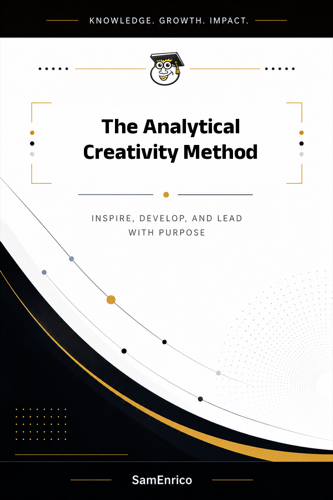
The Analytical Creativity Method eBook
Apply systematic brainstorming and lateral thinkin
by Hull Sherron
Apply systematic brainstorming and lateral thinking techniques to data-driven business problems.
Formats
Free sample
Chapter 1: The Spreadsheet Trap--The meeting had been going for forty-three minutes, and nobody had said anything useful for at least thirty.Around the conference table sat eight smart, well-intentioned people from a mid-sized e-commerce company called Verve Goods. They had perfect data. Every click, every cart abandonment, every second a customer spent hovering over a product image—all of it captured, cleaned, and beautifully visualized on a dashboard that would have made a NASA engineer weep with envy. Their conversion rate had been flat for six consecutive quarters. Not down, not up.
Flat. Like the heartbeat of a patient who was neither alive nor dead but simply... existing.The marketing director, a sharp woman named Priya who had been trained at a top consulting firm, had run every analysis in her arsenal. Regression models. Cohort analysis.
Funnel breakdowns. Customer lifetime value segmentation. She had even hired a data science consultant who built a random forest model so complex it required its own user manual. The model identified exactly one statistically significant predictor of conversion: time of day. Customers converted more often at 2:00 PM.
This was technically true and utterly useless."The data says we need more traffic," said the paid media manager, pointing at a bar chart that showed diminishing returns on ad spend."The data says we need better checkout flow," said the product manager, highlighting a heatmap of drop-offs at the shipping information screen."The data says we need to rethink our value proposition," said the brand strategist, who had been reading a lot of behavioral economics and wanted everyone to know it.Priya looked at the dashboard again. The numbers stared back, indifferent and immaculate. She felt something she had learned never to admit in a professional setting: she felt stupid. Not because she lacked intelligence or effort, but because she had followed every rule in the data playbook and had arrived exactly nowhere. The spreadsheets had become a trap, and she was caught inside it with no idea how to escape.Then she did something that, by her own admission, made no sense.She pulled up a random customer review from three months ago.
It was from a user named "Mike T." who had bought a camping lantern, returned it, bought it again, and then written a review that said only: "It's fine. I guess." The review had 47 upvotes—the most of any review on the site that month. Forty-seven people had read "It's fine. I guess." and thought, Yes. That is exactly how I feel.Priya turned to her team and asked a question that was not in any of her analytical frameworks: "What if 'fine' is actually our problem?
Not bad. Not terrible. Just... fine. What if our data is so clean and our operations so smooth that we've accidentally optimized for mediocrity?"The room went quiet.
Not the respectful quiet of people considering a deep insight. The uncomfortable quiet of people realizing that a sensible question had just been asked, and nobody had a spreadsheet to answer it.This book is about what happened next.The Mythology of the Lightning Bolt We have been sold a lie about creativity. The lie goes like this: breakthrough ideas arrive in a flash of inspiration, usually while taking a shower or walking the dog or staring out a rain-streaked window. The moment strikes without warning, and the lucky recipient—the genius, the visionary, the "creative type"—simply writes it down and changes the world. Everything else is just execution.This is called the Eureka Myth, and it is deeply, almost religiously embedded in how we talk about innovation.
Archimedes in his bathtub. Newton under the apple tree. The screenplay writer who wakes up with a fully formed plot. These stories are seductive because they make creativity seem magical and effortless. They also happen to be almost completely false.What the Eureka Myth leaves out is the decades of preparation, the systematic experimentation, the thousands of failed attempts, and—most critically for our purposes—the structure that made the breakthrough possible.
Newton didn't just get hit by an apple; he had spent years developing a mathematical framework for understanding motion. Archimedes didn't just notice water displacement; he had been wrestling with the problem of crown density for weeks. The lightning bolt struck a building that had already been constructed.The modern business world has inverted this relationship. We worship the lightning bolt while neglecting the building. We hire "creative directors" and host "brainstorming sessions" and install "innovation labs" with beanbag chairs and whiteboards shaped like clouds.
And then we wonder why, despite all this creative permission, our actual business problems remain unsolved.Meanwhile, on the other side of the building, the data team sits in a sterile room with fluorescent lighting and a dashboard that refreshes every hour. They have no beanbag chairs. They have no cloud-shaped whiteboards. They have numbers—columns and rows and pivot tables and regression outputs—and they are drowning in them.The tragedy is that both groups want the same thing: a better answer. But they speak different languages, inhabit different cultures, and operate under different assumptions about what constitutes progress.
The "creatives" believe that structure kills inspiration. The "analytics" believe that intuition is just bias with a better wardrobe. Both are partly right, and both are partly wrong.This chapter introduces the core problem that the rest of this book exists to solve: the gap between chaotic divergence and rigid convergence.The Two Dysfunctions of Modern Problem-Solving Every team that tries to solve a business problem falls into one of two traps. There is no third trap. I have watched hundreds of teams across dozens of industries, and they all—without exception—oscillate between these two dysfunctional states.Trap One: Chaotic Divergence This is the brainstorming session from hell.
A facilitator stands at the whiteboard with a marker and says something like, "No bad ideas! Let's just get everything out there!" For the next ninety minutes, the team generates a hundred and forty-seven ideas, of which approximately three are plausible, two are illegal, and the rest are variations of "what if we just tried harder?"The problem with chaotic divergence is not that it produces bad ideas. The problem is that it produces untethered ideas—notions that have no connection to data, no mechanism for testing, and no accountability for results. The team feels productive because the whiteboard is full. But a full whiteboard is not the same as a solved problem.I once watched a consumer goods company spend an entire day generating ideas for a declining product line.
The ideas ranged from the mildly interesting ("change the packaging") to the deeply unhinged ("release a limited-edition collaboration with a heavy metal band"). At the end of the day, the team had forty-seven sticky notes on the wall and no way to choose among them. They defaulted to the loudest voice in the room—the head of sales, who wanted to "run a promotion"—and the product line continued its decline.Chaotic divergence feels creative but produces nothing actionable.Trap Two: Rigid Convergence This is the meeting where someone projects a spreadsheet onto the wall and says, "Let's let the data decide." For the next…
This is the end of the free sample. Get the eBook to keep going. Buy now
About this book
Details
- Author
- Hull Sherron
- Publisher
- SamEnrico
- Language
- English
- Genre
- Non-Fiction, Self-Help, Problem Solving
- Released
- 2026-06-08
- Pages (approx.)
- 157
- Available as
- eBook, Audiobook

Read better in the ZLOADR app
Your eBooks on your phone or tablet. Sign in with your SamEnrico account and start reading.
More by Hull Sherron
 Continuous Glucose Monitor GuideHull Sherron$11.99
 The Beginner's Candle GazingHull Sherron$11.99
 Restaurant Recall ProcedureHull Sherron$11.99
 Scripted Self Hypnosis Trance GuideHull Sherron$11.99
 AI Deck Export GuideHull Sherron$11.99
 Large Chest Self EsteemHull Sherron$11.99
 Slovenian Pharma Contract ManufacturingHull Sherron$11.99
 Dreams About SchoolHull Sherron$11.99
 The Vault of Light: The Cathedral Heist of ChartresHull Sherron$11.99
 Seams of Power: The Untold Story of the First Black SupermodelHull Sherron$11.99
 Blood of the Standing Stones: The Druidic Wars of the BrigantesHull Sherron$11.99
 The Complete Guide to the Cr Way: Calorie Restriction For LongevityHull Sherron$11.99
You may also like
 Define Problem Statement WorkshopNichols Curtis$11.99
 The Interruption MVP MethodLyon Camellia$11.99
 Pain Point Innovation GuideHagan Davina$11.99
 The Struggle Is Data GuideBattle Kirby$11.99
 Problem Solving DBT WorkbookCriswell Violette$11.99
 Problem Solving VisualizationWeeks Jamar$11.99
 Problem Solving for EmotionsCollado Zelda$11.99
 Problem Framing WorkshopDancy Rosario$11.99
 Group Creative Problem Solving HandbookOliveira Mardell$11.99
 Problem Solving DreamsSchmid Ray$11.99
 Collaborative Problem SolvingGilson Dara$11.99
 Collaborative Problem Solving HandbookCross Lisa$11.99