
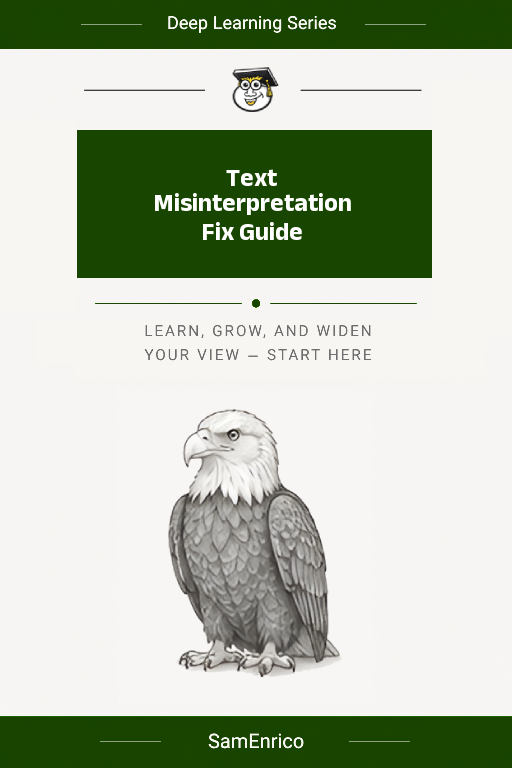
Text Misinterpretation Fix Guide eBook
Prevent text based miscommunication causing remote
by Crum Ashli
Prevent text based miscommunication causing remote team conflict. Use emojis, clarify intent, and summarize agreements in writing.
Formats
Free sample
Chapter 1: The $1.2 Trillion Period...--–- Sarah didn't quit because of her salary. She didn't quit because of a toxic culture, a bad manager, or a lack of growth opportunities. Sarah quit because of a period.One dot.The story begins on a Tuesday afternoon in March. Sarah, a senior product designer at a fast-growing startup called Lumina, had just spent fourteen hours over three days preparing a detailed proposal for a new feature that her team had been debating for weeks. She had incorporated feedback from six stakeholders, created three different mockups, and written a two-page rationale document.
At 2:47 PM, she posted everything in the #design-review channel on Slack. Her message read: "Here is the final proposal for the checkout flow redesign. Would love everyone's feedback by EOD Thursday so we can present on Friday."Three hours later, her manager, David, replied with two words and a single piece of punctuation: "Okay."Not "Okay, looks good." Not "Okay, let me review and get back to you." Not even "Okay, thanks for your work on this." Just "Okay." Period. Hard stop.Sarah stared at the message for eighteen seconds. Then she closed her laptop, walked to her kitchen, and sat in the dark for an hour.
That night, she updated her Linked In profile. Within three weeks, she had accepted an offer at a competitor. The exit interview was brief and diplomatic: "I found another opportunity that aligns better with my goals." The truth, which she never said aloud, was that she had interpreted "Okay." as dismissal, disrespect, and disappointment all wrapped into one grammatically correct package.The period cost Lumina $87,000 in recruiting fees, lost productivity, and institutional knowledge. All because of a punctuation mark that David later insisted he had meant as "Okay, I trust you, proceed." But text doesn't convey intent. Text conveys words.
And words without tone are weapons in disguise.This book exists because Sarah's story is not an exception. It is the rule. And the cost of that rule is $1.2 trillion annually.The Great Cost We Never Talk About Let me be clear about what that number represents. The $1.2 trillion figure comes from a comprehensive analysis by the Holmes Report, which synthesized data from over 400 companies across twenty-two countries. It accounts for the direct costs of workplace miscommunication: wasted hours, duplicated work, missed deadlines, employee turnover, and litigation.
For remote and hybrid teams, the problem has grown exponentially because the primary communication channel has shifted from face-to-face (where tone is obvious) to text-based (where tone is invisible).But statistics numb us. Let me translate $1.2 trillion into something you can feel.The average knowledge worker spends 7.47 hours per week deciphering ambiguous messages or cleaning up misunderstandings. That's nearly a full workday every week. Over the course of a year, that adds up to 388 hours—more than nine standard work weeks. For a team of ten people, that's nearly two full years of collective productivity lost annually to confusion about what someone actually meant when they typed "Sure."Think about your own Slack or Teams channel right now.
Scroll back through the last twenty messages. How many of them required a follow-up clarification? How many started with "Just to be clear..." or "What I meant was..." or "Sorry, let me rephrase that..."? How many times have you added an exclamation point not because you were excited but because you were afraid of being perceived as cold? How many times have you typed "Ha ha" when you weren't laughing?This phenomenon has a name.
Researchers at the University of California, Berkeley, coined the term Slack-splaining to describe the anxiety-driven habit of over-using exclamation points, emojis, and clarifiers in an attempt to control tone. It is the verbal equivalent of smiling so hard that your face hurts. And here is the cruel irony: Slack-splaining actually signals poor communication health rather than solving it. When you see a message that reads "Just following up on this again sorry to bother you!!! 😅" you don't think "This person is friendly." You think "This person is worried that I'm angry at them." And then you become slightly annoyed, fulfilling their prophecy.The Speed Trap Before we go any further, I need you to understand the first of four traps that will define every chapter of this book.
I call it The Speed Trap, and it is the single greatest predictor of text-based conflict.The Speed Trap works like this: when you receive a message that feels ambiguous, critical, or dismissive, your brain's amygdala (the threat detection center) activates before your prefrontal cortex (the reasoning center) has any chance to catch up. This is an evolutionary holdover from when the primary threats were predators and enemy tribes, not passive-aggressive project managers. Your body releases cortisol and adrenaline. Your heart rate increases. Your jaw tenses.
And in that state, you type a reply.The problem is that you are typing from threat response, not from thought. Your fingers move faster than your judgment. You hit send. And then, five seconds later, you realize what you just did.Here is the data point that should terrify you: according to a study of 1,200 remote workers published in the Journal of Organizational Behavior, 63% of regretted workplace messages were sent within three minutes of receiving the message that triggered them. Sixty-three percent.
The Speed Trap is not a character flaw. It is a biological reality. And it is the reason that "Okay." destroyed Sarah's relationship with her manager.David fell into the Speed Trap when he replied to Sarah. He was rushing between meetings, scanning messages on his phone, and typed "Okay" as a quick acknowledgment—the verbal equivalent of a nod. But Sarah's brain, reading the message in the quiet of her home office with no context about David's rushed state, filled in the missing tone with the worst possible assumption.
She didn't see a busy manager. She saw a dismissive one. The Speed Trap works in both directions: the sender types too quickly, and the reader interprets too quickly. The space between those two speeds is where careers go to die.The Three Hidden Costs of Misinterpretation The Lumina story illustrates the first hidden cost: voluntary turnover. But there are two others that rarely make it into the annual report.Hidden Cost #1: The Spiral of Over-Clarification When Sarah's colleague Michael saw the "Okay." message, he didn't say anything.
But he noticed. And he started adding three exclamation points to every message he sent to David. Then he started adding emojis. Then he started adding parenthetical clarifications like "(not meant to be passive-aggressive!)" which, of course, made him seem passive-aggressive. Within six weeks, Michael's messages had become so laden with anxiety-driven padding that his actual meaning was impossible to find.
This is the spiral: one ambiguous message leads to over-correction, which leads to more ambiguity, which leads to more over-correction. The average knowledge worker now spends 2.3 hours per week simply rewriting messages to avoid sounding like David. That is time not spent designing, coding, selling, or leading.Hidden Cost #2: The Decision Vacuum When David wrote "Okay." to Sarah's proposal, she assumed he disapproved. So she didn't schedule the presentation. The feature launch was delayed by three weeks.
No one knew why because no one had asked. David assumed Sarah would present because he had said "Okay" (which…
This is the end of the free sample. Get the eBook to keep going. Buy now
About this book
Details
- Author
- Crum Ashli
- Publisher
- SamEnrico
- Language
- English
- Genre
- Non-Fiction, Professional's Cheat Sheet, Communication
- Released
- 2026-06-01
- Pages (approx.)
- 137
- Available as
- eBook, Audiobook

Read better in the ZLOADR app
Your eBooks on your phone or tablet. Sign in with your SamEnrico account and start reading.
More by Crum Ashli
 Mobile Game Spending AddictionCrum Ashli$11.99
 Step Seven Humility PracticeCrum Ashli$11.99
 Grief and Loss in CaregivingCrum Ashli$11.99
 Controlling Parent Escape PlanCrum Ashli$11.99
 Non 24 Hour Sleep Wake DisorderCrum Ashli$11.99
 Anki Flashcard Mastery GuideCrum Ashli$11.99
 Yak-3 Soviet Lightweight DogfighterCrum Ashli$11.99
 The Rookie Year ODCrum Ashli$11.99
 Resentment After FireCrum Ashli$11.99
 The Habsburgs and the Vienna Waltz: A Dynasty of Art and PowerCrum Ashli$11.99
 The Great Barrier Reef's Last Stand: A Coral RebellionCrum Ashli$11.99
 Operation Midnight Sun: The Untold Spy War That Saved NATOCrum Ashli$11.99
You may also like
 Remote Review Language PhrasebookWard Earnest$11.99
 Recruiter InMail ResponseWinn Clarita$11.99
 Email and Communication BatchingGallardo Rory$12.99
 High Context vs Low ContextBatiste Florene$12.99
 OKR Communication GuideFry Arnulfo$12.99
 Mentoring Across Communication StylesPemberton Michel$12.99
 Vendor Communication TemplatesBickford Nila$12.99