
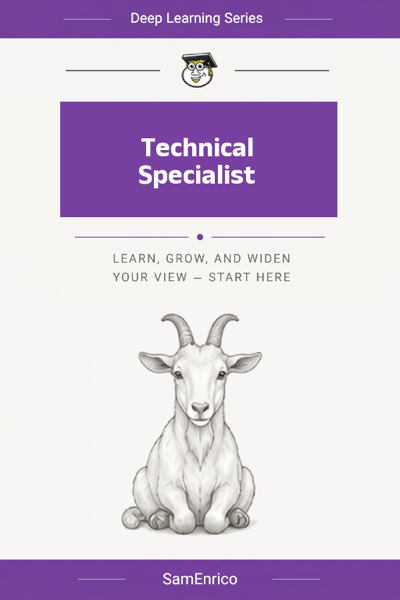
Non-FictionInformativeEducational
Technical Specialist eBook
A Coursebook on Technical Specialist
A Coursebook on Technical Specialist
Formats
Free sample
Chapter 1: The T‑Shaped Specialist...--The first time his pager went off at 2:17 AM, Marcus had been a “database administrator” for exactly eleven days. He answered the call, ran a script his senior had left in a shared drive, and watched the replication lag fall back to zero. “Good job,” the senior said the next morning, not asking whether Marcus understood why the script worked or what trade‑offs it had made. Marcus didn’t ask either. He was a specialist, after all.
He knew everything about Postgre SQL replication—or so he told himself. What he did not know was how the network switches between the primary and replica had been misconfigured for six months, why the application team kept receiving timeout errors even when the database was healthy, or why the monthly cloud bill had doubled without anyone noticing. He knew his layer. He assumed someone else knew the others.That assumption nearly cost his company a million‑dollar client.This book is written for everyone who has ever been Marcus. It is for the technical professional who has been told to “go deeper” until they can no longer see the rest of the system.
It is for the engineer who has mastered one tool, one database, one cloud provider, and yet feels perpetually surprised when outages leap across team boundaries. Most of all, it is for the technical specialist who suspects that being the smartest person in a silo is not the same as being effective.The central argument of this chapter—and indeed of this entire book—is that the old model of technical specialization is broken. The era when a database administrator could ignore the network, or a cloud architect could ignore the physical data center, or a security engineer could demand perfect isolation without understanding business cost, is over. In its place, we must adopt a new model: the T‑Shaped Specialist.This chapter defines that model, contrasts it with the roles that surround it (generalists, administrators, and siloed specialists), and introduces the three pillars that support every successful technical specialist’s career. By the end, you will have a clear framework for assessing your own shape—and a roadmap for becoming the architect of reliability your organization actually needs.The Myth of the Heroic Firefighter Before we build the new model, we must dismantle the old one.
The most persistent and damaging stereotype in technical operations is the Heroic Firefighter: the engineer who appears only during outages, types furiously for forty‑five minutes, restores service, and disappears without leaving documentation, runbooks, or a clear explanation of what went wrong.This archetype is celebrated in war stories, rewarded with “rockstar” bonuses, and secretly feared by every manager who depends on them. The Heroic Firefighter is a single point of failure disguised as a savior.Consider the following scenario, which plays out in some form across thousands of companies every quarter. A critical payment service stops processing transactions at 6 PM on a Friday. The on‑call specialist, Jordan, logs in, runs a series of diagnostic commands, identifies a deadlock in the order management database, kills the offending process, and restores service within twenty minutes. The incident is closed.
Jordan is praised.What Jordan does not do is equally important. Jordan does not ask why the deadlock occurred in the first place. Jordan does not check whether the same deadlock pattern exists in other databases. Jordan does not update the monitoring system to detect the precursor conditions before a full outage. And Jordan certainly does not write a runbook that would allow a less experienced engineer to resolve the same issue at 2 AM.The Heroic Firefighter model values speed over learning, individual heroics over systemic improvement, and short‑term restoration over long‑term reliability.
It is, to put it bluntly, a failure of engineering culture dressed up as expertise.The technical specialist we will build in this book is the opposite of the Heroic Firefighter. The specialist we will build is an Architect of Reliability—someone who works to make themselves less heroic by making the system more resilient, observable, and self‑healing. The Architect of Reliability celebrates not the outage they fixed, but the month that passed without an outage at all.Defining the T‑Shaped Specialist If the Heroic Firefighter is the anti‑pattern, what is the pattern we actually want? The answer is the T‑Shaped Specialist.Imagine the capital letter T. The vertical bar represents deep, expert‑level knowledge in one or two core domains.
For one specialist, that vertical bar might be Postgre SQL performance tuning. For another, it might be Kubernetes networking. For a third, it might be audio‑visual integration or industrial control systems. The vertical bar is what you were likely hired to do. It is the reason your resume landed on the hiring manager’s desk.The horizontal bar of the T represents broad, working competence across adjacent domains.
This is the knowledge you need to understand how your deep specialty interacts with everything else: cloud architecture, networking, security, automation, observability, cost management, and business communication. You do not need to be an expert network engineer, but you do need to know enough about TCP/IP, routing, firewalls, and load balancers to have an intelligent conversation with the network team when your database replication stops working.The T‑Shaped Specialist is not a generalist. A generalist knows a little about many things but lacks the deep expertise to solve the hardest problems in any domain. The T‑Shaped Specialist has both depth and breadth. They can go toe‑to‑toe with a siloed expert on their home turf, and they can also navigate across team boundaries to diagnose problems that span multiple layers of the stack.This combination is rare, valuable, and increasingly non‑negotiable.
In a 2024 survey of engineering leaders at Fortune 500 companies, 87 percent reported that their most debilitating outages involved at least three different technical domains. The database was slow because the network had packet loss, which was caused by a misconfigured firewall, which was changed to accommodate a security requirement that no one had documented. No single siloed expert could have solved that chain. Only a T‑Shaped Specialist could follow the thread from application to database to network to security policy.The Three Pillars of the T‑Shaped Specialist The T shape is a useful metaphor, but it needs operational substance. Across the top technical job models from Pearson, Michelin, Broadcom, and the AVIXA CTS framework, three capabilities appear consistently.
I call them the Three Pillars of the Technical Specialist.Pillar One: Deep Technical Depth This is the vertical bar of the T. Deep technical depth means that you possess mastery—not just familiarity—in at least one technical domain. You can diagnose problems that others cannot see. You can predict failure modes before they happen. You can optimize performance in ways that produce measurable business outcomes.Deep depth is not the same as “knowing a lot of commands.” True depth manifests as the ability to reason about a system at multiple levels of abstraction simultaneously.
When you have deep depth in a domain, you can:Troubleshoot from first principles when documentation is unavailable or wrong.Predict how…
This is the end of the free sample. Get the eBook to keep going. Buy now
About this book
Details
- Author
- Wayne Elizbeth
- Publisher
- SamEnrico
- Language
- English
- Genre
- Non-Fiction, Informative, Educational
- Released
- 2026-06-02
- Pages (approx.)
- 154
- Available as
- eBook, Audiobook

Read better in the ZLOADR app
Your eBooks on your phone or tablet. Sign in with your SamEnrico account and start reading.
More by Wayne Elizbeth
 LBO Debt Commitment LetterWayne Elizbeth$11.99
 NVC For Environmental Activism CourseWayne Elizbeth$11.99
 White Glove Logistics ForecastWayne Elizbeth$11.99
 Loving Kindness For IllnessWayne Elizbeth$11.99
 The Breath Awareness for InsomniaWayne Elizbeth$11.99
 The Shanghai Code: How a Spy Ring Exploited Wall StreetWayne Elizbeth$11.99
 Understanding Smet–fabry–fryns SyndromeWayne Elizbeth$17.99
 Pricing Case Study LibraryWayne Elizbeth$12.99
 Price Indexation StrategiesWayne Elizbeth$12.99
 How to Start a Accumulator Cell Cases Made of Glass Business (Beginners Guide)Wayne Elizbeth$11.99
You may also like
 Hong Kong Handover 1997Dunn Johnnie$11.99
 Zumba For Postnatal Recovery CourseNeal Christian$11.99
 Zumba for BeginnersLadner Nikia$11.99
 YouTube Comment Mining GuideHumes Pandora$12.99
 Worry Box MeditationCarlin Rudy$11.99
 Workplace Stress MeditationNguyen Lynn$11.99
 Workplace Stress and Sleep RepairHawley Ivory$11.99
 Workplace Perfectionism CureDelaney Jeffry$11.99
 Workplace Injustice Anger GuideWallen Isabelle$11.99
 Work Addiction and Burnout LinkGreenwood Ester$11.99
 Women in Yoga and WellnessBeattie Galina$11.99
 Women in Stand Up ComedyChun Evangeline$11.99