
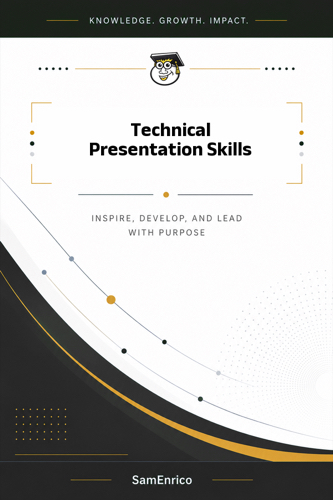
Non-FictionSelf-Help / Technical
Technical Presentation Skills eBook
undefined
by Ebert Elicia
undefined
Formats
Free sample
Chapter 1: The $10 Million Slide--–- The conference room was silent. Dr. Sarah Chen, a senior thermal engineer with sixteen years of experience and fourteen patents, had just finished her forty-five-minute presentation on a revolutionary cooling system for hyperscale data centers. She had shown forty-three slides. She had included every thermodynamic simulation, every material stress test, every statistical validation, every edge case, and every caveat.
The CEO, a woman named Patricia Okonkwo who had built three companies from scratch, looked at Sarah with genuine respect and said: "I can tell you're very smart. I can tell you've done incredible work. But I have no idea whether I should give you ten million dollars or send you back to the lab. What are you actually asking me to do?"Sarah felt the floor drop beneath her feet. She had spent six months on this project.
She had worked weekends. She had solved a problem that three other engineers had declared unsolvable. And in one sentence, the CEO had revealed the gap between being right and being understood.This is not a story about a bad engineer. Sarah Chen was an exceptional engineer. This is a story about a good engineer who believed a dangerous myth: that more data equals a better presentation.
That complexity is a virtue. That her expertise would speak for itself.It did not speak for itself. It never does.The Myth That Wastes Your Career If you are reading this book, you are likely a technical professional—an engineer, a data scientist, a researcher, an architect, a developer, a analyst, or a manager who rose through technical ranks. You have been trained to value precision, completeness, and rigor. You have been rewarded for finding edge cases, identifying exceptions, and documenting every assumption.
These are excellent qualities for solving technical problems. They are disastrous qualities for presenting to decision-makers.Here is the uncomfortable truth that no one tells you in technical training: Technical expertise is a prerequisite, not a differentiator. Everyone in the room assumes you know your stuff. That is the baseline, not the value add. The value add is your ability to translate that expertise into insights that drive decisions.
And translation is a different skill entirely.Let me be more direct. In your career, you will be evaluated not on the complexity of your thinking but on the clarity of your communication. The engineer who can explain a simple solution clearly will advance faster than the engineer who cannot explain a brilliant solution at all. This is not fair, but it is true. And once you accept it, you can stop resenting it and start mastering it.This chapter is about dismantling the myths that keep technical experts stuck.
We will identify three common pitfalls that sabotage technical presentations. We will introduce the single most important concept in this entire book: finding your Essential Truth. And you will take a self-assessment to diagnose your default presentation style—a diagnostic you will find in the Appendix, which you should complete before reading further.By the end of this chapter, you will understand why Sarah Chen failed and what she should have done instead. More importantly, you will understand why your own brilliant presentations are not landing the way you want them to—and what to do about it starting tomorrow.The Three Myths That Are Holding You Back Before we can build better presentations, we must first clear the wreckage of bad assumptions. Across decades of observing technical presenters—from software engineers at Google to research scientists at the NIH to project managers at Siemens—I have identified three pervasive myths that cause otherwise brilliant people to fail in front of audiences.Myth #1: "Data is Supreme"The first myth is the belief that your data should speak for itself.
This myth is seductive because it allows you to avoid the hard work of persuasion. If the data is clear, the reasoning goes, then anyone who disagrees must be irrational or uninformed. All you need to do is present the data, and reasonable people will reach the correct conclusion.This is wrong for three reasons.First, human beings are not logic-processing machines. We are story-processing machines. We evolved to understand narratives, not spreadsheets.
When you present raw data without a narrative frame, you are asking your audience to do something their brains are not optimized to do. They will struggle, and they will blame you—not their own biology—for the struggle.Second, data is never self-interpreting. Every number requires context. Every chart requires a claim. Every finding requires a "so what?" If you do not provide that interpretation, your audience will provide their own—and their interpretation will almost certainly be more pessimistic, more confused, or more dismissive than yours.Third, presenting all your data equally is a form of cowardice.
It says: "I am not willing to make a judgment about what matters most, so I will let the audience figure it out." That is not rigorous. That is abdication.Myth #2: "Extroverts Make Better Speakers"The second myth is the belief that charismatic, outgoing, naturally talkative people are inherently better presenters. This myth is especially damaging for technical professionals, many of whom identify as introverts and conclude, before they even begin, that they are at a permanent disadvantage.Here is the truth: some of the most compelling technical presenters I have ever seen are introverts. They are thoughtful. They are precise.
They do not fill silence with nervous chatter. They pause. They think. And audiences trust them because they communicate the careful deliberation that technical work requires.Extroversion is not the same as charisma, and charisma is not the same as effectiveness. The qualities that make a great technical presenter are learnable behaviors: clarity, structure, vocal variety, eye contact, and the ability to translate complexity.
None of these require an outgoing personality. In fact, the stereotypical extroverted presentation style—high energy, rapid speech, frequent audience interaction—can be actively counterproductive for technical content, which benefits from measured pacing and deliberate explanation.We will return to this myth in Chapter 10, when we discuss executive charisma. For now, simply note that you do not need to become a different person to become a better presenter. You need to learn a set of skills. And skills can be practiced.Myth #3: "Complexity Signals Intelligence"The third myth is the belief that if you simplify your content, you are dumbing it down.
This myth is the most deeply ingrained in technical culture. From your first engineering course to your most recent technical review, you have been rewarded for thoroughness. You have been penalized for leaving things out. You have internalized the idea that a complete answer is a long answer.But here is the paradox: simplicity is harder than complexity. Anyone can add more slides, more bullet points, more caveats, more data.
It takes discipline, clarity of thought, and genuine mastery to reduce a complex idea to its essential core. Albert Einstein is reputed to have said, "Everything should be made as simple as possible, but not simpler." The key phrase is "not simpler." You are not removing necessary nuance. You are removing noise so the signal can be heard.When you…
This is the end of the free sample. Get the eBook to keep going. Buy now
About this book
Details
- Author
- Ebert Elicia
- Publisher
- SamEnrico
- Language
- English
- Genre
- Non-Fiction, Self-Help / Technical
- Released
- 2026-06-06
- Pages (approx.)
- 141
- Available as
- eBook, Audiobook

Read better in the ZLOADR app
Your eBooks on your phone or tablet. Sign in with your SamEnrico account and start reading.
More by Ebert Elicia
 Niche Selection for Upwork SuccessEbert Elicia$11.99
 Low Frustration Tolerance CBTEbert Elicia$11.99
 NamUs Presumptive IdentificationsEbert Elicia$11.99
 The Hero Rescript MethodEbert Elicia$11.99
 The Staircase InductionEbert Elicia$11.99
 Night Sweat GuideEbert Elicia$11.99
 Albanian Jewelry Apprentice To DealerEbert Elicia$11.99
 The Last Breath of Cleopatra: A Funeral Fit for a QueenEbert Elicia$11.99
 The Dragon of the Black Forest: A Knight’s Last OathEbert Elicia$11.99
 How to Produce Non-metallic Mineral DepositEbert Elicia$11.99
 A Collector's Handbook to the Singer Nine RoadsterEbert Elicia$11.99
 Philippines Remote Team Communication ToolsEbert Elicia$12.99
You may also like
 Hong Kong Handover 1997Dunn Johnnie$11.99
 Zumba For Postnatal Recovery CourseNeal Christian$11.99
 Zumba for BeginnersLadner Nikia$11.99
 YouTube Comment Mining GuideHumes Pandora$12.99
 Worry Box MeditationCarlin Rudy$11.99
 Workplace Stress MeditationNguyen Lynn$11.99
 Workplace Stress and Sleep RepairHawley Ivory$11.99
 Workplace Perfectionism CureDelaney Jeffry$11.99
 Workplace Injustice Anger GuideWallen Isabelle$11.99
 Work Addiction and Burnout LinkGreenwood Ester$11.99
 Women in Yoga and WellnessBeattie Galina$11.99
 Women in Stand Up ComedyChun Evangeline$11.99