
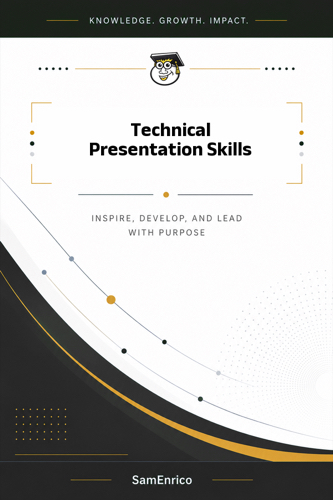
Non-FictionSelf-Help / Technical
Technical Presentation Skills Audiobook
undefined
by Ebert Elicia
undefined
Formats
Free sample
Chapter 1: The $10 Million Slide--–- The conference room was silent. Dr. Sarah Chen, a senior thermal engineer with sixteen years of experience and fourteen patents, had just finished her forty-five-minute presentation on a revolutionary cooling system for hyperscale data centers. She had shown forty-three slides. She had included every thermodynamic simulation, every material stress test, every statistical validation, every edge case, and every caveat.
The CEO, a woman named Patricia Okonkwo who had built three companies from scratch, looked at Sarah with genuine respect and said: "I can tell you're very smart. I can tell you've done incredible work. But I have no idea whether I should give you ten million dollars or send you back to the lab. What are you actually asking me to do?"Sarah felt the floor drop beneath her feet. She had spent six months on this project.
She had worked weekends. She had solved a problem that three other engineers had declared unsolvable. And in one sentence, the CEO had revealed the gap between being right and being understood.This is not a story about a bad engineer. Sarah Chen was an exceptional engineer. This is a story about a good engineer who believed a dangerous myth: that more data equals a better presentation.
That complexity is a virtue. That her expertise would speak for itself.It did not speak for itself. It never does.The Myth That Wastes Your Career If you are reading this book, you are likely a technical professional—an engineer, a data scientist, a researcher, an architect, a developer, a analyst, or a manager who rose through technical ranks. You have been trained to value precision, completeness, and rigor. You have been rewarded for finding edge cases, identifying exceptions, and documenting every assumption.
These are excellent qualities for solving technical problems. They are disastrous qualities for presenting to decision-makers.Here is the uncomfortable truth that no one tells you in technical training: Technical expertise is a prerequisite, not a differentiator. Everyone in the room assumes you know your stuff. That is the baseline, not the value add. The value add is your ability to translate that expertise into insights that drive decisions.
And translation is a different skill entirely.Let me be more direct. In your career, you will be evaluated not on the complexity of your thinking but on the clarity of your communication. The engineer who can explain…
This is the end of the free sample. Get the Audiobook to keep going. Buy now
About this book
Details
- Author
- Ebert Elicia
- Publisher
- SamEnrico
- Language
- English
- Genre
- Non-Fiction, Self-Help / Technical
- Released
- 2026-06-06
- Pages (approx.)
- 141
- Available as
- eBook, Audiobook

Listen in the VoxFlicks app
Audiobooks and audio dramas wherever you go. Sign in with your SamEnrico account and press play.
More by Ebert Elicia
 Niche Selection for Upwork SuccessEbert Elicia$11.99
 Low Frustration Tolerance CBTEbert Elicia$11.99
 NamUs Presumptive IdentificationsEbert Elicia$11.99
 The Hero Rescript MethodEbert Elicia$11.99
 The Staircase InductionEbert Elicia$11.99
 Night Sweat GuideEbert Elicia$11.99
 Albanian Jewelry Apprentice To DealerEbert Elicia$11.99
 The Last Breath of Cleopatra: A Funeral Fit for a QueenEbert Elicia$11.99
 The Dragon of the Black Forest: A Knight’s Last OathEbert Elicia$11.99
 How to Produce Non-metallic Mineral DepositEbert Elicia$11.99
 A Collector's Handbook to the Singer Nine RoadsterEbert Elicia$11.99
 Philippines Remote Team Communication ToolsEbert Elicia$12.99
You may also like
 Hong Kong Handover 1997Dunn Johnnie$11.99
 Zumba For Postnatal Recovery CourseNeal Christian$11.99
 Zumba for BeginnersLadner Nikia$11.99
 YouTube Comment Mining GuideHumes Pandora$12.99
 Worry Box MeditationCarlin Rudy$11.99
 Workplace Stress MeditationNguyen Lynn$11.99
 Workplace Stress and Sleep RepairHawley Ivory$11.99
 Workplace Perfectionism CureDelaney Jeffry$11.99
 Workplace Injustice Anger GuideWallen Isabelle$11.99
 Work Addiction and Burnout LinkGreenwood Ester$11.99
 Women in Yoga and WellnessBeattie Galina$11.99
 Women in Stand Up ComedyChun Evangeline$11.99