
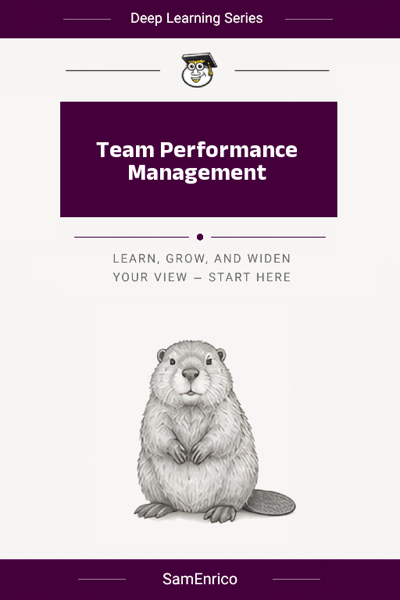
Non-FictionInformativeEducational
Team Performance Management eBook
A Coursebook on Team Performance Management
A Coursebook on Team Performance Management
Formats
Free sample
Chapter 1: The Review Delusion--–- It begins with a ritual that nearly every manager knows by heart. In December, or perhaps March, or maybe the anniversary of each employee's hire date, you close your office door. You pull up a template that HR emailed you—a form with boxes for "ratings," "comments," "goals for next year." You scroll through your vague memories of the past twelve months. You recall that one project in June that went surprisingly well. You remember that frustrating email chain in September that kept you up at night.
You assign a number: a 3 out of 5, a "Meets Expectations," a "Solid Performer." You write a few sentences, trying to sound both honest and kind. You click submit. The employee reads it, nods, and says nothing. The two of you never speak of it again. Then, ten minutes later, the entire exercise is forgotten.This is not performance management.
This is a theater of compliance. And it is costing your organization far more than you realize.For decades, the annual performance review has been treated as a sacred cow of corporate life. Consultants have built empires around it. HR departments have defended it as a necessary evil. Managers have dreaded it.
Employees have endured it. And yet, the evidence has been accumulating for years that this ritual does not improve performance. In fact, it actively undermines it. The annual review does not motivate. It does not develop talent.
It does not create accountability. What it does, with remarkable consistency, is produce frustration, anxiety, and mediocrity.This book is not a gentle revision of that broken system. It is a demolition. And then, more importantly, it is a rebuild. What follows in these twelve chapters is a complete alternative—a way of managing team performance that is continuous, forward-looking, psychologically safe, and grounded in how actual human beings actually improve.
The Adaptive Model, as we will call it, replaces the annual autopsy with a living system of coaching, feedback, and growth. But before we can build the new, we must fully understand why the old has failed. That is the work of this opening chapter.Let us begin with the most damning statistic of all. According to a comprehensive study by CEB, now part of Gartner, approximately 2 percent of CHROs believe that their organization's performance management system delivers value commensurate with the time invested. Pause and absorb that number.
Two percent. In a survey of thousands of human resources leaders, only one in fifty said that the system they were running was worth the effort. The other ninety-eight percent acknowledged, either explicitly or implicitly, that they were presiding over a process that was, at best, a waste of time, and at worst, actively damaging.This is not a fringe finding. It has been replicated across industries, geographies, and organizational sizes. Deloitte, after years of running a traditional performance management system, published a famous analysis revealing that they spent 1.8 million hours per year on performance reviews—and that internal surveys showed no correlation between the review process and employee engagement, retention, or business outcomes.
Adobe, before its own highly publicized overhaul, calculated that managers spent 80,000 hours annually on performance reviews, with zero measurable improvement in performance. Accenture, GE, Microsoft, Netflix—one by one, the most data-driven organizations in the world have abandoned or radically transformed the annual review.If you are a manager reading this, you likely do not need studies to convince you. You have lived the experience. You have spent hours writing reviews that felt formulaic and dishonest. You have watched talented employees become demoralized by a rating that reduced their complex, year-long contribution to a single number.
You have had the conversation where an employee, blindsided by feedback they had never heard before, sat in stunned silence or defensive anger. And you have wondered, in the quiet moments after that conversation, whether anyone was actually better off for having done it.The answer, uncomfortable as it is, is no. Let us examine why.The Three Fatal Flaws of the Annual Review The annual performance review fails for three fundamental reasons. These are not minor implementation issues that can be fixed with better forms or more training. They are structural flaws baked into the very concept of evaluating performance on an annual, retrospective basis.Flaw One: Recency Bias Human memory is not a video recording.
It is a narrative reconstruction that favors what happened most recently and what was most emotionally intense. When you sit down to write an annual review, what do you actually remember? You remember the past four to six weeks. You remember the project that went off the rails last month. You remember the heroic effort someone made three weeks ago to meet a deadline.
You remember the mistake that required you to send an apologetic email to a client last Tuesday.What you do not remember is the work from last February. Or the consistent, reliable output from last August. Or the subtle ways an employee helped their struggling colleague in October. Those events have faded into the background of your memory, not because they were unimportant, but because time has eroded them.This is recency bias, and it is not a moral failing. It is a feature of how human cognition works.
When you rely on annual recall, you are not evaluating a year of performance. You are evaluating the most salient one to two months of that year. The rest is lost, or reduced to a vague impression that your brain fills in with whatever stereotype feels easiest.The consequences are devastating. An employee who had a mediocre ten months but a stellar two months near the review date will be rated as a high performer. An employee who had a stellar ten months but made a well-intentioned mistake in the final weeks will be rated as average or worse.
Neither rating reflects reality. Both ratings are artifacts of a flawed recall process.Flaw Two: The Demotivation of Rankings and Ratings Almost all traditional performance management systems involve some kind of numerical or categorical rating. Perhaps it is a scale of 1 to 5. Perhaps it is a forced distribution where only 10 percent of employees can be rated as "top performers" and 10 percent must be rated as "low performers." Perhaps it is a simple binary of "meets expectations" versus "exceeds expectations."Regardless of the specific mechanism, ratings produce the same psychological effect for the majority of employees: demotivation. Let us walk through the math.
In a typical forced distribution system, approximately 10 to 20 percent of employees receive a rating that makes them feel like winners. Another 10 to 20 percent receive a rating that makes them feel like failures. The remaining 60 to 80 percent—the vast majority—receive a "meets expectations" or "solid performer" rating that communicates, in effect, that they are invisible.What does "meets expectations" actually mean to the employee who hears it? It means: you showed up, you did your job, you were not a problem, but neither were you memorable. It means: you are not on a trajectory for promotion, but you are also not going to be fired.
It means: your work is fine, and fine is not a feeling anyone chases.This is not motivating. Decades of research…
This is the end of the free sample. Get the eBook to keep going. Buy now
About this book
Details
- Author
- Guevara Beverley
- Publisher
- SamEnrico
- Language
- English
- Genre
- Non-Fiction, Informative, Educational
- Released
- 2026-05-11
- Pages (approx.)
- 139
- Available as
- eBook, Audiobook

Read better in the ZLOADR app
Your eBooks on your phone or tablet. Sign in with your SamEnrico account and start reading.
More by Guevara Beverley
 The Monk Who Argued with KingsGuevara Beverley$11.99
 Metta Phrase Selection GuideGuevara Beverley$11.99
 Welfare Office Waiting RoomGuevara Beverley$11.99
 Flash Sale Urge Surfing GuideGuevara Beverley$11.99
 Downsizing Survivor BurnoutGuevara Beverley$11.99
 Gut Health for FertilityGuevara Beverley$11.99
 The TM Music BackgroundGuevara Beverley$11.99
 Grip Strength Training ManualGuevara Beverley$11.99
 ASL AA Meeting GuideGuevara Beverley$11.99
 The Last Broadcast: The Unsolved Mystery of Flight 19Guevara Beverley$11.99
 The Lost City of Dhows: Uncovering the Indian Ocean’s Prehistoric Trade RoutesGuevara Beverley$11.99
 Obsidian Spires: The Forgotten Pyramids of the Sun GodGuevara Beverley$11.99
You may also like
 Hong Kong Handover 1997Dunn Johnnie$11.99
 Zumba For Postnatal Recovery CourseNeal Christian$11.99
 Zumba for BeginnersLadner Nikia$11.99
 YouTube Comment Mining GuideHumes Pandora$12.99
 Worry Box MeditationCarlin Rudy$11.99
 Workplace Stress MeditationNguyen Lynn$11.99
 Workplace Stress and Sleep RepairHawley Ivory$11.99
 Workplace Perfectionism CureDelaney Jeffry$11.99
 Workplace Injustice Anger GuideWallen Isabelle$11.99
 Work Addiction and Burnout LinkGreenwood Ester$11.99
 Women in Yoga and WellnessBeattie Galina$11.99
 Women in Stand Up ComedyChun Evangeline$11.99