
Non-FictionSelf-HelpCognitive Load
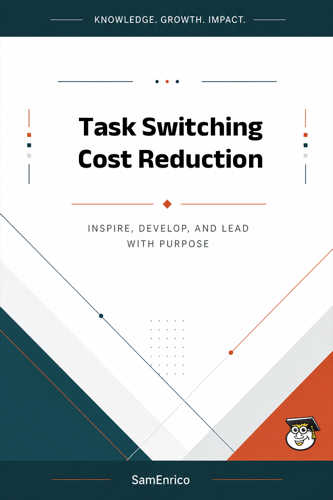
Task Switching Cost Reduction Audiobook
Block similar cognitive tasks together to minimize
Block similar cognitive tasks together to minimize transition penalties.
Formats
Free sample
Chapter 1: The Neurological Toll--–- Every morning, Sarah opens her laptop and begins what she calls “the dance.” She checks email, switches to a spreadsheet, answers a Slack message, reviews a document, jumps back to email, then opens a second spreadsheet. By 10 a.m., she has completed thirty-seven distinct task switches. She feels busy, even productive. Yet by 5 p.m., her most important work remains undone. She is exhausted but cannot name why.
Sarah is not lazy, undisciplined, or distracted in the usual sense. She is paying a tax she does not know exists—a tax levied not by her employer or her government, but by the ancient architecture of her own brain.The Switch Cost That Nobody Told You About For decades, cognitive psychologists have studied a phenomenon called the switch cost. It is the measurable penalty in time, accuracy, and mental energy that occurs whenever you transition from one task to another. Unlike a financial tax, which appears on a receipt, the switch cost is invisible. You do not feel the milliseconds adding up.
You do not see the errors accumulating. You only notice the vague sense of exhaustion at the end of the day and the nagging feeling that you should have accomplished more.The switch cost is not a metaphor. It is a replicated empirical finding, demonstrated in hundreds of laboratory studies and field experiments. When you switch between tasks, your brain does not seamlessly reallocate attention. It must unload one set of rules, suppress competing memories, load a new set of instructions, and reorient to different goals.
This process takes time—typically 0.5 to 2 seconds for simple tasks, but significantly longer for complex cognitive work. More importantly, even after you have switched, your performance remains degraded for seconds or minutes. You are not fully back to baseline efficiency until your brain has settled into the new task set.The numbers are stark. Research consistently shows that switching between dissimilar tasks increases completion time by 25 to 100 percent and raises error rates by up to 50 percent. If you switch tasks ten times in an hour, you may lose fifteen to thirty minutes of productive capacity—not to breaks or distractions, but to the pure overhead of reconfiguration.
Over a full workday, chronic switchers lose two to three hours. Over a year, that is the equivalent of one to two full working months. The tax is enormous, and you…
This is the end of the free sample. Get the Audiobook to keep going. Buy now
About this book
Details
- Author
- Leone Sherley
- Publisher
- SamEnrico
- Language
- English
- Genre
- Non-Fiction, Self-Help, Cognitive Load
- Released
- 2026-06-09
- Pages (approx.)
- 140
- Available as
- eBook, Audiobook

Listen in the VoxFlicks app
Audiobooks and audio dramas wherever you go. Sign in with your SamEnrico account and press play.
More by Leone Sherley
 Anger And Child OCD SymptomsLeone Sherley$11.99
 Cultural Anger Trigger GuideLeone Sherley$11.99
 Internal Comms Scaling GuideLeone Sherley$11.99
 Gilgamesh's Shadow: The Untold Mentor of the Wild ManLeone Sherley$11.99
 The Silk Road's Shadow: How a Tech Whiz Cracked the Dark Web's Drug EmpireLeone Sherley$11.99
 Residential SurveyorLeone Sherley$11.99
 Climate Policy And Advocacy HandbookLeone Sherley$12.99
 Synthetic Identity Fraud DetectionLeone Sherley$12.99
 Understanding Hyperlipoproteinemia Type VLeone Sherley$17.99
 How to Become a ChemistLeone Sherley$11.99
You may also like
 Hong Kong Handover 1997Dunn Johnnie$11.99
 Zumba For Postnatal Recovery CourseNeal Christian$11.99
 Zumba for BeginnersLadner Nikia$11.99
 YouTube Comment Mining GuideHumes Pandora$12.99
 Worry Box MeditationCarlin Rudy$11.99
 Workplace Stress MeditationNguyen Lynn$11.99
 Workplace Stress and Sleep RepairHawley Ivory$11.99
 Workplace Perfectionism CureDelaney Jeffry$11.99
 Workplace Injustice Anger GuideWallen Isabelle$11.99
 Work Addiction and Burnout LinkGreenwood Ester$11.99
 Women in Yoga and WellnessBeattie Galina$11.99
 Women in Stand Up ComedyChun Evangeline$11.99