
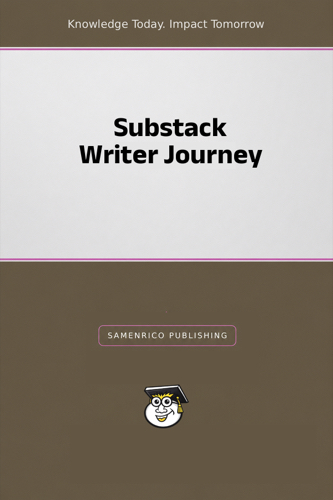
Non-FictionBiography / Substack
Substack Writer Journey eBook
undefined
by Muir Bree
undefined
Formats
Free sample
Chapter 1: The Ownership Shift...--–- On a Tuesday morning in March 2021, a freelance writer named Sarah published a Twitter thread about productivity systems. It was her best work yet—3,000 words of original research, original frameworks, and a decade of hard-won lessons. Within 48 hours, the thread had generated 2.4 million impressions, 18,000 retweets, and 35,000 likes. She gained 2,100 new followers. She felt, for the first time, like she had arrived.Then she checked her bank account.Not a single dollar had been earned.
Not one.She opened her Etsy shop, where she sold digital planners. Zero sales. She checked her consulting inquiry form. Zero messages. She looked at her newsletter signups, hoping at least a fraction of those 2,100 followers had clicked through.
Seventeen people had subscribed. Seventeen.Sarah had just experienced the central lie of the social media age: that attention equals wealth. It does not. Attention, when hosted on someone else's platform, is a rental agreement that can be terminated at any time, for any reason, with no notice and no compensation. She had thrown a party in someone else's backyard, invited 2.4 million strangers, and the landlord kept all the tips.Two weeks later, Sarah started a Substack.
She wrote the same quality of content—actually, slightly worse, because she was learning the platform. Within six months, she had 800 subscribers, 120 of whom paid $8/month. That was $960 in monthly recurring revenue, or $11,520 per year. Not life-changing, but real. And here is what mattered more than the money: she owned those 800 email addresses.
No algorithm could hide her. No platform update could shadow-ban her. No CEO could decide overnight that her niche was "not brand safe."Sarah had discovered the difference between renting and owning.This book is about helping you do the same. But before we dive into tactics, we need to name the enemy. Because you cannot defeat what you cannot see.The Algorithm Is a Slot Machine Let us begin with a simple economic fact: social media platforms are not your partners.
They are not your friends. They are not even your generous hosts. They are casinos, and you are playing a game where the house always wins.Consider how each major platform makes money. Facebook, Instagram, Twitter (now X), Tik Tok, Linked In—every single one of them sells access to attention. You create content for free.
The platform surrounds your content with ads. The platform keeps nearly all of the revenue. In exchange, you receive "exposure" and the fleeting dopamine hit of likes, retweets, and comments.This is not a fair trade. It is a feudal arrangement. You are a sharecropper on digital land you will never own.
And like all feudal systems, the lord can change the rules at any moment.In 2020, Twitter changed its algorithmic feed without warning. Overnight, a writer who had spent three years building 150,000 followers saw her engagement drop by 80%. She had done nothing wrong. Her content had not worsened. The platform simply decided to prioritize tweets with images over tweets without images.
She posted mostly text threads. Her reach evaporated.In 2021, Facebook changed its News Feed algorithm to deprioritize "public content" from pages and prioritize "meaningful social interactions" between friends. Thousands of small publishers who had built millions of followers saw their traffic collapse by 50-90% in a single week. They had no recourse. No appeal.
No severance package.In 2023, Substack itself—ironically, the platform this book champions—could change its policies. The difference is that Substack gives you an exportable email list. Your relationship with your readers lives in their inboxes, not on Substack's servers. If Substack goes away tomorrow, you still have your list. You can move to Ghost, Convert Kit, Beehiiv, or any other platform.
Your business survives.That is the fundamental distinction this chapter wants to sear into your consciousness: rented land vs. owned land.Rented Land (Social Media)Owned Land (Email + Substack)Algorithm decides who sees you You decide who receives your email Platform keeps 100% of ad revenue You keep 90% of subscription revenue Your followers are not your contacts Your email list is your asset One policy change can erase years of work You can export your list anytime You are the product being sold You are the seller The Economics of Ownership Let us make this concrete with numbers.Imagine you are a writer with 50,000 followers on Twitter. You post daily. You are good at it. Your engagement rate is a respectable 2%, meaning each tweet reaches about 1,000 people organically.
A brand offers you $500 to tweet about their product. You accept. You have just earned $500.Now imagine you have a Substack with 5,000 free subscribers and 500 paid subscribers at $8/month. That is $4,000 in monthly recurring revenue, or $48,000 per year. You do not need brands.
You do not need ads. You do not need sponsors. You have a direct relationship with your audience, and they pay you because they value what you create.Which scenario sounds more sustainable to you? The one where you chase brands and algorithm favor, or the one where you wake up on the first of every month and see payments automatically deposited into your account from hundreds of people who genuinely want to hear from you?Here is the truth that the "creator economy" does not want you to know: most social media influencers are poor. They are performing wealth while struggling to pay rent.
A study by the influencer marketing platform Fohr found that 97% of Instagram influencers with over 100,000 followers make less than $100,000 per year from their content. That sounds good until you realize that number includes brand deals, speaking fees, and merchandise—and that most of those influencers live in expensive cities like Los Angeles, New York, and London, where $100,000 is barely middle class.Meanwhile, Substack publishes transparency reports showing that the top 10 newsletters on the platform collectively earn over $50 million per year. But more importantly, the median paid newsletter on Substack earns $2,500 per month. That is $30,000 per year—enough to replace a part-time job or supplement a full-time salary for a writer with a modest but loyal following.The difference is not talent. The difference is the business model.
Social media pays you for rental attention. Substack pays you for owned relationships.The Portfolio of One Another way to understand Substack's power is to look at what it replaces. Before Substack, a writer who wanted to start a paid newsletter needed to assemble a technology stack of at least four separate tools:An email service provider (Mailchimp, Convert Kit, or AWeber) to manage subscribers and send emails.A payment processor (Stripe or Pay Pal) to collect money.A website or landing page builder (Word Press, Squarespace, or Webflow) to host your archive and attract new readers.A commenting system (Disqus or embedded social media) to enable discussion.Each of these tools had its own login, its own learning curve, and its own monthly fee. By the time you paid for all four, you were spending $50-100 per month before you had written a single word. And that was before you dealt with the headaches of integration—making sure your email service provider talked to your payment processor, your payment processor talked to your website, and your website talked to your commenting system.
One broken integration could mean a new subscriber pays but never receives your welcome email. You would never know. They…
This is the end of the free sample. Get the eBook to keep going. Buy now
About this book
Details
- Author
- Muir Bree
- Publisher
- SamEnrico
- Language
- English
- Genre
- Non-Fiction, Biography / Substack
- Released
- 2026-06-06
- Pages (approx.)
- 146
- Available as
- eBook, Audiobook

Read better in the ZLOADR app
Your eBooks on your phone or tablet. Sign in with your SamEnrico account and start reading.
More by Muir Bree
 Ujjayi Victory Breath ControlMuir Bree$11.99
 The Fiji Earthquake EscapeMuir Bree$11.99
 CPR Team DynamicsMuir Bree$11.99
 Price Justification Writing TacticsMuir Bree$11.99
 Gratitude for Single LifeMuir Bree$11.99
 The Church Conversion TrapMuir Bree$11.99
 Blue Light and Nap QualityMuir Bree$11.99
 Blue Zone Sleep PatternsMuir Bree$11.99
 The Last Unknown River: The 1930s Expedition to Discover the Source of the MekongMuir Bree$11.99
 The Fall of Constantinople: The Last Stand of Byzantium (1453)Muir Bree$11.99
 The Echo Chamber: How a Self-Help Guru Built a Cult in Silicon ValleyMuir Bree$11.99
 The Mineral Guide to Mckelveyite-(Y)Muir Bree$11.99
You may also like
 Hong Kong Handover 1997Dunn Johnnie$11.99
 Zumba For Postnatal Recovery CourseNeal Christian$11.99
 Zumba for BeginnersLadner Nikia$11.99
 YouTube Comment Mining GuideHumes Pandora$12.99
 Worry Box MeditationCarlin Rudy$11.99
 Workplace Stress MeditationNguyen Lynn$11.99
 Workplace Stress and Sleep RepairHawley Ivory$11.99
 Workplace Perfectionism CureDelaney Jeffry$11.99
 Workplace Injustice Anger GuideWallen Isabelle$11.99
 Work Addiction and Burnout LinkGreenwood Ester$11.99
 Women in Yoga and WellnessBeattie Galina$11.99
 Women in Stand Up ComedyChun Evangeline$11.99