
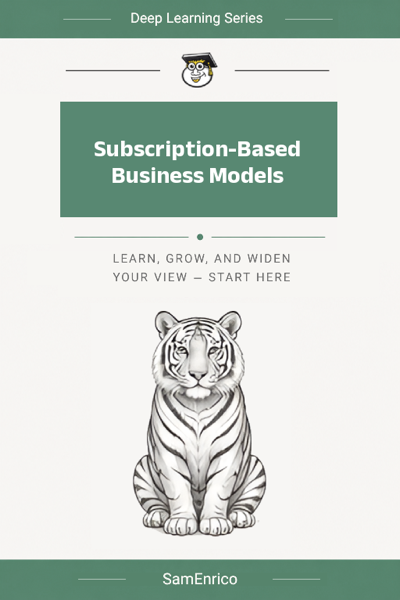
Non-FictionInformativeEducational
Subscription-Based Business Models eBook
A Coursebook on Subscription-Based Business Models
A Coursebook on Subscription-Based Business Models
Formats
Free sample
Chapter 1: The Ownership Delusion--–- In the spring of 2011, a group of Adobe executives gathered in a windowless conference room in San Jose, California. They were about to make a decision that would either save their company or destroy it. For nearly three decades, Adobe had perfected the art of selling software in boxes. Creative Suite, their flagship product, generated over $4 billion in annual revenue. Designers, photographers, and video editors around the world swore by Photoshop, Illustrator, and Premiere Pro.
The business was profitable, growing, and dominant.The proposal on the table was simple and terrifying: stop selling boxes. Stop selling perpetual licenses. Stop allowing customers to own the software they purchased. Instead, force every single customer to pay a monthly fee just to access the tools they had already been using for years. No more ownership.
No more one-time purchases. Only subscription, only recurring payments, only an ongoing relationship.One executive reportedly said, "We will be hanged in the town square." Another warned that customers would defect en masse to cheaper competitors. A third pointed out that their own sales team, compensated on license revenue, would revolt. Every rational business instinct screamed that this was madness.They did it anyway.Three years later, Adobe's revenue had recovered and then surpassed its pre-transition peaks. By 2018, Creative Cloud had over 13 million subscribers, and Adobe's market capitalization had grown from roughly 20billiontoover20 billion to over 20billiontoover130 billion.
The company that analysts said would be destroyed by its own arrogance had instead executed one of the most successful business model transformations in history.What did Adobe understand that their critics missed? They understood something so fundamental, so counterintuitive, and so deeply threatening to traditional business thinking that most executives cannot bring themselves to believe it. Here it is, stated plainly:Customers do not actually want to own your product. They want what ownership provides.A DVD on a shelf provides access to a movie. A car in a driveway provides transportation.
A software license on a computer provides functionality. Ownership is merely a means to an end—and for most products in most categories, it is an increasingly inefficient, expensive, and undesirable means to that end.This is the Ownership Delusion. It is the deeply embedded, mostly unconscious belief that customers prefer to own products rather than access outcomes. It is the assumption that a transaction—one exchange of money for a physical or digital good—is the natural endpoint of commerce. It is the reason that most businesses continue to build products, set prices, and measure success the same way they did fifty years ago.And it is wrong.The subscription economy did not emerge because technology made recurring billing easier, though that helped.
It did not emerge because venture capitalists fell in love with recurring revenue multiples, though that accelerated it. The subscription economy emerged because customers, en masse and across every demographic category, began rejecting the burdens of ownership in favor of the freedom of access.This chapter establishes the macroeconomic, cultural, and strategic foundation for everything that follows in this book. We will explore the three forces driving the irreversible shift from products to subscriptions. We will examine why traditional businesses fail to adapt and what the successful ones do differently. We will introduce the diagnostic frameworks that will help you determine whether—and how—your own business should make the transition.
And we will tell the stories of companies that have already walked this path, from Netflix to Spotify to Peloton to the thousands of smaller businesses you have never heard of.By the end of this chapter, you will understand not just that the subscription economy is replacing product-centric thinking, but why it is doing so with the force of a tectonic shift. And you will begin to see your own business—its products, its customers, its assumptions—in an entirely new light.The Three Engines of the Subscription Revolution To understand where commerce is heading, we must first understand how we arrived at this moment. The shift from ownership to access is not driven by a single cause. It is driven by three powerful, mutually reinforcing forces. Think of them as three engines firing simultaneously, each accelerating the others.
Together, they have created a new economic reality that makes subscription models not just viable but inevitable for an ever-expanding range of products and services.Engine One: Digital Ubiquity The first engine is the simplest to understand but the most profound in its implications. The world is now connected. Pervasively, persistently, and predictably connected.When Netflix began streaming in 2007, broadband penetration in American homes had just crossed fifty percent. Streaming video was a pixelated, buffering frustration. Most consumers did not have the bandwidth to watch a full movie without interruptions.
Netflix's own executives admitted that the streaming quality was, in their words, "barely acceptable."Today, more than ninety percent of Americans have broadband access, and over eighty-five percent own a smartphone. Globally, there are more connected devices than people. The average American household has more than ten connected devices. Five billion people worldwide have access to the internet. The infrastructure of connectivity is no longer a luxury or a novelty.
It is as fundamental as electricity or running water.This matters because subscription models require ongoing interaction. A one-time product sale can happen in a vacuum. You buy a hammer at a hardware store, and that transaction is complete. You may never interact with the hammer manufacturer again. The hammer does not need to check in, authenticate your identity, or download updates.
It just sits in your toolbox until you need it.A subscription is different. A subscription requires an ongoing relationship, and that relationship requires data, communication, and connectivity. Before digital ubiquity, subscription models were largely limited to a few traditional categories: magazines and newspapers delivered by mail, utilities providing electricity or water, clubs requiring in-person attendance. The friction of managing recurring payments, tracking usage, and delivering ongoing value was simply too high for most products.Digital ubiquity eliminated that friction. Now, a fitness company can stream high-definition workouts to millions of subscribers simultaneously.
A software company can push updates continuously, fixing bugs and adding features without any action from the user. A car manufacturer can monitor vehicle performance in real time and offer predictive maintenance as a service. A mattress company can track when customers typically replace their mattresses and send reminders. A pet food company can ship precisely the right amount of food exactly when the customer runs out.The technical barriers that once made subscriptions impractical have disappeared. But ubiquity alone is not enough.
Connectivity tells you that a customer is using your service, but it does not tell you what they value, what frustrates them, or what would make them stay. That requires the second engine.Engine Two: Data Abundance Every subscription interaction generates data. Every click, every view, every pause, every skip, every upgrade, every downgrade, every cancellation. These are not passive transactions. They are active signals.
Each one is a customer voting on what works, what fails, and what they value.In a product-centric business, that feedback is slow, noisy, and indirect. You might know that quarterly sales are down, but…
This is the end of the free sample. Get the eBook to keep going. Buy now
About this book
Details
- Author
- Brownlee Annemarie
- Publisher
- SamEnrico
- Language
- English
- Genre
- Non-Fiction, Informative, Educational
- Released
- 2026-05-06
- Pages (approx.)
- 160
- Available as
- eBook, Audiobook

Read better in the ZLOADR app
Your eBooks on your phone or tablet. Sign in with your SamEnrico account and start reading.
More by Brownlee Annemarie
 Martial Arts Joint Lock SafetyBrownlee Annemarie$11.99
 Assertiveness In StoresBrownlee Annemarie$11.99
 The Toxic Boss Shield GuideBrownlee Annemarie$11.99
 Creative Block HandbookBrownlee Annemarie$11.99
 Immigrant Photography Studio Chain GuideBrownlee Annemarie$11.99
 Mentorship for Startup FoundersBrownlee Annemarie$11.99
 The CrossFit Starter GuideBrownlee Annemarie$11.99
 Rain Driving Stress ReliefBrownlee Annemarie$11.99
 Calming Breath Sensation MeditationBrownlee Annemarie$11.99
 The Oracle of Delphi: Whispers of the DivineBrownlee Annemarie$11.99
 The Midnight Compromise: How a Sleep-Deprived Congress Saved a NationBrownlee Annemarie$11.99
 Pill Poppers & Power Brokers: The Opioid Empire That Bought WashingtonBrownlee Annemarie$11.99
You may also like
 Hong Kong Handover 1997Dunn Johnnie$11.99
 Zumba For Postnatal Recovery CourseNeal Christian$11.99
 Zumba for BeginnersLadner Nikia$11.99
 YouTube Comment Mining GuideHumes Pandora$12.99
 Worry Box MeditationCarlin Rudy$11.99
 Workplace Stress MeditationNguyen Lynn$11.99
 Workplace Stress and Sleep RepairHawley Ivory$11.99
 Workplace Perfectionism CureDelaney Jeffry$11.99
 Workplace Injustice Anger GuideWallen Isabelle$11.99
 Work Addiction and Burnout LinkGreenwood Ester$11.99
 Women in Yoga and WellnessBeattie Galina$11.99
 Women in Stand Up ComedyChun Evangeline$11.99