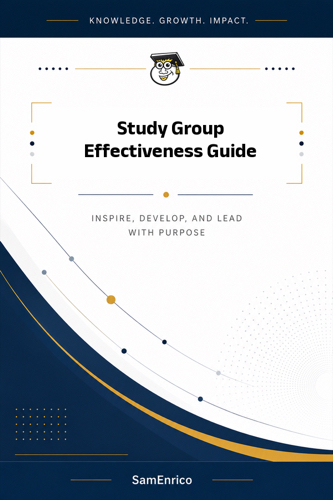
Study Group Effectiveness Guide eBook
Form productive study groups that reduce workload,
by Pence Frank
Form productive study groups that reduce workload, not increase anxiety.
Formats
Free sample
Chapter 1: The Accountability Lie--–- Every study group you have ever been in probably failed. Not because you chose the wrong people, not because the material was too hard, and not because you didn't try hard enough. It failed because you were trying to solve the wrong problem. You thought the goal was to "study together" – to share notes, to explain confusing concepts, to suffer through the textbook as a team. But here is the truth that no professor tells you and no friend admits: studying together, in the traditional sense, does not work.
In fact, for most students, it makes everything worse.This chapter is going to dismantle everything you think you know about study groups. By the time you finish reading it, you will understand why your past groups descended into gossip sessions, why the hour before an exam felt more productive than the three hours you spent "studying" with friends, and why you have probably left every group session feeling more anxious than when you arrived. More importantly, you will learn the single most important reframe of this entire book: the goal is not to study together. The goal is to create parallel accountability.Let me say that again because it is the foundation of everything that follows. The goal is not to study together.
The goal is to create parallel accountability. If you remember nothing else from this book, remember that sentence.The Misery Loves Company Trap Think back to the last time you joined a study group. What triggered it? Almost certainly, it was an exam. Probably a big one.
Probably one you felt underprepared for. You were sitting in the library or your dorm room, staring at a textbook that seemed to be written in a language you had forgotten, and the anxiety started to build. Your heart rate increased. Your thoughts started spiraling. You thought, "I can't do this alone."So you texted a few classmates.
"Hey, want to study for the bio exam together?" Within an hour, you were sitting in a circle with three or four other equally anxious humans, each of you hoping that someone else in the room knew more than you did. And then the session began.What happened next? If you are honest with yourself, it looked something like this. The first ten minutes were spent complaining about the professor. The next fifteen minutes were spent trying to figure out what would actually be on the exam.
Someone pulled up their phone to check the syllabus. Someone else realized they had missed a reading. One person confidently explained a concept – but you later realized they were completely wrong. Another person sat silently, scrolling through Instagram, occasionally looking up to nod. Someone suggested splitting up the chapters.
Everyone agreed because it felt efficient. And then, somehow, two hours had passed, you had covered almost nothing, and you felt worse than when you started.This is not a failure of character. This is not because you are lazy or unfocused. This is a predictable outcome of a flawed model. Let me explain why.The Cognitive Load Problem Your brain has a limited amount of cognitive resources at any given moment.
Psychologists call this cognitive load theory, and it is one of the most well-established findings in educational research. The basic idea is simple: your working memory can only hold about four to seven discrete pieces of information at once. Everything beyond that either gets dropped or gets shunted into long-term memory through repetition and rehearsal.Here is the problem. When you study alone, your cognitive load is devoted entirely to one thing: learning the material. You read a paragraph, you try to understand it, you maybe write a note.
That is it. But when you study in a chaotic, unfocused group, your brain has to do three things simultaneously. First, it has to process the material itself – the actual content you are trying to learn. Second, it has to manage social dynamics – tracking who is speaking, deciding whether to interrupt, worrying about whether your question will sound stupid, monitoring the group's emotional state. Third, it has to filter out distractions – the phone buzzing, the person next to you tapping their pencil, the side conversation about weekend plans.You cannot do all three well.
Something has to give. And what gives is almost always the learning itself. Your brain, trying to protect you from social embarrassment, prioritizes the social dynamics. You spend your cognitive energy on looking competent rather than becoming competent. You nod along even when you don't understand.
You avoid asking the clarifying question because you don't want to slow the group down. You leave the session having spent two hours in the presence of information without actually encoding any of it.This is what I call the Misery Loves Company Trap. You think you are seeking support, but you are actually multiplying your cognitive load. The group does not distribute the work. It distributes the distraction.The Social Anxiety Multiplier There is a second mechanism at work here, and it is even more insidious than cognitive load.
It is social anxiety – the fear of being judged negatively by others.When you study alone, you can be wrong in private. You can misread a sentence, misunderstand a concept, or completely forget something you learned yesterday, and no one will ever know. The only witness is you, and you are generally forgiving of your own mistakes (or at least, you should be). But when you study in a group, every moment of confusion carries a potential social cost. If you admit you don't understand something, you risk looking stupid.
If you ask a question that everyone else already knows the answer to, you risk being judged. If you make a mistake while explaining a concept, you risk losing status.So you stay quiet. You nod along. You let the loudest person in the room set the agenda, even if they are wrong. And here is the cruel irony: the loudest person is often the least knowledgeable.
Research on group dynamics consistently shows that confidence is a terrible predictor of competence. The people who speak the most are not the people who know the most – they are the people who are most comfortable with the risk of being wrong. Extroversion is not expertise. But in a chaotic study group, extroversion sounds like expertise.This creates a feedback loop of anxiety. You feel anxious about not knowing the material.
That anxiety makes you less likely to speak up. Your silence makes you feel even more disconnected from the group. The disconnection increases your anxiety. And on it goes, until you either disengage entirely or you cram alone the night before the exam out of sheer desperation.The Process Loss Equation There is a third reason unfocused groups fail, and it has a name in organizational psychology: process loss. Process loss is the gap between what a group could accomplish if it operated perfectly and what it actually accomplishes given the inevitable friction of coordination.Think of it as a tax on collaboration.
Every time you add a person to a group, you add not just their potential contribution but also the overhead…
This is the end of the free sample. Get the eBook to keep going. Buy now
About this book
Details
- Author
- Pence Frank
- Publisher
- SamEnrico
- Language
- English
- Genre
- Non-Fiction, Self-Help, Collaborative Learning
- Released
- 2026-06-08
- Pages (approx.)
- 138
- Available as
- eBook, Audiobook

Read better in the ZLOADR app
Your eBooks on your phone or tablet. Sign in with your SamEnrico account and start reading.
More by Pence Frank
 Financial Stress Relationship SaverPence Frank$11.99
 Parent Caregiver MeditationPence Frank$11.99
 NFT Market DynamicsPence Frank$11.99
 Meditation for Veteran PTSD AnxietyPence Frank$11.99
 Loving Kindness For Body ImagePence Frank$11.99
 Loci for Language LearnersPence Frank$11.99
 Hybrid Work Talent FlowPence Frank$11.99
 Lake Clark Remote AlaskaPence Frank$11.99
 The Silent Coup: How a Tech Titan Fell to a Boardroom BetrayalPence Frank$11.99
 The O’Jays: Love Train, Still RollingPence Frank$11.99
 The Tongue of Kings: The Multilingual Genius of King Seba of AksumPence Frank$11.99
 Growing DregeaPence Frank$11.99