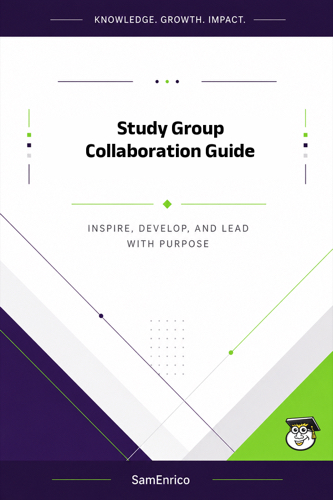
Study Group Collaboration Guide eBook
Work effectively with peers to fill gaps and expla
by Piper Arla
Work effectively with peers to fill gaps and explain concepts to each other.
Formats
Free sample
Chapter 1: The Lonely Genius Myth--–- Maria was a third-year pre-med student who did everything right. She attended every lecture, took color-coded notes, highlighted her textbooks like a professional, and spent an average of 35 hours per week studying alone in the library's silent floor. Before her organic chemistry midterm, she logged 47 hours of solo review over twelve days. She walked into the exam feeling prepared. She walked out in tears.
She scored a 62%. Her classmate, Javier, who had attended the same lectures but spent half as many total hours studying, scored an 89%. Javier studied with two other people for three hours every Thursday night.This is not a story about intelligence. Maria had a 3.7 GPA. This is a story about a hidden flaw in how most people are taught to learn.
And it is a story that plays out millions of times every semester, across every discipline, from first-year composition to doctoral seminars. The flaw has a name, and once you understand it, you will never study the same way again.The Most Expensive Mistake Students Make Let us begin with a simple experiment that you can perform in the next two minutes. Think of a concept you learned in the past month. Not something trivial, but a real idea with some depth: the Krebs cycle, supply and demand shifts, the structure of a sonnet, conditional probability, the causes of World War I. Got one?
Good. Now, without looking at any notes or books, explain that concept aloud to an imaginary friend who knows nothing about it. Go ahead. Do it now.If you are like ninety-four percent of the students who have performed this exercise across dozens of studies, you experienced something uncomfortable. You found gaps.
You realized that you could recognize the concept when you saw it written down, but you could not produce a clear, step-by-step explanation from memory. You might have said things like, "Well, it's kind of like..." or "There's this thing that happens, and then something else happens, but I'm not totally sure about the order." That feeling is not a sign that you are bad at studying. It is a sign that you have been victimized by one of the most powerful and least understood illusions in learning science.The Two Villains of Solo Studying Every time you study alone, two psychological traps are working against you. They are not character flaws. They are features of how human memory operates, and they will fool you every single time unless you build countermeasures into your study routine.Villain One: The Illusion of Competence The first trap is so sneaky because it feels like progress.
When you read a textbook chapter and recognize the information, your brain releases a small reward signal. You think, "I know this." But recognition is not recall. Recognition means you can identify the correct answer when it is placed in front of you, like multiple-choice questions. Recall means you can pull the information out of your memory with no cues at all, which is what essays, short-answer questions, and real-world problem-solving demand.Here is the difference in concrete terms. Imagine you are trying to learn the capital cities of every country.
Recognition would be looking at a list that says "France: A) Berlin B) Madrid C) Paris D) Rome" and picking C. Recall would be staring at a blank piece of paper and writing "Paris" next to France without any options in front of you. The first task is dramatically easier. The second task is what actually demonstrates mastery.The research on this is definitive. In a landmark study published in the Journal of Experimental Psychology, researchers had students study a text passage.
One group read the passage four times. Another group read it once and then practiced recalling as much as they could without looking. One week later, the recall group remembered fifty percent more than the rereading group. But here is the kicker: when asked to predict how well they would perform, the rereading group was overconfident by a factor of two to one. They genuinely believed they had mastered the material because it felt familiar.
That feeling of familiarity is the Illusion of Competence in action.Every time you highlight a sentence, you are not learning it. You are decorating it. Every time you reread a chapter, you are not strengthening memory. You are increasing familiarity while mistaking that comfort for knowledge. The neuroscientist Henry Roediger, one of the world's leading memory researchers, puts it bluntly: "Rereading is one of the least effective study strategies, yet it is the most commonly used." Students fall back on it precisely because it feels easy and produces an immediate sense of progress.
That feeling is a lie.Villain Two: Cognitive Load Overload The second trap is more structural. Your working memory is not an infinite hard drive. It is a tiny whiteboard. Cognitive psychologists estimate that the average person can hold only about four to seven discrete pieces of information in conscious awareness at any given moment. When you are studying a complex topic alone, you are asking that tiny whiteboard to hold definitions, relationships, exceptions, examples, and sequences all at once while also trying to connect them to prior knowledge.
Something will fall off.Consider what happens when you try to understand a multi-step process like how a bill becomes a law or how a neural impulse travels across a synapse. Alone, you are responsible for every piece: the initiating event, each intermediary step, the conditions that can alter the sequence, and the final outcome. Your working memory becomes overloaded, and when working memory overloads, nothing moves into long-term memory. You are spinning your wheels on a wet road.This is why you can read the same paragraph five times and still feel confused. It is not because you are not trying hard enough.
It is because your cognitive architecture has limits, and you have exceeded them without realizing it.The Peer Solution That Changes Everything Now for the good news. These two villains have a common weakness. They both crumble in the face of one specific activity: explaining a concept to another person who does not yet understand it.When you explain something to a peer, several powerful mechanisms activate simultaneously. First, you cannot rely on recognition. You have to recall the information from scratch, organizing it into a coherent sequence.
That act of retrieval, without cues, is exactly what strengthens memory. Every time you successfully retrieve a piece of information, you make it easier to retrieve next time. This is called the testing effect, and it is one of the most replicated findings in cognitive science.Second, explaining forces you to confront your own gaps immediately. You will be moving along, feeling confident, and then you will hit a spot where you say, "And then... um...
something happens... and then the result is..." Your listener will stare at you. In that moment, you cannot hide behind the vague feeling that you "kind of get it." You either can explain the step or you cannot. There is no middle ground. That moment of honest confrontation with a gap is the most valuable learning opportunity you will ever have…
This is the end of the free sample. Get the eBook to keep going. Buy now
About this book
Details
- Author
- Piper Arla
- Publisher
- SamEnrico
- Language
- English
- Genre
- Non-Fiction, Self-Help, Collaborative Learning
- Released
- 2026-06-09
- Pages (approx.)
- 137
- Available as
- eBook, Audiobook

Read better in the ZLOADR app
Your eBooks on your phone or tablet. Sign in with your SamEnrico account and start reading.
More by Piper Arla
 Career Transition Affirmation GuidePiper Arla$11.99
 DoorDash Cash Order HandlingPiper Arla$11.99
 Depression Biopsychosocial ModelPiper Arla$11.99
 Values Driven Success GuidePiper Arla$11.99
 Spitfire Pilot MemoirPiper Arla$11.99
 Citation Rules Reference Management SoftwarePiper Arla$11.99
 Panzer Tactics Against Soviet ArmorPiper Arla$11.99
 Resentment And InjusticePiper Arla$11.99
 The Verdict of the SphinxPiper Arla$11.99
 The Last Flight of the Icebreaker: A Race Against Time in AntarcticaPiper Arla$11.99
 The Healing Hands of Ankh: Egypt's Forgotten Medical PioneersPiper Arla$11.99
 Understanding Aplasia Cutis MyopiaPiper Arla$17.99