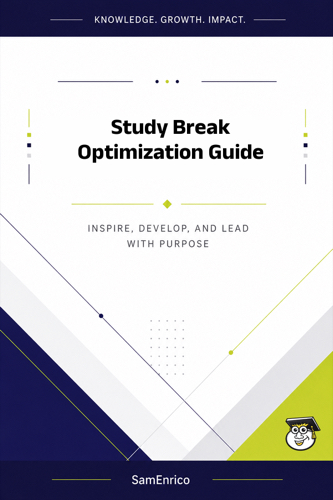
Study Break Optimization Guide eBook
Shows students how to use Pomodoro and other timed
by Campos Hyon
Shows students how to use Pomodoro and other timed rest methods effectively.
Formats
Free sample
Chapter 1: The Grind Illusion--Every student has lived this moment.It is three days before your final exam. You have been sitting at the same desk for four hours. Your back aches. Your eyes burn. You have read the same paragraph about the Krebs cycle—or the Federalist Papers, or the derivative of tangent—seven times, and you still could not repeat a single word of it.
Your phone is face-down, but you feel its gravitational pull. You are exhausted, but you cannot stop because stopping feels like losing. So you push. You grind. You tell yourself that suffering equals productivity.The next morning, you remember almost nothing.
You feel ashamed. You tell yourself you just need to study harder next time.This is the Grind Illusion. And it is the most expensive lie in education.The Lie You Have Been Sold The Grind Illusion is the cultural belief that longer study sessions produce better results. It is the voice that says: If you are not tired, you are not working hard enough. It is the reason students pull all-nighters, skip meals, and glue themselves to chairs for six hours straight.
It is reinforced by parents who brag about their child studying "all weekend," by professors who assign impossible reading loads, and by social media influencers who post 4 AM study vlogs with captions like "no days off."Here is the truth that those influencers do not show you: the last two hours of that six-hour study session produced almost zero net learning. In fact, they may have made you worse at remembering the material.This is not opinion. This is not a productivity hack from a lifestyle blogger. This is peer-reviewed cognitive science.The Three Scientific Pillars of the Grind Illusion Why does grinding fail? Three separate lines of research explain why studying until you are tired is not just inefficient—it is counterproductive.Pillar 1: Attention Restoration Theory Your brain has two attention systems.
The first is involuntary attention—the kind that snaps your head toward a loud noise or a flashing light. It requires no effort. It is automatic. The second is directed attention—the kind you use to read a textbook, solve a calculus problem, or memorize vocabulary. Directed attention requires effort.
It is a limited resource. And it depletes with use.Think of directed attention like a battery. When you wake up after a good night's sleep, that battery is at 100%. Every minute of focused studying drains it a little. After 20 minutes, you are at 90%.
After 40 minutes, 75%. After 90 minutes, you are below 50%. Crucially, you may not feel this drain. Your brain compensates by working harder, like a car burning extra fuel when the tank is low. But the work becomes slower, more error-prone, and more exhausting.By the time you feel tired—by the time you notice your eyes glazing over or your mind wandering—you have already been studying at significantly reduced capacity for 30 minutes or more.
Fatigue is a lagging indicator. It is not a signal to start resting. It is a signal that you should have rested long ago.Attention Restoration Theory (ART), developed by environmental psychologist Dr. Rachel Kaplan and her colleagues at the University of Michigan, demonstrates that directed attention can be restored. The most effective restoration comes from what Kaplan calls "soft fascination"—activities that engage your attention gently, without demanding focused effort.
Walking in nature. Sitting quietly with your eyes closed. Listening to ambient sounds. Looking at a horizon. These activities allow the directed attention battery to recharge.What does not restore directed attention?
Anything that requires focused cognitive processing. Scrolling social media. Reading the news. Watching a video with dialogue. Texting a friend.
Playing a game. These activities keep the prefrontal cortex engaged. You are not resting your attention battery—you are simply switching from one demanding task (studying) to another demanding task (processing variable rewards).Pillar 2: The Forgetting Curve In the 1880s, German psychologist Hermann Ebbinghaus conducted a series of experiments on his own memory. He memorized lists of nonsense syllables (like "DAX," "BOK," "ZIF") and tested himself at varying intervals. His results, now known as the Ebbinghaus Forgetting Curve, were startling: without reinforcement, humans forget 50% of new information within one hour and 80% within 24 hours.But here is the counterintuitive finding that most students miss: strategic breaks interrupt the forgetting curve.
When you study a topic, then take a break that involves not thinking about that topic, your brain uses the break time to consolidate memories. During quiet wakefulness—walking, showering, sitting with closed eyes—the brain replays recent experiences and strengthens the neural pathways associated with them. This process, called consolidation, is essential for moving information from short-term to long-term memory.Students who take breaks are not "wasting time." They are giving their brains the opportunity to hardwire new information. Students who grind for hours without breaks are actively preventing consolidation from occurring.Pillar 3: The Ultradian Rhythm You have heard of circadian rhythms—the 24-hour cycles that regulate sleep and wakefulness. But humans also operate on ultradian rhythms, cycles shorter than 24 hours.
The most important ultradian rhythm for studying is the 90-120 minute cycle of high focus followed by 20-30 minutes of lower alertness. This is sometimes called the "basic rest-activity cycle."Throughout the day, your brain naturally moves through peaks and troughs. During a peak, you can focus deeply, think clearly, and retain information efficiently. During a trough, your attention fragments, your processing speed slows, and your error rate increases. Fighting the trough—forcing yourself to study during a natural low—produces diminishing returns.
Working with the trough—taking a break, moving your body, or switching to a low-focus task—allows you to conserve energy for the next peak.The Grind Illusion tells you to power through troughs. Science tells you to rest through them.The Price of Grinding If grinding is inefficient, why does it feel so productive? Why do students continue to do it, generation after generation?The answer lies in a cognitive bias called the labor illusion: humans tend to believe that more effort produces better outcomes, even when evidence suggests otherwise. If you sit at a desk for four hours, you feel like you worked hard. If you study for two hours with strategic breaks, you feel like you worked less.
The labor illusion confuses effort with effectiveness.But the costs of grinding are real and measurable.Cost 1: Diminishing Returns. Research on cognitive fatigue shows that performance declines steadily after 40-60 minutes of continuous focused work. By the third hour, your effective learning rate is below 30% of your peak rate. You are spending three hours to achieve what you could achieve in one hour with proper breaks.Cost 2: Error Multiplication. Fatigued brains make more errors—and then compound those errors by failing to catch them.
In subjects like math, chemistry, or foreign language, grinding through fatigue means practicing mistakes. You are literally training yourself to be wrong.Cost 3: Motivation Erosion. Every grinding session reinforces the belief that studying is painful. Your brain associates the activity with exhaustion, frustration, and failure. Over time, this creates avoidance behavior.
You procrastinate not because you are lazy, but because your brain has learned that studying hurts. Strategic breaks reverse this…
This is the end of the free sample. Get the eBook to keep going. Buy now
About this book
Details
- Author
- Campos Hyon
- Publisher
- SamEnrico
- Language
- English
- Genre
- Non-Fiction, Self-Help, Study Techniques
- Released
- 2026-06-06
- Pages (approx.)
- 133
- Available as
- eBook, Audiobook

Read better in the ZLOADR app
Your eBooks on your phone or tablet. Sign in with your SamEnrico account and start reading.
More by Campos Hyon
 The Cargo Ship KidnappingCampos Hyon$11.99
 Five Minute Anxiety Relief MeditationCampos Hyon$11.99
 Deposit Requirement IncreaseCampos Hyon$11.99
 Facial Expression Anger GuideCampos Hyon$11.99
 Esports Addiction in YouthCampos Hyon$11.99
 Cognitive Behavioral Therapy WorkbookCampos Hyon$11.99
 Spain GR11 Pyrenees TraverseCampos Hyon$11.99
 The Swiss Volcano Hunters: Taming Fire and IceCampos Hyon$11.99
 The Minstrels of the Holy Roman Court: Music in the Age of EmperorsCampos Hyon$11.99
 How to Become a Syrup MixerCampos Hyon$11.99
 Growing CymbopogonCampos Hyon$11.99
 Middle East Sales Loyalty BuildersCampos Hyon$12.99