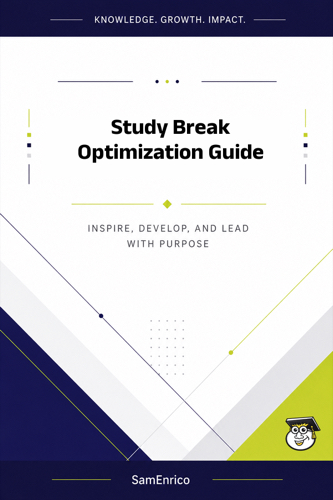
Study Break Optimization Guide Audiobook
Shows students how to use Pomodoro and other timed
by Campos Hyon
Shows students how to use Pomodoro and other timed rest methods effectively.
Formats
Free sample
Chapter 1: The Grind Illusion--Every student has lived this moment.It is three days before your final exam. You have been sitting at the same desk for four hours. Your back aches. Your eyes burn. You have read the same paragraph about the Krebs cycle—or the Federalist Papers, or the derivative of tangent—seven times, and you still could not repeat a single word of it.
Your phone is face-down, but you feel its gravitational pull. You are exhausted, but you cannot stop because stopping feels like losing. So you push. You grind. You tell yourself that suffering equals productivity.The next morning, you remember almost nothing.
You feel ashamed. You tell yourself you just need to study harder next time.This is the Grind Illusion. And it is the most expensive lie in education.The Lie You Have Been Sold The Grind Illusion is the cultural belief that longer study sessions produce better results. It is the voice that says: If you are not tired, you are not working hard enough. It is the reason students pull all-nighters, skip meals, and glue themselves to chairs for six hours straight.
It is reinforced by parents who brag about their child studying "all weekend," by professors who assign impossible reading loads, and by social media influencers who post 4 AM study vlogs with captions like "no days off."Here is the truth that those influencers do not show you: the last two hours of that six-hour study session produced almost zero net learning. In fact, they may have made you worse at remembering the material.This is not opinion. This is not a productivity hack from a lifestyle blogger. This is peer-reviewed cognitive science.The Three Scientific Pillars of the Grind Illusion Why does grinding fail? Three separate lines of research explain why studying until you are tired is not just inefficient—it is counterproductive.Pillar 1: Attention Restoration Theory Your brain has two attention systems.
The first is involuntary attention—the kind that snaps your head toward a loud noise or a flashing light. It requires no effort. It is automatic. The second is directed attention—the kind you use to read a textbook, solve a calculus problem, or memorize vocabulary. Directed attention requires effort.
It is a limited resource. And it depletes with use.Think of directed attention like a battery. When you wake up after a good night's sleep, that battery…
This is the end of the free sample. Get the Audiobook to keep going. Buy now
About this book
Details
- Author
- Campos Hyon
- Publisher
- SamEnrico
- Language
- English
- Genre
- Non-Fiction, Self-Help, Study Techniques
- Released
- 2026-06-06
- Pages (approx.)
- 133
- Available as
- eBook, Audiobook

Listen in the VoxFlicks app
Audiobooks and audio dramas wherever you go. Sign in with your SamEnrico account and press play.
More by Campos Hyon
 The Cargo Ship KidnappingCampos Hyon$11.99
 Five Minute Anxiety Relief MeditationCampos Hyon$11.99
 Deposit Requirement IncreaseCampos Hyon$11.99
 Facial Expression Anger GuideCampos Hyon$11.99
 Esports Addiction in YouthCampos Hyon$11.99
 Cognitive Behavioral Therapy WorkbookCampos Hyon$11.99
 Spain GR11 Pyrenees TraverseCampos Hyon$11.99
 The Swiss Volcano Hunters: Taming Fire and IceCampos Hyon$11.99
 The Minstrels of the Holy Roman Court: Music in the Age of EmperorsCampos Hyon$11.99
 How to Become a Syrup MixerCampos Hyon$11.99
 Growing CymbopogonCampos Hyon$11.99
 Middle East Sales Loyalty BuildersCampos Hyon$12.99