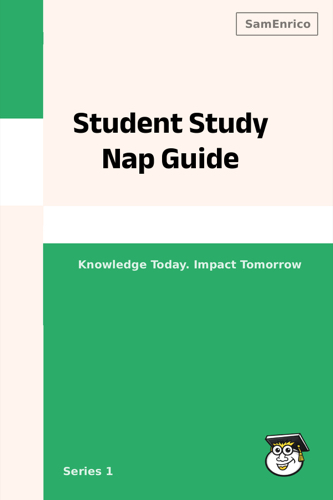
Student Study Nap Guide eBook
Boosts memory consolidation between study sessions
by Barry Laure
Boosts memory consolidation between study sessions.
Formats
Free sample
Chapter 1: The Cramming Trap--Every student has been there. It’s 11:47 PM. The exam is at 8:00 AM. You have 237 unread flashcards, three chapters you skimmed once, and a growing sense of dread that caffeine will no longer fix. So you do what generations of students have done: you pour another coffee, put on your headphones, and tell yourself that this time, somehow, sheer hours will equal good grades.They won’t.
And the science is brutally clear about why.For decades, the education system has operated on a flawed assumption: that learning is simply the accumulation of study hours. More time with your eyes on a page, more repetitions, more late nights—these must produce better results, right? Wrong. This chapter will introduce you to a counterintuitive truth that separates top-performing students from the chronically exhausted: studying is only half of learning. The other half happens when you stop.Welcome to the offline processor.The Myth of the Marathon Studier Let’s start with a simple experiment you can run on yourself.
Take twenty unfamiliar vocabulary words. Study them intensely for one hour. Immediately after, test yourself. You will likely recall 60-80% of them. Now, wait four hours without reviewing.
Test yourself again. Your recall will likely drop to 30-50%. By the next morning, without sleep, you might remember 20%.This isn’t a failure of effort. It’s a failure of understanding how memory works.Your brain is not a hard drive that instantly saves everything you input. It is a dynamic, filtering system designed to prioritize survival-relevant information over arbitrary facts.
When you study, the information first lands in a temporary holding area called the hippocampus—a small, seahorse-shaped structure buried deep in your temporal lobe. Think of the hippocampus as a very small, very expensive whiteboard. It can hold a decent amount of information, but it has two critical limitations.First, the hippocampus has limited capacity. Once it fills up, new information starts overwriting old information. This is why studying for six hours straight often leaves you remembering only the last hour.
You’ve been writing over your own work.Second, and more importantly, the hippocampus is not designed for long-term storage. Its job is to hold information just long enough for your brain to decide whether to send it to permanent storage—or erase it. Permanent storage happens in the neocortex, the wrinkled outer layer of your brain where long-term memories, skills, and knowledge reside. Transferring information from the hippocampus to the neocortex requires a specific biological process. That process does not happen while you are awake.It happens while you are asleep.The Neuroplasticity Window: When Your Brain Rewires Itself Here is where most students, textbooks, and even some teachers get it wrong.
They treat sleep as a passive state—a shutdown, a pause, a necessary evil. In reality, sleep is an active, highly orchestrated period of neural maintenance and optimization. During sleep, your brain does not rest. It works.Neuroplasticity—the brain’s ability to reorganize itself by forming new neural connections—operates on a cycle. During wakefulness, your brain is in “encoding mode.” It absorbs information, but the connections are fragile.
Think of them as temporary dirt paths. During sleep, your brain switches to “consolidation mode.” It replays the day’s experiences, strengthens some connections, prunes away others, and integrates new information with existing knowledge. This is the Neuroplasticity Window—a critical period lasting several hours during which your brain literally rewires itself based on what you learned while awake.Here is the key insight that will transform how you study: If you learn something and then deprive yourself of sleep, you are effectively closing the file without saving it. The information may linger in your hippocampus for a few hours—long enough to pass a quiz if you take it immediately—but it will not transfer to long-term storage. It will vanish, often by the next morning, as if you never studied at all.This explains a common student experience: cramming all night, passing the exam, and then two weeks later remembering almost nothing.
You didn’t fail to learn. You failed to consolidate. You saved nothing.The Dual-Processor Model of Learning To make this concrete, let’s introduce the Dual-Processor Model of Learning. Your brain operates in two distinct modes, and you cannot be in both at the same time.Mode 1: Active Encoding (Study Mode)While awake and focused, your brain encodes new information into the hippocampus. This mode requires attention, effort, and energy.
It is metabolically expensive. You can sustain it for about 45-90 minutes before mental fatigue sets in. This is the mode most students spend 90% of their time in—often inefficiently, because they don’t understand the second mode.Mode 2: Offline Consolidation (Sleep & Rest Mode)While asleep—and to a lesser extent during quiet wakefulness—your brain replays, strengthens, and transfers information from hippocampus to neocortex. This mode requires no conscious effort. In fact, conscious effort interrupts it.
You cannot consolidate and actively think at the same time. This is why scrolling social media during a break is so damaging: it keeps your brain in active mode, preventing the replay process.Here is the equation that replaces every study myth you’ve been told:Learning = Study + Sleep Not study alone. Not sleep alone. Study followed by sleep. The order matters.
If you sleep before studying, you’re just rested. If you study before sleeping, you consolidate. This single distinction separates effective learners from frustrated crammers.The Forgetting Curve and Why Napping Interrupts It In the late 19th century, German psychologist Hermann Ebbinghaus discovered what became known as the Forgetting Curve. He found that without reinforcement or sleep, humans forget approximately 50% of new information within one hour, 70% within 24 hours, and 80-90% within one week. The curve is steep and unforgiving.But here is what Ebbinghaus didn’t know—and what sleep science has since revealed: sleep dramatically flattens the Forgetting Curve.
When you sleep within a few hours of learning, your retention can jump from 20-30% to 70-80% or higher. A nap as short as 20 minutes can stabilize memory enough to flatten the curve for that specific information.This is the core promise of this book. You do not need to study more. You need to study smarter by strategically placing sleep and rest between study sessions. A 20-minute nap after a 45-minute study block can double your retention compared to studying for 90 minutes straight.
A 60-minute nap can triple it. A 90-minute full-cycle nap can unlock creative connections you would never make while awake.But before you start napping, you need to understand your own biology. Not every nap time works for every student. That’s where your chronotype comes in.Find Your Chronotype: Lark, Owl, or Hummingbird?Humans are not all built on the same internal clock. Your circadian rhythm—the roughly 24-hour cycle that governs when you feel alert and when you feel sleepy—varies significantly from person to person.
Ignoring your chronotype is like wearing someone else’s prescription glasses. You might see something, but it will be blurry and exhausting.Take the following quiz to determine your chronotype. Answer honestly based on how you feel without caffeine or…
This is the end of the free sample. Get the eBook to keep going. Buy now
About this book
Details
- Author
- Barry Laure
- Publisher
- SamEnrico
- Language
- English
- Genre
- Non-Fiction, Health & Wellness, Learning
- Released
- 2026-06-10
- Pages (approx.)
- 139
- Available as
- eBook, Audiobook

Read better in the ZLOADR app
Your eBooks on your phone or tablet. Sign in with your SamEnrico account and start reading.
More by Barry Laure
 Micronutrients For Eye Health GuideBarry Laure$11.99
 MBSR for Digital DetoxBarry Laure$11.99
 Deserving Success WorkbookBarry Laure$11.99
 Emergency Repair ProtocolBarry Laure$11.99
 Caregiver Therapy OptionsBarry Laure$11.99
 Up Round RatchetsBarry Laure$11.99
 The Merger and Banker StressBarry Laure$11.99
 Roast Battle CasualtyBarry Laure$11.99
 The Quantum Leap: How a Soviet Satellite Sparked the Cold War’s Digital Arms RaceBarry Laure$11.99
 Xochiquetzal's Song: The Flower Goddess Who Defied the GodsBarry Laure$11.99
 The Andes Accelerator: The Perilous Quest for Cosmic RaysBarry Laure$11.99
 Growing YuugaoBarry Laure$11.99