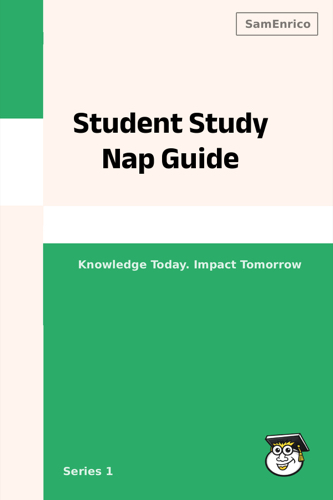
Student Study Nap Guide Audiobook
Boosts memory consolidation between study sessions
by Barry Laure
Boosts memory consolidation between study sessions.
Formats
Free sample
Chapter 1: The Cramming Trap--Every student has been there. It’s 11:47 PM. The exam is at 8:00 AM. You have 237 unread flashcards, three chapters you skimmed once, and a growing sense of dread that caffeine will no longer fix. So you do what generations of students have done: you pour another coffee, put on your headphones, and tell yourself that this time, somehow, sheer hours will equal good grades.They won’t.
And the science is brutally clear about why.For decades, the education system has operated on a flawed assumption: that learning is simply the accumulation of study hours. More time with your eyes on a page, more repetitions, more late nights—these must produce better results, right? Wrong. This chapter will introduce you to a counterintuitive truth that separates top-performing students from the chronically exhausted: studying is only half of learning. The other half happens when you stop.Welcome to the offline processor.The Myth of the Marathon Studier Let’s start with a simple experiment you can run on yourself.
Take twenty unfamiliar vocabulary words. Study them intensely for one hour. Immediately after, test yourself. You will likely recall 60-80% of them. Now, wait four hours without reviewing.
Test yourself again. Your recall will likely drop to 30-50%. By the next morning, without sleep, you might remember 20%.This isn’t a failure of effort. It’s a failure of understanding how memory works.Your brain is not a hard drive that instantly saves everything you input. It is a dynamic, filtering system designed to prioritize survival-relevant information over arbitrary facts.
When you study, the information first lands in a temporary holding area called the hippocampus—a small, seahorse-shaped structure buried deep in your temporal lobe. Think of the hippocampus as a very small, very expensive whiteboard. It can hold a decent amount of information, but it has two critical limitations.First, the hippocampus has limited capacity. Once it fills up, new information starts overwriting old information. This is why studying for six hours straight often leaves you remembering only the last hour.
You’ve been writing over your own work.Second, and more importantly, the hippocampus is not designed for long-term storage. Its job is to hold information just long enough for your brain to decide whether to send it to permanent storage—or erase it. Permanent storage happens in the neocortex, the wrinkled outer layer of your brain where long-term memories…
This is the end of the free sample. Get the Audiobook to keep going. Buy now
About this book
Details
- Author
- Barry Laure
- Publisher
- SamEnrico
- Language
- English
- Genre
- Non-Fiction, Health & Wellness, Learning
- Released
- 2026-06-10
- Pages (approx.)
- 139
- Available as
- eBook, Audiobook

Listen in the VoxFlicks app
Audiobooks and audio dramas wherever you go. Sign in with your SamEnrico account and press play.
More by Barry Laure
 Micronutrients For Eye Health GuideBarry Laure$11.99
 MBSR for Digital DetoxBarry Laure$11.99
 Deserving Success WorkbookBarry Laure$11.99
 Emergency Repair ProtocolBarry Laure$11.99
 Caregiver Therapy OptionsBarry Laure$11.99
 Up Round RatchetsBarry Laure$11.99
 The Merger and Banker StressBarry Laure$11.99
 Roast Battle CasualtyBarry Laure$11.99
 The Quantum Leap: How a Soviet Satellite Sparked the Cold War’s Digital Arms RaceBarry Laure$11.99
 Xochiquetzal's Song: The Flower Goddess Who Defied the GodsBarry Laure$11.99
 The Andes Accelerator: The Perilous Quest for Cosmic RaysBarry Laure$11.99
 Growing YuugaoBarry Laure$11.99