
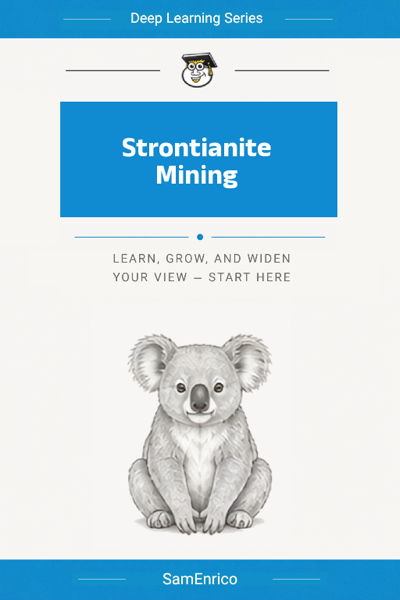
Non-FictionInformativeEducational
Strontianite Mining
A Coursebook on Strontianite Mining
A Coursebook on Strontianite Mining
Formats
About this book
Free sample
Chapter 1: The Scottish Spark...--–- On a damp October morning in 1790, a mineralogist named Thomas Charles Hope stood ankle-deep in mud outside the abandoned lead mines of Strontian, a remote village in the Scottish Highlands. He was not looking for lead. He was not looking for silver, copper, or any of the usual metals that had drawn men to these hills for centuries. He was looking for a ghost – a mineral that had been misidentified, miscataloged, and dismissed as worthless for over a decade. What he found would eventually color every red firework burst on every Independence Day, enable the tiny ceramic magnets in your laptop speaker, and, more than two centuries later, become a quiet but critical battleground in the global competition for electric vehicle supply chains.
He found strontianite.The story of strontium begins not with a bang, but with a misprint. In 1787, two German chemists, Friedrich Gabriel Sulzer and Johann Friedrich Blumenbach, analyzed a pale green mineral from a lead mine in the Scottish village of Strontian. They concluded it was a variety of witherite – a barium carbonate mineral already known to science. They published their findings, filed their samples, and moved on. No one paid much attention.
The mineral was rare, found only in a handful of locations, and had no obvious commercial use. For three years, it sat in museum drawers, mislabeled and forgotten.But Thomas Charles Hope, then a young professor of chemistry at the University of Edinburgh, had a skeptical mind and a patient hand. He obtained samples of the mysterious Strontian mineral and subjected them to a series of flame tests – a crude but effective technique where a powdered mineral is heated on a platinum wire in a colorless flame. Barium burns yellow-green. Calcium burns orange-red.
But the Strontian mineral burned a brilliant, unmistakable crimson. Hope repeated the test. He dissolved the mineral in acids, precipitated it with various reagents, and compared the results against known barium and calcium compounds. The reaction patterns did not match. In a series of elegant experiments that would become a model of analytical chemistry, Hope…
This is the end of the free sample. Get the eBook to keep going. Buy now
Contents
- Chapter 1
- Chapter 2
- Chapter 3
- Chapter 4
- Chapter 5
- Chapter 6
- Chapter 7
- Chapter 8
- Chapter 9
- Chapter 10
- Chapter 11
- Chapter 12
Details
- Author
- Royster Rosaline
- Publisher
- SamEnrico
- Language
- English
- Genre
- Non-Fiction, Informative, Educational
- Released
- 2026-05-09
- Pages (approx.)
- 155
- Available as
- eBook, Audiobook

Read better in the ZLOADR app
Your eBooks on your phone or tablet. Sign in with your SamEnrico account and start reading.
More by Royster Rosaline
 Fear of Exposure TreatmentRoyster Rosaline$11.99
 The Self Talk for ExerciseRoyster Rosaline$11.99
 Active Listening Assessment GuideRoyster Rosaline$11.99
 TM for Psychic SensitivityRoyster Rosaline$11.99
 The Envy of Success WorkbookRoyster Rosaline$11.99
 The Timbuktu Scholars: Guardians of the Mathematical CosmosRoyster Rosaline$11.99
 Factoring for Large Corporate SuppliersRoyster Rosaline$12.99
 Asana Free Replaces Monday GuideRoyster Rosaline$12.99
 Understanding Toriello SyndromeRoyster Rosaline$17.99
 How to Start a Canal Carrier (passenger) Business (Beginners Guide)Royster Rosaline$11.99
You may also like
 Hong Kong Handover 1997Dunn Johnnie$11.99
 Zumba For Postnatal Recovery CourseNeal Christian$11.99
 Zumba for BeginnersLadner Nikia$11.99
 YouTube Comment Mining GuideHumes Pandora$12.99
 Worry Box MeditationCarlin Rudy$11.99
 Workplace Stress MeditationNguyen Lynn$11.99
 Workplace Stress and Sleep RepairHawley Ivory$11.99
 Workplace Perfectionism CureDelaney Jeffry$11.99
 Workplace Injustice Anger GuideWallen Isabelle$11.99
 Work Addiction and Burnout LinkGreenwood Ester$11.99
 Women in Yoga and WellnessBeattie Galina$11.99
 Women in Stand Up ComedyChun Evangeline$11.99