
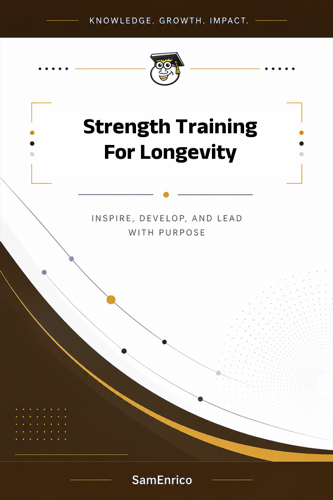
Strength Training For Longevity eBook
Lift for life to maintain function and independenc
Lift for life to maintain function and independence into old age.
Formats
Free sample
Chapter 1: The Chair Test--–- My father couldn't stand up. Let me say that again. My 82-year-old father, a man who had walked miles every day of his retirement, who had never been hospitalized, who took no prescription medications – could not stand up from a standard dining room chair without using both arms to push off.I watched him do it on a Tuesday afternoon in his suburban Chicago living room. I had asked him, as part of a casual experiment, to fold his arms across his chest, keep his feet flat on the floor, and stand up from the chair. No hands.
Just legs.He rocked forward once. Then twice. His face reddened. His jaw tightened. On the third attempt, he made it halfway up, paused, and collapsed back down with a grunt.
He looked at me not with frustration, but with acceptance. "I'm just old," he said.I am a strength researcher. I have spent two decades studying what happens to the human body when it stops being loaded, when it stops being challenged, when it stops being asked to do hard things. I knew the literature. I knew the statistics.
And in that moment, sitting in my father's living room, I realized I had been intellectualizing a crisis that was happening inside my own family.My father was not "just old." He was deconditioned. He was sarcopenic. He was, in the most literal sense, losing the ability to live independently – not because of disease, not because of genetics, not because of bad luck, but because he had stopped loading his skeleton. And he had stopped loading his skeleton because no one had ever told him that loading his skeleton was the single most important thing he could do for his longevity.This book exists because of that Tuesday afternoon. It exists because I went home, reviewed the data again, and realized that my father's story is not an exception.
It is the rule. And it is a rule that can be rewritten.The Lifespan Lie We have been sold a story about aging that is comforting, passive, and almost entirely wrong. The story goes like this: you are born, you live, you gradually decline, and somewhere around age 65 or 70, you accept that your body will shrink, your strength will fade, your balance will wobble, and eventually, you will need help with the basic tasks of daily living – getting out of a chair, climbing a flight of stairs, carrying a bag of groceries, picking up a grandchild. This decline, the story tells us, is inevitable. It is written into our DNA.
It is the price of getting older.This story is a lie.Not a small lie, not a white lie, not a harmless simplification. A destructive, life-shortening, independence-stealing lie that has convinced millions of older adults to accept frailty as fate and surrender their physical agency years or decades before they need to.Here is the truth that the fitness industry, the medical establishment, and the culture of aging have failed to communicate: the vast majority of what we call "aging" is actually deconditioning. The loss of muscle mass, the loss of bone density, the loss of balance, the loss of metabolic health – these are not primarily driven by the passage of time. They are driven by the cessation of load.Let me give you the headline data point. In 2014, a team of researchers at the University of Pittsburgh published a landmark study following nearly 3,000 older adults for an average of 15 years.
They measured grip strength at the beginning of the study – a simple, five-second test of how hard you can squeeze a handheld device. Then they waited. Fifteen years later, the results were staggering. For every five-kilogram decrease in grip strength at the start of the study, the risk of death from any cause increased by 16 percent. That is not a typo.
Grip strength – the force you generate when you close your hand – predicted mortality more accurately than blood pressure, more accurately than cholesterol, more accurately than body mass index, more accurately than any other standard clinical marker.Think about what that means. If you walk into a doctor's office today, they will check your blood pressure. They will check your cholesterol. They might check your blood sugar. They will almost certainly not check your grip strength.
And yet the data is clear: your grip strength is a better predictor of how long you will live than any of those numbers.Why? Because grip strength is not just about your hand. Grip strength is a proxy for total muscle mass. It is a proxy for neuromuscular function. It is a proxy for your body's ability to generate force, to recover from illness, to resist falls, to maintain independence.
When your grip weakens, it is a signal that your entire system is weakening. And that weakening is not inevitable.The Healthspan Horizon To understand why this matters, we need to distinguish between two concepts that most people treat as identical but are actually profoundly different: lifespan and healthspan.Lifespan is simple. It is the total number of years you live. Lifespan is what gets recorded on your death certificate. Lifespan is what we talk about when we say "people are living longer than ever." And it is true – average lifespan has increased dramatically over the last century, from about 47 years in 1900 to nearly 79 years today.But lifespan tells us nothing about the quality of those years.
A person who spends their last decade in a nursing home, unable to dress themselves, unable to use the bathroom alone, unable to stand up from a chair without assistance – that person has a long lifespan but a short healthspan.Healthspan is the number of years you live in good health, free from disability and chronic disease. Healthspan is what we actually care about. No one lies on their deathbed and says, "I'm so glad I survived for ten extra years inside a nursing home." What we want – what every human being wants – is to live well and die quickly. We want to compress morbidity into the final months or years of life, not expand it across decades.Here is the problem. Lifespan has increased.
Healthspan has not kept pace. The average American now spends the last 10 to 15 years of life in a state of declining function, chronic disease, and increasing dependency. That means if you live to 85, you can expect to spend roughly one-sixth of your entire existence in a state of physical decline. One-sixth. Think about that in terms of your relationships, your hobbies, your ability to travel, your ability to play with grandchildren.
That is a massive chunk of life spent not living.But here is the hopeful news – and I want you to hold onto this, because the rest of this book will give you the tools to act on it. The gap between lifespan and healthspan is not fixed. It is not genetic. It is not fate. It is largely determined by one modifiable factor: your muscle mass.The Muscle Currency Muscle is the currency of longevity.
I want you to remember that phrase. Write it down. Put it on your refrigerator. Say it to yourself every…
This is the end of the free sample. Get the eBook to keep going. Buy now
About this book
Details
- Author
- Tejada Catrice
- Publisher
- SamEnrico
- Language
- English
- Genre
- Non-Fiction, Health & Wellness, Longevity
- Released
- 2026-06-08
- Pages (approx.)
- 130
- Available as
- eBook, Audiobook

Read better in the ZLOADR app
Your eBooks on your phone or tablet. Sign in with your SamEnrico account and start reading.
More by Tejada Catrice
 Procrastination Script GuideTejada Catrice$11.99
 Micronutrients For Wound Healing GuideTejada Catrice$11.99
 Mood Regulation NappingTejada Catrice$11.99
 Crossover Round TermsTejada Catrice$11.99
 The One Liner KingTejada Catrice$11.99
 Rental Market Analysis GuideTejada Catrice$11.99
 Caregiver Medication ManagementTejada Catrice$11.99
 The Air Force Pilot Stress PlanTejada Catrice$11.99
 The Raven’s Oath: A Lone Warrior’s Quest in the Land of the ThunderbirdsTejada Catrice$11.99
 The House That Rockefeller Built: How a Rivalry Reshaped FinanceTejada Catrice$11.99
 The Cosmic Visionaries of the Dogon: Decoding the Stars of MaliTejada Catrice$11.99
 Prompting for Market Sentiment AnalysisTejada Catrice$11.99
You may also like
 Mediterranean Longevity GuideJuarez Barney$11.99
 Blue Zones Longevity Secrets GuideBain Fredericka$11.99
 CRON Diet GuideGrey Christa$11.99
 The Blue Zones Longevity GuideTobin Martin$11.99
 Longevity Risk ManagementHarrison Henry$11.99
 HIIT For Longevity GuideLachance Carita$11.99
 Fasting for LongevityCornelius Zana$11.99
 Microbiome Longevity GuideHemphill Shaniqua$11.99
 Blue Zones Longevity SecretsRamos Christopher$11.99
 Testosterone and TelomeresBelcher Larita$11.99
 TCM Kidney Jing EssenceJett Gaynell$11.99
 Boosting HGH NaturallyFoy Gil$11.99