
Non-FictionStrategic AtlasMobility Barriers
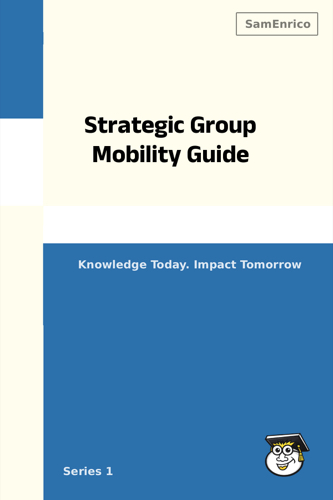
Strategic Group Mobility Guide
Measure the ease or difficulty of moving between s
by Shaffer Eli
Measure the ease or difficulty of moving between strategic groups on your positioning map.
Formats
About this book
Free sample
Chapter 1: The Airline Paradox--–- On a humid July morning in 2018, two aircraft landed at London Heathrow within seventeen minutes of each other. The first, an Emirates A380 from Dubai, carried 489 passengers who had paid an average of $1,200 for their tickets. The second, a Southwest Airlines Boeing 737 from Chicago via Baltimore, carried 143 passengers who had paid an average of $380. Both were airlines. Both transported human beings through the same airspace.
Both complied with the same international safety regulations. Both landed on the same runway. Yet these two companies inhabited different economic universes. Emirates earned a net profit margin of 6.2 percent that year. Southwest earned 12.7 percent.
A regional carrier flying the same route, Norwegian Air Shuttle, lost money. A legacy carrier, British Airways, earned 8.1 percent. The question that launched the entire field of strategic group analysis—and the question that opens this book—is simple, almost childlike in its directness: How can firms in the same industry, selling similar products to overlapping customers, enjoy such radically different profitability?The answer is not found in industry-level analysis. It is not found in the Five Forces, which would tell you that the airline industry is unattractive due to high rivalry, low switching costs for customers, and powerful unions. If that were the full story, no airline would be profitable.
Yet some are, consistently. The answer is also not found in firm-level uniqueness alone, because Southwest and Emirates share their profitability with clusters of similar competitors. Jet Blue, Ryanair, and Indi Go look more like Southwest than they look like Emirates. Singapore Airlines, Qatar Airways, and Cathay Pacific look more like Emirates than they look like Southwest. The industry contains distinct neighborhoods of strategic similarity.
These neighborhoods are called strategic groups, and the invisible walls between them—the barriers that prevent a Southwest from becoming an Emirates overnight—are called mobility barriers. Understanding those barriers, measuring them, and learning to cross them is the entire subject of this book.This chapter lays the foundation. It explains why industry-level thinking blinds executives to half the competitive landscape. It introduces the concept of strategic groups as cognitive communities. It…
This is the end of the free sample. Get the eBook to keep going. Buy now
Contents
- Chapter 1
- Chapter 2
- Chapter 3
- Chapter 4
- Chapter 5
- Chapter 6
- Chapter 7
- Chapter 8
- Chapter 9
- Chapter 10
- Chapter 11
- Chapter 12
Details
- Author
- Shaffer Eli
- Publisher
- SamEnrico
- Language
- English
- Genre
- Non-Fiction, Strategic Atlas, Mobility Barriers
- Released
- 2026-06-07
- Pages (approx.)
- 145
- Available as
- eBook, Audiobook

Read better in the ZLOADR app
Your eBooks on your phone or tablet. Sign in with your SamEnrico account and start reading.
More by Shaffer Eli
 Remote Retreats for IntrovertsShaffer Eli$11.99
 The Substance Use ConcernShaffer Eli$11.99
 French Resistance Escape NetworksShaffer Eli$11.99
 Focus Fasting Technique GuideShaffer Eli$11.99
 Wings Over the Sands: The Aerial Pioneers of the Middle EastShaffer Eli$11.99
 The Ballad of the Green Book: A Traveler's Guide to FreedomShaffer Eli$11.99
 Understanding Chorea AcanthocytosisShaffer Eli$17.99
 Parsnip HarvestingShaffer Eli$11.99
 HR Department Budget GuideShaffer Eli$12.99
 JEE Main Chemistry HandbookShaffer Eli$12.99
 10 Ways to Use Chenpi (Recipe Book)Shaffer Eli$11.99
You may also like
 Hong Kong Handover 1997Dunn Johnnie$11.99
 Zumba For Postnatal Recovery CourseNeal Christian$11.99
 Zumba for BeginnersLadner Nikia$11.99
 YouTube Comment Mining GuideHumes Pandora$12.99
 Worry Box MeditationCarlin Rudy$11.99
 Workplace Stress MeditationNguyen Lynn$11.99
 Workplace Stress and Sleep RepairHawley Ivory$11.99
 Workplace Perfectionism CureDelaney Jeffry$11.99
 Workplace Injustice Anger GuideWallen Isabelle$11.99
 Work Addiction and Burnout LinkGreenwood Ester$11.99
 Women in Yoga and WellnessBeattie Galina$11.99
 Women in Stand Up ComedyChun Evangeline$11.99