
Non-FictionSelf-HelpBlended Families
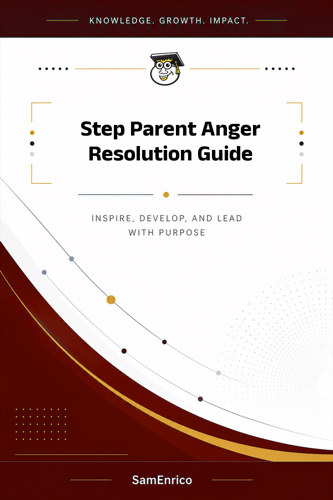
Step Parent Anger Resolution Guide eBook
Navigate loyalty conflicts and rejection without d
by Holt Dianna
Navigate loyalty conflicts and rejection without directing anger at stepchildren or bioparents.
Formats
Free sample
Chapter 1: The Loyalty Trap--When Sarah, a 38-year-old accountant, first walked into my clinical practice, she sat down, folded her arms across her chest like armor, and said seven words I have heard thousands of times: “I hate that I hate this child.” She was three years into her second marriage. Her stepson, age eleven, had never been overtly cruel. He hadn’t stolen from her, hit her, or cursed her out in public. Instead, he had perfected a quieter form of torture: the half-turn away when she entered a room, the way he leaned into his father during family photos while leaving a visible gap on her side, the single word answers delivered to the floor instead of her face. She had tried everything.
She had baked his favorite cookies. She had driven him to soccer practice in silence because he refused to speak. She had read three parenting books that all assumed she was the biological mother. Nothing worked. And now, sitting in my office, she confessed what no step parent is supposed to admit: “Sometimes I wish he didn’t exist.
Not dead. Just… gone. And then I hate myself for thinking that.”I told her something she had never heard before. I said, “Your stepson’s rejection of you is almost certainly not personal. It is physics.
Loyalty is gravity. And you are trying to fight gravity with willpower.”That was the beginning of her understanding the loyalty bind.If you are reading this book, you have likely experienced something similar. You have tried to be kind, patient, generous, and fair. You have extended olive branches only to have them ignored or, worse, weaponized. You have watched your stepchild warm up to a neighbor, a teacher, a distant aunt, even the barista at the coffee shop—but remain cold with you.
And you have felt something dark rise in your chest: not just frustration, but a burning, humiliating rage that you would never admit to anyone except perhaps the blank page of a journal or the late hour of a sleepless night.Here is the truth that will change everything you think about your anger: Your stepchild’s rejection is rarely about you as a person. It is about their impossible position between two biological parents. And until you understand the mechanics of that position, you will continue to take their behavior personally, and your anger will continue to escalate.This chapter exists to dismantle the most painful trigger for stepparent rage: the sense that your stepchild has rejected you as a human being. We will explore what loyalty conflicts actually look like (which is rarely defiance and almost always survival). We will introduce the concept of the “split self”—the psychological impossibility of loving a stepparent without feeling betrayal toward a biological parent.
We will explain why your anger, no matter how justified it feels, actually makes the problem worse by confirming your stepchild’s deepest fear: that you are a threat to their first family. And you will complete the first of several exercises in this book: mapping your stepchild’s loyalty drivers so you can stop reacting to their behavior as if it were about you.By the end of this chapter, you will no longer see your stepchild’s coldness as a verdict on your worth. You will see it as a predictable, almost mechanical response to an impossible psychological situation. And that shift—from “Why are they doing this to me?” to “This is how loyalty conflicts work”—will be the beginning of your anger resolution.What Loyalty Conflicts Actually Look Like Let us begin by clearing away a dangerous myth. Most stepparents believe that a stepchild’s hostility is a form of deliberate punishment.
They imagine the child thinking: “I will make this new person suffer because I want my original family back.” This assumption fuels enormous anger because it attributes malice to the child. And when we believe someone is deliberately hurting us, our moral outrage activates, and we feel entitled to retaliate.But clinical research and decades of stepfamily therapy tell a different story. Loyalty conflicts are not strategic campaigns of cruelty. They are unconscious survival mechanisms.A loyalty conflict occurs when a child believes—whether accurately or not—that showing warmth, acceptance, or obedience to a stepparent will betray their biological parent. This belief is rarely spoken aloud.
It lives in the body, in the nervous system, in the automatic flinch when you try to hug them, in the exaggerated coldness they display when the other biological parent is about to arrive for pickup.Here is what loyalty conflicts actually look like in daily life, and why each one triggers stepparent rage:The pendulum swing. Your stepchild spends a lovely weekend with you and your partner. They laugh at your jokes. They ask you to play a board game. They seem almost… happy.
Then, the night before they return to their other parent’s house, they become irritable, withdrawn, or outright hostile. You feel blindsided. You think, “What did I do wrong?” The answer is almost nothing. The child is preemptively proving loyalty to the parent they are about to see. The warmth they showed you was real.
The coldness is also real. Both exist in the same child because the child exists in two worlds.The audience effect. Your stepchild treats you with reasonable politeness when you are alone together. But the moment a biological parent enters the room—whether your partner (the Resident Bioparent) or your partner’s ex (the Non-Resident Bioparent)—their demeanor shifts dramatically. They may ignore you, interrupt you, or speak to you with contempt.
This is not because they hate you. It is because they are performing loyalty for an audience. The biological parent’s presence triggers the loyalty alarm, and the child instinctively distances themselves from you to prove where their allegiance lies.The selective amnesia. You remind your stepchild about a fun outing you shared last week—a movie, a hike, a trip for ice cream. They shrug and say, “I don’t remember that.” Or they deny it happened.
This is not gaslighting in the adult sense. It is psychological protection. Acknowledging good memories with you feels dangerous to their loyalty to the other parent. So their mind simply… deletes them. Temporarily.
This is infuriating for stepparents who have worked hard to create positive experiences. But the anger you feel is based on the assumption that the child is lying or ungrateful. In reality, they are surviving.The comparison trap. Your stepchild talks constantly about the other parent’s house. The food is better there.
The rules are more fair. The bedrooms are bigger. This is rarely an accurate assessment of reality. It is a loyalty script. The child has learned that praising the other parent keeps that parent’s love secure.
Conversely, praising you feels risky. The comparisons are not about objective truth. They are about emotional safety.The proxy attack. Your stepchild says something cruel that sounds exactly like something the Non-Resident Bioparent would say. “You’re not my real mom.” “My dad says you’re the reason their marriage failed.” “You’ll never be family.” When you hear these words…
This is the end of the free sample. Get the eBook to keep going. Buy now
About this book
Details
- Author
- Holt Dianna
- Publisher
- SamEnrico
- Language
- English
- Genre
- Non-Fiction, Self-Help, Blended Families
- Released
- 2026-06-06
- Pages (approx.)
- 155
- Available as
- eBook, Audiobook

Read better in the ZLOADR app
Your eBooks on your phone or tablet. Sign in with your SamEnrico account and start reading.
More by Holt Dianna
 Small Group Presentation NervesHolt Dianna$11.99
 Terrorist Cell CaptiveHolt Dianna$11.99
 Emotional Regulation for Loneliness GuideHolt Dianna$11.99
 Murdoch Captain Australia TitleHolt Dianna$11.99
 Soulful Revolution: How Motown Took Over the WorldHolt Dianna$11.99
 Ragtime Rebels: The Harlem Hellfighters' Jazz of WarHolt Dianna$11.99
 Understanding BothriocephalosisHolt Dianna$17.99
 Zoom Remote Intern ExperienceHolt Dianna$12.99
 Remote Conflict Resolution Across CulturesHolt Dianna$12.99
 How to Start a Hobby in Ice hockeyHolt Dianna$11.99
 Cancer RegistrarHolt Dianna$11.99
You may also like
 Hong Kong Handover 1997Dunn Johnnie$11.99
 Zumba For Postnatal Recovery CourseNeal Christian$11.99
 Zumba for BeginnersLadner Nikia$11.99
 YouTube Comment Mining GuideHumes Pandora$12.99
 Worry Box MeditationCarlin Rudy$11.99
 Workplace Stress MeditationNguyen Lynn$11.99
 Workplace Stress and Sleep RepairHawley Ivory$11.99
 Workplace Perfectionism CureDelaney Jeffry$11.99
 Workplace Injustice Anger GuideWallen Isabelle$11.99
 Work Addiction and Burnout LinkGreenwood Ester$11.99
 Women in Yoga and WellnessBeattie Galina$11.99
 Women in Stand Up ComedyChun Evangeline$11.99