
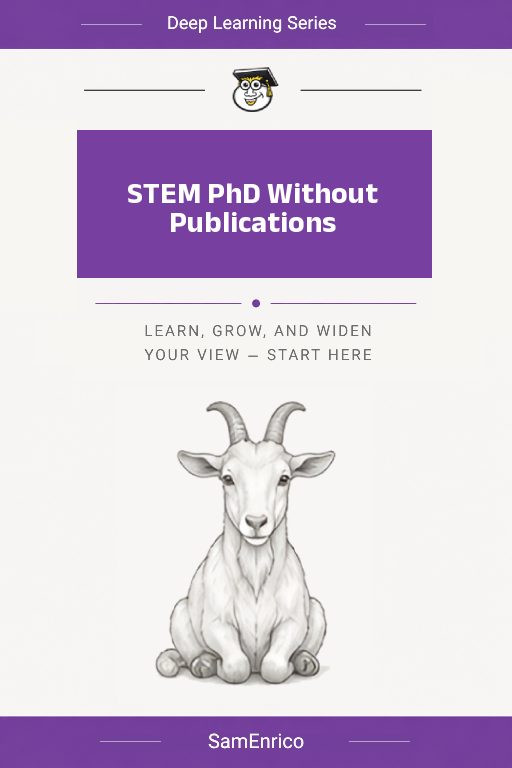
Non-FictionStudent's ShortcutSTEM
STEM PhD Without Publications eBook
Secures STEM PhD admission without first-author pa
Secures STEM PhD admission without first-author papers by emphasizing collaborative research and technical contributions.
Formats
Free sample
Chapter 1: The Silence Signal--The email arrived on a Tuesday, three weeks after the application deadline. It was short—professors are never verbose when delivering bad news—and it contained a single sentence that would haunt the applicant for months: “While your qualifications are strong, we have admitted candidates with more substantial publication records.”No mention of the eighteen months he had spent building a data pipeline for a lab that had no funding for a postdoc. No acknowledgment that he had taught himself Bayesian statistics from a PDF found at 2 AM. No recognition that he had, entirely alone, replicated a published result from a competing lab and found a subtle but important error in their normalization method. None of that counted.
Because he had no paper.That email, and the thousands like it sent every admissions cycle, represents the single greatest lie in graduate admissions: the lie that a publication record is a reliable signal of research potential.This book exists to expose that lie and to replace it with something far more useful. If you are reading this, you likely fall into one of three categories. First, you have no first-author papers and are wondering if a STEM Ph D is even possible. Second, you have some middle-author papers but know—deep down—that you did not lead the intellectual work. Third, you have no papers at all but have done real research, real troubleshooting, real thinking, and you are furious that the system seems to value a line on a CV over the actual ability to solve problems.
You are the audience for this book. And you are far more competitive than you have been led to believe.The year 2024 marked a quiet turning point in academic admissions. The Nature Career Column published a survey that should have been front-page news in every university administration building. When asked to rank the most important signals in a Ph D application, 62 percent of global STEM advisors placed “research design ability” above “publication count.” Let that sink in. Nearly two-thirds of the people who actually make admission decisions said they would trade a middle-author paper for evidence that an applicant could design a good experiment, ask a smart question, or troubleshoot a failed protocol.But if that is true, why does every admission forum, every well-meaning advisor, every anxious Reddit thread scream the opposite?
Why do students without papers feel like they are bringing a knife to a gunfight?Because the academic incentive structures have not caught up with what admission committees actually want. The appearance of a paper ceiling—the myth that you cannot get in without one—persists because it is easier to count publications than to evaluate thinking. Counting is lazy. Counting is fast. Counting allows overwhelmed committees to triage 500 applications into a “maybe” pile of 50.
But counting is also wrong. And the committees know it.This chapter dismantles the paper ceiling myth by introducing three frameworks that will guide the entire book: the Paper vs. Potential Matrix, which redefines admission as a venture capital investment; the Three Pillars of Replacement, which give you a concrete alternative to publication chasing; and the Readiness Audit, which distinguishes between a true deficiency and a fixable gap. By the end of this chapter, you will understand not only why you do not need a paper to get into a top STEM Ph D program, but also exactly what you need to build instead.The Venture Capital Logic of Ph D Admissions Imagine you are a venture capitalist. You have five hundred thousand dollars to invest—roughly the cost of a fully funded STEM Ph D including stipend, tuition, and overhead.
You cannot invest in every startup that sends you a pitch deck. You have to choose. What do you look for?If you are a bad venture capitalist, you look at past exits. You fund the founder who already sold a company, even if that company was in a different industry, even if the founder was just along for the ride as an early employee. This is the logic of the paper-counting admission committee: they fund the student with a first-author paper, regardless of whether that paper represents genuine intellectual leadership or simply being in the right lab at the right time.If you are a good venture capitalist, you look at something else entirely.
You look at the founder. You look at their ability to identify a real problem. You look at their resilience when things go wrong—because things always go wrong. You look at their technical depth: do they understand the product or are they just assembling off-the-shelf components? And you look at their fit for the specific market you understand best.
You invest in people, not past exits.Ph D admissions operate on exactly the same logic. A professor has one slot. That slot represents a five-year investment of time, money, and intellectual energy. They cannot afford to waste it on someone who looked good on paper but cannot actually do research. And here is the dirty secret that paper-counting applicants do not want you to know: a first-author paper from a highly structured, well-funded lab with a hands-on PI tells the professor almost nothing about whether the student can think independently.
It tells them that the student can follow instructions. It tells them that the student was in the right place. It does not tell them what happens when the instructions run out and the experiment fails and the PI is busy with grant proposals.This is not speculation. It is backed by data. The same Nature survey that found 62 percent of advisors prioritize research design ability also found that advisors consistently rated publication count as a less reliable signal of future success than a well-written research proposal or a strong letter from a supervisor describing a student’s troubleshooting process.
The paper is a noisy signal. The process of getting the paper—or failing to get one—is often far more informative.The Three Pillars of Replacement If publication count is a weak signal, what should replace it? This book builds on three pillars that together form a complete alternative framework for demonstrating Ph D readiness without a single first-author paper. Each pillar addresses a specific dimension of research ability that paper-counting obscures.Pillar One: Intellectual Maturity Intellectual maturity is the hardest quality to fake and therefore the most valuable signal you can send. It is demonstrated not by a list of successes but by ownership of a complete research cycle—from question to failed experiment to pivot to insight.
A student with intellectual maturity does not need to be told what to do next. They can look at ambiguous data, generate competing hypotheses, design a discriminating experiment, and—crucially—recognize when they are wrong.Here is what intellectual maturity looks like in practice: a student spends three weeks trying to amplify a specific DNA sequence. The PCR keeps failing. A less mature student would repeat the same protocol, hoping for different results. A merely competent student would ask the postdoc for help.
A student with intellectual maturity would systematically vary one parameter at a time: annealing temperature, magnesium concentration, primer design. They would keep…
This is the end of the free sample. Get the eBook to keep going. Buy now
About this book
Details
- Author
- Buckley Rowena
- Publisher
- SamEnrico
- Language
- English
- Genre
- Non-Fiction, Student's Shortcut, STEM
- Released
- 2026-06-01
- Pages (approx.)
- 142
- Available as
- eBook, Audiobook

Read better in the ZLOADR app
Your eBooks on your phone or tablet. Sign in with your SamEnrico account and start reading.
More by Buckley Rowena
 The Medical Student Stress GuideBuckley Rowena$11.99
 The Real Estate Syndication GuideBuckley Rowena$11.99
 Dream Incubation Step By Step GuideBuckley Rowena$11.99
 Dreams And Animal Attack TraumaBuckley Rowena$11.99
 DBT For Social WorkersBuckley Rowena$11.99
 The Devil’s Trill: Paganini’s Infernal VirtuosityBuckley Rowena$11.99
 How to Start a Pallet Rental Business (Beginners Guide)Buckley Rowena$11.99
 Pop Up Design NYC GuideBuckley Rowena$12.99
 Understanding Tamari–goodman SyndromeBuckley Rowena$17.99
 Kleihauer-betke TestBuckley Rowena$11.99
You may also like
 Hong Kong Handover 1997Dunn Johnnie$11.99
 Zumba For Postnatal Recovery CourseNeal Christian$11.99
 Zumba for BeginnersLadner Nikia$11.99
 YouTube Comment Mining GuideHumes Pandora$12.99
 Worry Box MeditationCarlin Rudy$11.99
 Workplace Stress MeditationNguyen Lynn$11.99
 Workplace Stress and Sleep RepairHawley Ivory$11.99
 Workplace Perfectionism CureDelaney Jeffry$11.99
 Workplace Injustice Anger GuideWallen Isabelle$11.99
 Work Addiction and Burnout LinkGreenwood Ester$11.99
 Women in Yoga and WellnessBeattie Galina$11.99
 Women in Stand Up ComedyChun Evangeline$11.99