
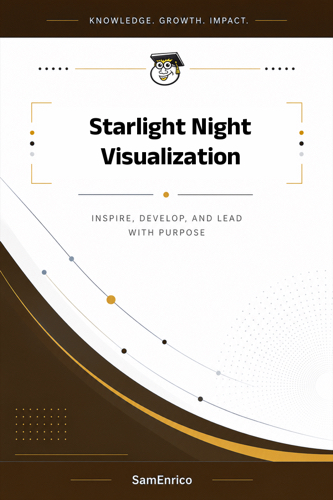
Starlight Night Visualization eBook
Lie under a vast canopy of stars feeling small and
Lie under a vast canopy of stars feeling small and deeply peaceful.
Formats
Free sample
Chapter 1: The Darkness You've Forgotten...--–- You have forgotten how to see in the dark. This is not an insult. It is not a failure of character or a lack of willpower. It is simply what happens to every human being who spends their days beneath fluorescent lights, their evenings bathed in the blue glow of screens, and their nights pretending that the bedroom ceiling is the only sky that matters. The pupils of your eyes can dilate to nearly eight millimeters in true darkness, letting in thirty times more light than they do on a sunny afternoon.
But they never get the chance. You live in a world that has declared war on darkness and won every single battle.Before you can lie under a vast canopy of stars and feel that deep, ancient peace this book promises, you must first remember what darkness actually is. Not the pale, orange-tinted glow of a city night—that bruised-looking sky above streetlights and highway overpasses. Not the semi-darkness of a bedroom with curtains that leak light around the edges. Not the comfortable dimness of a movie theater or a restaurant with low-hanging lamps.
Real darkness. The kind your ancestors knew every single night of their lives. The kind that forces your eyes to work differently, your mind to slow down, and your sense of self to expand in ways you cannot yet imagine.This chapter is called rewilding your night vision because that is exactly what we are going to do. We are going to take something that has been domesticated—your ability to perceive darkness—and return it to its wild, capable, ancient state. We are going to unlearn the urban speed that tells you darkness is dangerous, or boring, or simply nothing at all.
And we are going to build, from the ground up, a new relationship with the night that will serve as the foundation for every visualization and meditation in the rest of this book.The Myth of Night Blindness Let me start with a confession. I used to believe I had bad night vision. I would walk from a brightly lit house into my backyard and see nothing but a vague wash of gray. The stars? A few of the brightest ones, maybe.
The Milky Way? A rumor I had heard about but never witnessed. I assumed my eyes simply weren't as good as other people's. I assumed the photographers who captured those breathtaking images of the night sky were using equipment my naked eye could never match. I assumed wrong.What I had was not a biological limitation.
It was a behavioral one. I had spent thirty years training my eyes to expect light. Every time I walked from indoors to outdoors at night, I gave my pupils about thirty seconds before deciding "it's too dark to see anything" and retreating back inside or pulling out my phone. Thirty seconds. That is less than one percent of the time your eyes actually need to fully adapt to darkness.The human eye is a remarkable instrument, and its ability to adjust to low light conditions is nothing short of miraculous.
Let me walk you through what actually happens when you step from light into darkness. For the first thirty seconds, almost nothing. Your pupils begin to dilate, but the process is slow. Your cone cells—the photoreceptors responsible for color vision and fine detail—are still trying to do their job, but they are starved for light. This is why everything looks muddy and gray.
This is why most people give up.But if you stay, something changes. After about five minutes, your rod cells begin to take over. Rod cells are the unsung heroes of night vision. They cannot see color. They cannot see fine detail.
What they can do is detect single photons of light. A single photon. The smallest possible unit of light in the universe. Your eyes are capable of detecting individual particles of light that have traveled across the galaxy for thousands or millions of years to reach your retina. That is not poetry.
That is physiology.After twenty minutes, your rod cells are operating at near full capacity. The world begins to resolve itself not in color but in shades of gray and silver and deep blue-black. Shapes emerge. The ground beneath your feet reveals contours you could not see before. The trees are no longer a single black mass but individual trunks and branches.
And the stars—the stars begin to multiply. What looked like a dozen scattered pinpricks of light becomes a hundred, then a thousand.After forty-five minutes, you are fully dark adapted. And this is where the magic happens. Because at forty-five minutes, the Milky Way ceases to be a faint smudge and becomes a river. The Andromeda Galaxy, that faint fuzzy patch you have heard about but never seen, resolves itself as a distinct oval of light.
The gaps between stars fill in with more stars, until the sky looks less like a black blanket with holes poked in it and more like a vast, glittering ocean in which darkness is not the absence of light but the space between infinite points of radiance.This is what you have been missing. Not because your eyes are broken, but because you have never given them the time they need.The Psychological Blindness Beneath the Physical But here is the deeper truth, and it is one that most books about stargazing never touch. The blindness you have developed is not only in your eyes. It is in your mind.We live in what attention researchers call the "attention economy." Every app, every notification, every headline is designed to capture and hold your focus. Your brain has been trained to scan for novelty, to react to alerts, to switch tasks every few minutes, to never rest.
This training does not stop when you go outside at night. If anything, it becomes more frantic. Because darkness triggers something ancient and primal in the human brain—a vigilance system that evolved to protect you from predators and threats in the dark. Your mind, left to its own devices in the darkness, will scan. It will search.
It will generate worries and to-do lists and half-remembered embarrassments from high school. It will do anything except settle into the quiet vastness above you.This is the psychological night blindness this chapter aims to heal. The rewilding we are doing is not only about your pupils and rod cells. It is about teaching your brain that darkness is not a void to fear but a medium to explore. It is about retraining your attention to slow down, to soften, to stop hunting for threats and start receiving wonder.The good news is that the same practice that rewilds your physical night vision also rewilds your psychological night vision.
They are not two separate processes. They are the same process, happening in parallel, each one reinforcing the other. As your eyes learn to see more in the darkness, your mind learns to be more at ease in it. As your mind releases its frantic scanning, your eyes relax into peripheral vision. It is…
This is the end of the free sample. Get the eBook to keep going. Buy now
About this book
Details
- Author
- Hoffmann Georgeann
- Publisher
- SamEnrico
- Language
- English
- Genre
- Non-Fiction, Self-Help, Night Sky
- Released
- 2026-06-09
- Pages (approx.)
- 151
- Available as
- eBook, Audiobook

Read better in the ZLOADR app
Your eBooks on your phone or tablet. Sign in with your SamEnrico account and start reading.
More by Hoffmann Georgeann
 B Complex HandbookHoffmann Georgeann$11.99
 The Digital Declutter DawnHoffmann Georgeann$11.99
 Ambiguous Loss Grief GuideHoffmann Georgeann$11.99
 Immigrant Micro Lending Circle GuideHoffmann Georgeann$11.99
 Depreciation of Leasehold ImprovementsHoffmann Georgeann$11.99
 Fluid Intelligence TransferHoffmann Georgeann$11.99
 Perfectionism Time BoxingHoffmann Georgeann$11.99
 NVC For Social WorkHoffmann Georgeann$11.99
 The Angel of the ER: How a Nurse Turned a Hospital into a Killing FieldHoffmann Georgeann$11.99
 The Green Hell of the Wilderness: Grant's Bloody March to RichmondHoffmann Georgeann$11.99
 The Forgotten War of Inanna and the AnunnakiHoffmann Georgeann$11.99
 Ultimate Handbook Guide to Nassau : (Bahamas) Travel GuideHoffmann Georgeann$11.99
You may also like
 Hong Kong Handover 1997Dunn Johnnie$11.99
 Zumba For Postnatal Recovery CourseNeal Christian$11.99
 Zumba for BeginnersLadner Nikia$11.99
 YouTube Comment Mining GuideHumes Pandora$12.99
 Worry Box MeditationCarlin Rudy$11.99
 Workplace Stress MeditationNguyen Lynn$11.99
 Workplace Stress and Sleep RepairHawley Ivory$11.99
 Workplace Perfectionism CureDelaney Jeffry$11.99
 Workplace Injustice Anger GuideWallen Isabelle$11.99
 Work Addiction and Burnout LinkGreenwood Ester$11.99
 Women in Yoga and WellnessBeattie Galina$11.99
 Women in Stand Up ComedyChun Evangeline$11.99