
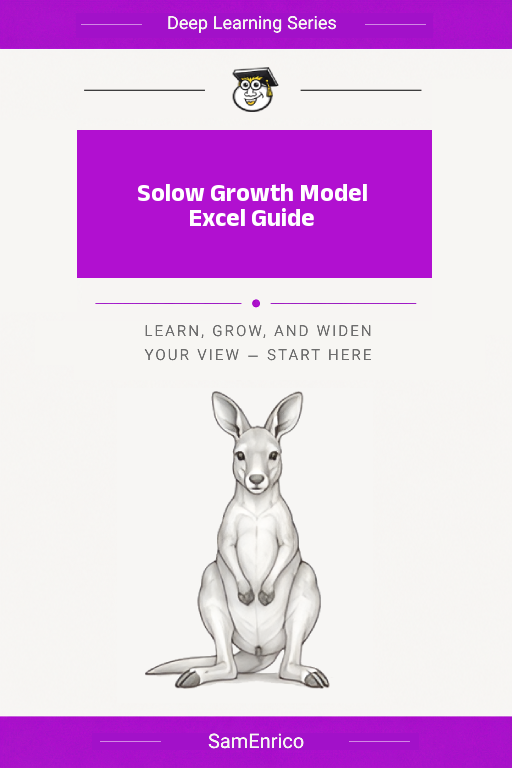
Solow Growth Model Excel Guide
Simulate steady-state capital and output using Exc
by Culp Nida
Simulate steady-state capital and output using Excel, analyzing savings rate changes for economic growth exam questions.
Formats
About this book
Free sample
Chapter 1: The 2 AM Panic--–- The screen glows at 1:47 AM. Your textbook lies open to page 312, where a dense cluster of Greek letters seems to multiply every time you blink. The equation stares back—Y=Kα(AL)1−αY = K^{\alpha}(AL)^{1-\alpha}Y=Kα(AL)1−α—and you understand exactly three symbols: the equals sign, the parentheses, and the exponent. The rest might as well be ancient Sanskrit. Your professor said the Solow model is "intuitive." Your classmates nod along.
You nod along. But alone, in the blue light of your laptop, you realize the truth: you have no idea how any of this actually works.You are not alone.Every semester, thousands of economics students memorise the Solow growth model formulas, recite them on exams, and promptly forget everything two weeks later. Not because the model is too hard. Not because you're not smart enough. But because you've never been taught to use it.
You've been taught to recite it. There is a difference.This book exists because of that difference.What This Chapter Will Do For You By the time you finish this chapter, you will have built your first working Solow model in Excel. You will understand what each symbol in that intimidating production function actually means—not as a definition to memorise, but as a number you can change and watch ripple through an economy. You will create named ranges that make your spreadsheet read like English. And you will learn the single most important concept in growth theory: diminishing returns.
More importantly, you will learn why that concept changes everything about how we think about rich countries, poor countries, and the impossible quest for endless growth.But first, let me tell you a story.Why Your Textbook Lied To You (A Little)In 1956, a quiet MIT economist named Robert Solow published a paper that would eventually win him a Nobel Prize. His insight was deceptively simple: economic growth comes from three places—capital, labour, and ideas. But more than that, he showed that there is a natural limit to how much growth you can get from just piling…
This is the end of the free sample. Get the eBook to keep going. Buy now
Contents
- Chapter 1
- Chapter 2
- Chapter 3
- Chapter 4
- Chapter 5
- Chapter 6
- Chapter 7
- Chapter 8
- Chapter 9
- Chapter 10
- Chapter 11
- Chapter 12
Details
- Author
- Culp Nida
- Publisher
- SamEnrico
- Language
- English
- Genre
- Non-Fiction, Student's Shortcut
- Released
- 2026-06-01
- Pages (approx.)
- 123
- Available as
- eBook, Audiobook

Read better in the ZLOADR app
Your eBooks on your phone or tablet. Sign in with your SamEnrico account and start reading.
More by Culp Nida
 Mice Phobia Pest ControlCulp Nida$11.99
 Research Proposal for STEM FieldsCulp Nida$11.99
 Sector Research ReviewCulp Nida$11.99
 The Consumer Choice FrameworkCulp Nida$11.99
 Cannabis and Motivation GuideCulp Nida$11.99
 The Positive Aging Affirmation GuideCulp Nida$11.99
 Recovery Self Hypnosis ScriptsCulp Nida$11.99
 Addison Rae DanceCulp Nida$11.99
 The Hollow King’s Last Stand: A Warrior’s Oath in the OtherworldCulp Nida$11.99
 Kali’s Shadow: The Goddess Who Dances on CorpsesCulp Nida$11.99
 The Mineral Guide to BorniteCulp Nida$11.99
 Crowd Monitoring and Public Safety DronesCulp Nida$11.99
You may also like
 Hong Kong Handover 1997Dunn Johnnie$11.99
 Zumba For Postnatal Recovery CourseNeal Christian$11.99
 Zumba for BeginnersLadner Nikia$11.99
 YouTube Comment Mining GuideHumes Pandora$12.99
 Worry Box MeditationCarlin Rudy$11.99
 Workplace Stress MeditationNguyen Lynn$11.99
 Workplace Stress and Sleep RepairHawley Ivory$11.99
 Workplace Perfectionism CureDelaney Jeffry$11.99
 Workplace Injustice Anger GuideWallen Isabelle$11.99
 Work Addiction and Burnout LinkGreenwood Ester$11.99
 Women in Yoga and WellnessBeattie Galina$11.99
 Women in Stand Up ComedyChun Evangeline$11.99