
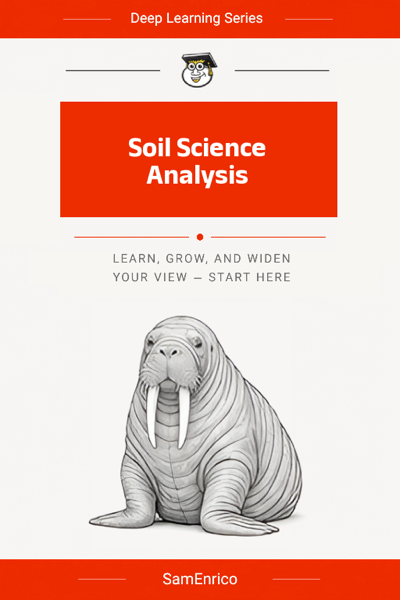
Non-FictionInformativeEducational
Soil Science Analysis
A Coursebook on Soil Science Analysis
A Coursebook on Soil Science Analysis
Formats
About this book
Free sample
Chapter 1: Beyond Ordinary Dirt--–- The first mistake most beginners make is treating soil like a simple growing medium – a passive, inert substance that merely holds plants upright while providing a few dissolved nutrients. This misconception leads to failed experiments, misinterpreted data, and costly field errors. The truth is far more complex and fascinating. Soil is a living, breathing, three-dimensional biogeochemical system that responds dynamically to management, climate, and time. Before you can analyze soil, you must understand what soil actually is and why your analytical approach matters as much as your analytical technique.This opening chapter establishes the philosophical and methodological foundation for every procedure in this book.
Without grasping the principles presented here, you cannot trust a single soil test result you produce or interpret. You will learn to think like a soil scientist – someone who sees beyond the surface, questions every measurement, and understands that quality control begins long before the sample reaches the laboratory bench.What Soil Really Is: A Living System Soil is not dirt. The term "dirt" implies something out of place, something to be cleaned away. Soil, by contrast, is a natural body formed through the complex interaction of five factors: parent material, climate, organisms, topography, and time. These factors, first systematized by the Russian scientist Vasily Dokuchaev in the late nineteenth century, produce soil horizons – distinct layers that develop parallel to the Earth's surface.A mature soil profile typically contains three major horizons.
The A horizon, or topsoil, is rich in organic matter and supports most biological activity. The B horizon, or subsoil, accumulates clay, iron, and aluminum leached from above. The C horizon consists of partially weathered parent material. Below that lies bedrock in most landscapes. Understanding this vertical structure is essential because sampling depth dramatically affects analytical results.
Surface organic matter tells you about recent management; deep subsoil reveals leaching patterns and parent material influences.Soil performs five critical ecosystem services that sustain human civilization. It serves as the medium for plant growth, providing physical support, water, and nutrients. It regulates the hydrologic cycle, storing and filtering water while reducing flood…
This is the end of the free sample. Get the eBook to keep going. Buy now
Contents
- Chapter 1
- Chapter 2
- Chapter 3
- Chapter 4
- Chapter 5
- Chapter 6
- Chapter 7
- Chapter 8
- Chapter 9
- Chapter 10
- Chapter 11
- Chapter 12
Details
- Author
- Briscoe Allegra
- Publisher
- SamEnrico
- Language
- English
- Genre
- Non-Fiction, Informative, Educational
- Released
- 2026-05-09
- Pages (approx.)
- 146
- Available as
- eBook, Audiobook

Read better in the ZLOADR app
Your eBooks on your phone or tablet. Sign in with your SamEnrico account and start reading.
More by Briscoe Allegra
 Sobriety Without Shame: A Recovery PrimerBriscoe Allegra$11.99
 Healthcare Burnout GuideBriscoe Allegra$11.99
 Workaholism and Substance AbuseBriscoe Allegra$11.99
 Term Loan B Structures GuideBriscoe Allegra$11.99
 Tangaroa and Hina: The Ocean’s Forbidden LoveBriscoe Allegra$11.99
 How to Produce Aircraft Parts and AccessoriesBriscoe Allegra$11.99
 How to Become a Mainspring Winder And OilerBriscoe Allegra$11.99
 Virtual Account Management WorkbookBriscoe Allegra$12.99
You may also like
 Hong Kong Handover 1997Dunn Johnnie$11.99
 Zumba For Postnatal Recovery CourseNeal Christian$11.99
 Zumba for BeginnersLadner Nikia$11.99
 YouTube Comment Mining GuideHumes Pandora$12.99
 Worry Box MeditationCarlin Rudy$11.99
 Workplace Stress MeditationNguyen Lynn$11.99
 Workplace Stress and Sleep RepairHawley Ivory$11.99
 Workplace Perfectionism CureDelaney Jeffry$11.99
 Workplace Injustice Anger GuideWallen Isabelle$11.99
 Work Addiction and Burnout LinkGreenwood Ester$11.99
 Women in Yoga and WellnessBeattie Galina$11.99
 Women in Stand Up ComedyChun Evangeline$11.99