
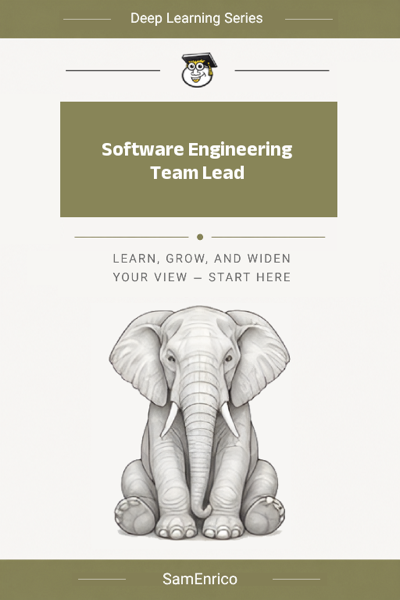
Non-FictionInformativeEducational
Software Engineering Team Lead eBook
A Coursebook on Software Engineering Team Lead
A Coursebook on Software Engineering Team Lead
Formats
Free sample
Chapter 1: The Dual‑Role Hero--The day you accept the Team Lead promotion is the day your old identity as a “great coder” becomes a liability.Most new leads discover this the hard way. You walk into the role believing that your technical brilliance got you here, and that more of the same brilliance will keep you afloat. So you keep coding. You keep reviewing pull requests at midnight. You keep being the one who jumps on the production outage at 2 AM, fixes the bug, and pushes the hotfix.
You feel useful. You feel necessary. And slowly, silently, your team starts to fail.This is the Dual‑Role Hero trap, and it is the single most common failure mode for first‑time engineering leads.--The Promotion That Breaks You Let me paint a picture you might recognise.You were a senior engineer. You wrote clean, fast, maintainable code. When things broke, you fixed them.
When the team was stuck, you unblocked them. Management noticed. They pulled you aside and said, “We want you to be the Team Lead.”The title came with a raise, a new sense of responsibility, and an unspoken expectation: keep doing what you’re doing, but also lead the team.So you tried. You went to the product roadmap meetings. You sat in on sprint planning.
You wrote performance reviews. And you still picked up tickets because, let’s be honest, the team was behind and you were the fastest coder in the room.Within six weeks, you are working 55 hours. Within eight weeks, 65. You are the first one online and the last one offline. Your own code quality starts slipping, but you convince yourself it’s fine because you’re shipping.
Your team is not growing. Junior engineers wait for you to review their pull requests. Senior engineers stop making decisions without you. The backlog of “leadership work” – 1:1s, career planning, stakeholder alignment – piles up untouched.You are not failing because you aren’t good enough. You are failing because you are trying to do two full‑time jobs at once.That is the Dual‑Role Hero fallacy: the belief that your individual output as a coder is the team’s safety net.
It feels heroic. It feels productive. And it is a slow‑motion catastrophe.--Why Brooks’ Law Explains Everything In 1975, software engineer Fred Brooks wrote a book that became a curse and a prophecy: The Mythical Man‑Month. In it, he proposed what is now called Brooks’ Law:Adding people to a late software project makes it later.This sounds counterintuitive. If you need to dig a trench, ten people finish faster than one.
But software is not a trench. Software is a network of dependencies, hidden assumptions, and communication overhead.When you add a new person to a late project, four things happen:Training time – existing team members must teach the newcomer.Communication overhead – the number of communication channels grows as n(n‑1)/2.Coordination drag – more standups, more design reviews, more merge conflicts.Risk of bad decisions – newcomers don’t know the history and may introduce subtle bugs.Brooks’ Law applies directly to the Dual‑Role Hero. When you, as the lead, try to code and manage, you are effectively adding a second person (the “manager you”) to a system that already has a full team. But you don’t add net capacity – you add coordination overhead. You become the bottleneck that every decision must flow through.Let me give you a concrete example.Imagine a team of five engineers.
One of them is the lead. Under normal conditions, the lead spends 50% of their time on management and 50% on coding. That sounds balanced. But in reality, the coding half is constantly interrupted by management questions (“Can you approve this design?” “What’s the priority for this ticket?”). Each interruption costs 15–20 minutes of context recovery.
By 3 PM, the lead has written almost no new code, but has also not done any deep management work. They stay late to code, then burn out, then make mistakes, then create more work for the team.The math is brutal. A lead who tries to be a full‑time coder and a full‑time manager delivers less than a half‑time coder and worse management than an average manager. The team loses twice.--The Emotional Difficulty of Stepping Away Knowing that the Dual‑Role Hero is a trap does not make it easy to escape.There is a deep psychological barrier here. You were promoted because you were the best engineer on the team.
That excellence became part of your identity. “I am the person who solves hard problems.” “I am the one everyone comes to when things are broken.” These are not just job descriptions – they are sources of self‑worth.When you stop coding, you feel like you are losing your superpower.Worse, you feel lazy. Your teammates are pushing commits. You are sitting in meetings and sending emails. It doesn’t feel like real work.
The imposter syndrome whispers, “You aren’t contributing anymore. They will find out you’re a fraud.”This feeling is normal. It is also dangerous.I have coached dozens of new leads through this transition. Almost every single one describes the first month as “uncomfortable” and “guilt‑ridden.” The good ones push through. The ones who don’t – who cling to their coding identity – burn out within a year or get quietly moved back to an individual contributor role.Here is the truth you need to internalise:Your value as a lead is not measured by the code you write.
It is measured by the code your team writes, the problems they solve, and the growth they achieve without you.Radical Candor: The Framework for Letting Go So how do you actually let go? How do you stop being the hero without becoming a passive bystander?You need a framework that balances two competing forces: caring about your team and holding them accountable. That framework is Radical Candor, developed by Kim Scott.Radical Candor lives in the intersection of two dimensions:Care Personally – you genuinely care about your engineers as humans, not just as output machines.Challenge Directly – you are willing to give difficult feedback, hold high standards, and push back when needed.The two danger zones are:Ruinous Empathy – you care personally but don’t challenge directly. This looks like saying “it’s fine” when it isn’t, or doing the work yourself to avoid a hard conversation.Obnoxious Aggression – you challenge directly but don’t care personally. This looks like harsh criticism without context, or demanding results without empathy.The Dual‑Role Hero often falls into Ruinous Empathy.
You take the ticket because you don’t want to overload a junior engineer. You approve a suboptimal design because you don’t want to hurt feelings. You stay late to fix a bug because you don’t want the team to suffer. You are “being nice” – and in the process, you are robbing your team of growth opportunities.Radical Candor in the context of delegation looks like this:Care Personally: trust that your engineers are capable of learning. Believe that your role is to enable, not to rescue.Challenge Directly: hold them accountable for…
This is the end of the free sample. Get the eBook to keep going. Buy now
About this book
Details
- Author
- Ashford Samatha
- Publisher
- SamEnrico
- Language
- English
- Genre
- Non-Fiction, Informative, Educational
- Released
- 2026-05-06
- Pages (approx.)
- 152
- Available as
- eBook, Audiobook

Read better in the ZLOADR app
Your eBooks on your phone or tablet. Sign in with your SamEnrico account and start reading.
More by Ashford Samatha
 TM Group Meditation BenefitsAshford Samatha$11.99
 Esusu SoftBank Exit PlaybookAshford Samatha$11.99
 The Road Rage WorkbookAshford Samatha$11.99
 Waste Management Tech OutlookAshford Samatha$11.99
 The Lower Back Pain Relief WorkbookAshford Samatha$11.99
 The Scandal of the Silk and the Scoundrel: A Regency Love Triangle That Shook LondonAshford Samatha$11.99
 Flutterwave Business VerificationAshford Samatha$12.99
 Luxury Pop Up in London GuideAshford Samatha$12.99
 Understanding Peripheral Nervous DisorderAshford Samatha$17.99
 How to Start a Orthopaedic Appliances (retail) Business (Beginners Guide)Ashford Samatha$11.99
You may also like
 Hong Kong Handover 1997Dunn Johnnie$11.99
 Zumba For Postnatal Recovery CourseNeal Christian$11.99
 Zumba for BeginnersLadner Nikia$11.99
 YouTube Comment Mining GuideHumes Pandora$12.99
 Worry Box MeditationCarlin Rudy$11.99
 Workplace Stress MeditationNguyen Lynn$11.99
 Workplace Stress and Sleep RepairHawley Ivory$11.99
 Workplace Perfectionism CureDelaney Jeffry$11.99
 Workplace Injustice Anger GuideWallen Isabelle$11.99
 Work Addiction and Burnout LinkGreenwood Ester$11.99
 Women in Yoga and WellnessBeattie Galina$11.99
 Women in Stand Up ComedyChun Evangeline$11.99