
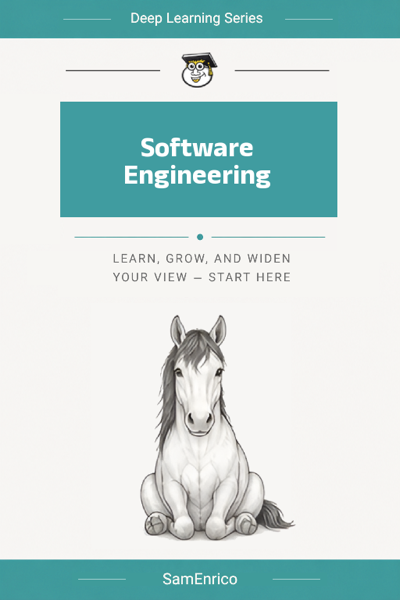
Non-FictionInformativeEducational
Software Engineering eBook
A Coursebook on Software Engineering
A Coursebook on Software Engineering
Formats
Free sample
Chapter 1: The Broken Promise...–- In 1968, a room full of the world’s most brilliant computer scientists gathered in Garmisch, Germany, to solve a problem that didn’t yet have a name. They called it the “software crisis.” Programs were running over budget by years, not weeks. The IBM OS/360 project had just consumed 5,000 person-years of effort—and still shipped with thousands of known bugs. The NASA Apollo Guidance Computer, a miracle of engineering by any measure, contained software that no single person fully understood. The conference proceedings concluded with a quiet admission: writing code and engineering software were not the same thing.
Fifty-six years later, that crisis never ended. It just got rebranded.Welcome to the discipline that pretends to be a science, operates like a craft, and fails as often as a poorly built bridge—except when a bridge fails, people notice immediately. When software fails, we call it a “glitch” and restart our phones.This chapter is not an introduction. It is an intervention. You have written code before.
You may have even shipped software. But if you cannot answer the three questions that end this chapter, you are not an engineer. You are a programmer with a job title. And that is fine—until it isn’t. Until the system you built at 2 AM, fueled by energy drinks and optimism, becomes the backbone of a hospital’s patient database or a bank’s transaction processor.
Then the difference between coding and engineering becomes a matter of life and debt.We begin where all engineering begins: with the uncomfortable recognition that you do not know what you do not know.The Myth of the Silver Bullet In 1986, Frederick Brooks—the same Brooks who managed IBM’s OS/360 project—published an essay that has haunted software engineering ever since. Its title was “No Silver Bullet: Essence and Accidents of Software Engineering.” Brooks argued that there is no single technological breakthrough, no magical solution, that will ever tame software complexity by an order of magnitude. Not object-oriented programming. Not Agile. Not AI.
Not blockchain, Web3, or whatever acronym arrives next year.The reason, Brooks explained, is that most software difficulty is essential, not accidental. Accidental difficulties are the annoying ones: limited memory, slow networks, clumsy languages. These get better with better tools. Essential difficulties are the impossible ones: the problem you are solving is inherently complicated; the people who want the software cannot agree on what they want; every change creates three new questions. Essential complexity cannot be engineered away.
It can only be managed.This is the first and hardest truth of software engineering: you will never eliminate complexity. You will only decide where to hide it.The software industry has spent fifty years refusing to accept this. Each new methodology arrives with a messianic promise: “Do Scrum and your estimates will improve.” “Adopt microservices and your deployment fears will vanish.” “Use AI and your junior engineers will write senior code.” These are silver bullets. They are also lies—not malicious lies, but the more dangerous kind: comforting lies that postpone the inevitable day when complexity reasserts itself.Consider the most famous silver bullet of the 2010s: microservices. The promise was beautiful: small teams, independent deployments, technology diversity.
The reality, for most organizations, was a distributed monolith—the same tangled dependencies as before, but now with network latency and serialization errors. A 2021 study of 800 microservices adoptions found that only 17% reported improved developer productivity within the first two years. The rest reported increased operational costs and debugging nightmares. The silver bullet had turned into silver shrapnel.This does not mean microservices are bad. It means they are not magic.
And nothing is magic.The Three Pillars of Real Engineering If there is no silver bullet, what actually distinguishes software engineering from programming? The answer lies in three pillars that appear in every mature engineering discipline, from civil to chemical to aerospace. These pillars are not technology. They are not languages or frameworks or cloud providers. They are ways of thinking about work.Pillar One: Process.
Process is how you organize people over time. It answers the question: who does what, when, and in what order? A programmer might write code alone, in any order, delivering “when it’s done.” An engineer follows a process not because they love bureaucracy but because they have learned—often through painful failure—that undisciplined work produces undisciplined results. Process does not guarantee success. But it makes failure predictable, and predictable failure is the first step toward preventing it.Process is also the most easily corrupted pillar.
The moment process becomes ritual—standup meetings where no one listens, estimates that no one believes, documents that no one reads—it stops being engineering and becomes theater. Good process is a tool, not a totem. You should be able to explain why each step exists. If you cannot, delete that step.Pillar Two: Methods. Methods are the technical techniques you apply to the work itself.
Requirements analysis. Architecture design. Code review. Testing. Debugging.
Refactoring. Each method is a repeatable way of solving a recurring problem. Methods are what separate a carpenter who builds a table that wobbles from one who builds a table that lasts for generations. Both know how to cut wood. The second knows how to measure, how to join, how to finish, how to test the weight.The tragedy of our industry is that methods are taught as checklists, not as judgment.
“Write unit tests” becomes an order, not a decision. “Use SOLID principles” becomes a grade, not a guide. But methods are situational. Testing a medical device requires different methods than testing a video game. The engineer’s skill is choosing the right method for the context, not memorizing the most methods.Pillar Three: Tools.
Tools are the most visible pillar and the least important. Compilers, version control systems, continuous integration servers, debuggers, profilers, linters—these are the machinery of modern development. Good tools make good engineering easier. Bad tools make good engineering nearly impossible. But no tool has ever made a bad engineer good.The tool that most reveals an engineer’s maturity is the debugger.
Junior programmers debug with print statements, scattering logs like breadcrumbs and hoping to spot the moment the bear arrives. Senior engineers use breakpoints, watch variables, step through execution. They understand that debugging is a science—form a hypothesis, design an experiment, observe the result, refine. The tool is just the microscope. The method is the scientific process.These three pillars interact.
Your process determines when tools are used. Your methods determine which tools are valuable. Your tools enable or constrain your methods. Collapse any pillar, and the structure tilts.The Ten Fallacies That Will Ruin You Fallacies are false beliefs that feel true. They are dangerous not because they are obviously wrong but because they are seductively right—until they are catastrophically wrong.
Here are ten that have destroyed more projects than technical debt ever has.Fallacy 1: Adding more people will catch up a late project. Brooks’ Law, named after the same Brooks who wrote “No Silver Bullet.” When a project is late, management’s instinct is to add headcount. But new people need to be…
This is the end of the free sample. Get the eBook to keep going. Buy now
About this book
Details
- Author
- Corea Consuela
- Publisher
- SamEnrico
- Language
- English
- Genre
- Non-Fiction, Informative, Educational
- Released
- 2026-06-02
- Pages (approx.)
- 139
- Available as
- eBook, Audiobook

Read better in the ZLOADR app
Your eBooks on your phone or tablet. Sign in with your SamEnrico account and start reading.
More by Corea Consuela
 Services PMI SentimentCorea Consuela$11.99
 The Workload Triage HandbookCorea Consuela$11.99
 Loneliness for CaregiversCorea Consuela$11.99
 Nursing Student Stress ReliefCorea Consuela$11.99
 The Space Race Heist: How a Cold War Rivalry Stole the MoonCorea Consuela$11.99
 MVP Definition Agile HandbookCorea Consuela$12.99
 How to Produce Baby Safety RailsCorea Consuela$11.99
 Ultimate Handbook Guide to Cebu : (Philippines) Travel GuideCorea Consuela$11.99
You may also like
 Hong Kong Handover 1997Dunn Johnnie$11.99
 Zumba For Postnatal Recovery CourseNeal Christian$11.99
 Zumba for BeginnersLadner Nikia$11.99
 YouTube Comment Mining GuideHumes Pandora$12.99
 Worry Box MeditationCarlin Rudy$11.99
 Workplace Stress MeditationNguyen Lynn$11.99
 Workplace Stress and Sleep RepairHawley Ivory$11.99
 Workplace Perfectionism CureDelaney Jeffry$11.99
 Workplace Injustice Anger GuideWallen Isabelle$11.99
 Work Addiction and Burnout LinkGreenwood Ester$11.99
 Women in Yoga and WellnessBeattie Galina$11.99
 Women in Stand Up ComedyChun Evangeline$11.99