
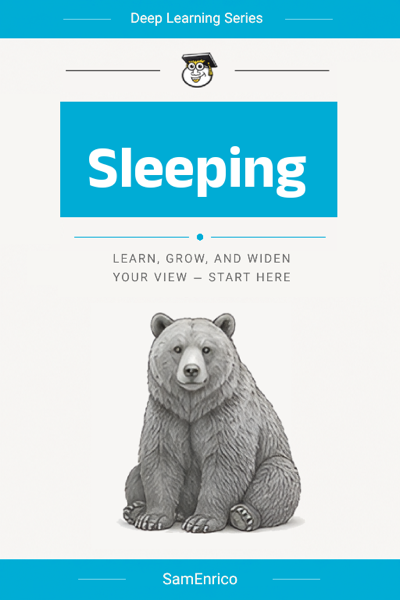
Sleeping eBook
A Coursebook on Sleeping
A Coursebook on Sleeping
Formats
Free sample
Chapter 1: The Grade Curve...--You are failing sleep. Not because you are lazy, undisciplined, or broken. Because no one ever taught you how it works.Here is the first thing you need to understand: sleep is not a passive state. It is not the absence of wakefulness, not a biological off switch, not a void where nothing happens. For most of human history, we treated sleep as a mystery – a little death, a nightly surrender to forces beyond our control.
Modern neuroscience has reversed that equation. We now know that sleep is an active, aggressive, highly engineered performance state. Your brain does more work while you are asleep than it does during most of your waking hours. It cleans itself. It consolidates memories.
It regulates your emotions. It repairs your cardiovascular system. It recalibrates your immune response. And it does all of this on a precise schedule that evolution spent millions of years perfecting.You are here because something in that system has broken. Or perhaps nothing has broken – perhaps you have simply never been given the instruction manual.
This book is that manual. It is a coursebook, not a collection of vague tips. You will learn the neuroscience, the psychology, and the practical protocols. You will keep a sleep diary. You will complete an 8-week cognitive behavioral therapy protocol if you need it.
You will redesign your bedroom, retrain your brain, and reset your circadian clock. By the end, you will not have "better sleep." You will have transformed your relationship with rest from a battleground into a partnership.But first, you need to see the full scope of the problem. Because most people who struggle with sleep do not actually understand what they are fighting against. They think they have an insomnia problem. They have a design problem.The Silent Epidemic Let us begin with a number: two-thirds.Two-thirds of adults in developed nations fail to meet the recommended 7–9 hours of sleep on a regular basis.
That is not a statistic about shift workers or new parents or people with diagnosed sleep disorders. That is the general population. In the United States, the Centers for Disease Control has declared insufficient sleep a public health epidemic. In the United Kingdom, the Royal Society for Public Health reports that sleep deprivation costs the economy £40 billion annually. In Japan, the phenomenon of karoshi – death from overwork – is so culturally embedded that the government has launched national campaigns to encourage citizens to sleep more.These numbers are not improving.
They are getting worse. Every major sleep study conducted over the past fifty years shows the same trend: average sleep duration has fallen by approximately 1.5 hours per night since the 1940s. The proportion of adults sleeping less than 6 hours has increased by 31% in just the last two decades. We are, as a species, sleeping less than at any point in recorded history.The standard explanation for this decline points to technology: screens, smartphones, social media, streaming services, the 24-hour news cycle. And that is partially correct.
But the deeper truth is more uncomfortable. We have built a culture that treats sleep as optional – a luxury for the unambitious, a sign of laziness, something to be minimized in the pursuit of productivity. The phrase "I'll sleep when I'm dead" is not just a colloquialism. It is a mission statement.Here is what the data actually says about that mission statement: you will be dead sooner. Chronic short sleep – defined as consistently sleeping less than 6 hours per night – is associated with a 12% higher risk of all-cause mortality.
That number climbs to 25% for those sleeping less than 5 hours. The relationship is dose-dependent and nonlinear. Every hour of sleep you lose below 7 hours carries a compounding health debt that cannot be fully repaid by weekend lie-ins.The economic cost of this epidemic is staggering. In the United States alone, insufficient sleep costs an estimated 411billionannuallyinlostproductivity,medicalerrors,workplaceaccidents,andhealthcareutilization.Asingledrowsy−drivingaccidentcostsanaverageof411 billion annually in lost productivity, medical errors, workplace accidents, and healthcare utilization. A single drowsy-driving accident costs an average of 411billionannuallyinlostproductivity,medicalerrors,workplaceaccidents,andhealthcareutilization.Asingledrowsy−drivingaccidentcostsanaverageof1.2 million.
A single medical error caused by a sleep-deprived resident or nurse costs an average of $400,000 in additional treatment and litigation. These are not abstract numbers. They are the price of a culture that has decided that sleep is negotiable.The Two Numbers That Actually Matter If you have tried to improve your sleep before, you have almost certainly focused on the wrong number. Most people obsess over sleep duration – how many hours they spend unconscious. They chase the mythical 8 hours like a finish line.
They buy tracking devices that congratulate them for hitting 7 hours and 42 minutes. They lie in bed for 9 hours, sleep for 6, and tell themselves they are failing.Sleep duration is important. But it is only half of the equation. The other half – the half that almost no one knows about – is sleep efficiency.Sleep efficiency is a simple calculation: total time asleep divided by total time spent in bed, multiplied by 100. If you spend 8 hours in bed and sleep for 7 of them, your efficiency is 87.5%.
If you spend 10 hours in bed and sleep for 6, your efficiency is 60%. Efficiency tells you how well you are using your time in bed. And for most people with sleep problems, efficiency is the real culprit.Here is why efficiency matters more than most people realize. Your brain is a pattern-matching machine. It learns associations.
When you spend hours lying in bed awake – worrying, scrolling, staring at the ceiling – your brain learns that bed is a place for wakefulness. The bed becomes a trigger for frustration, anxiety, and hyperarousal. You develop what sleep scientists call conditioned insomnia. You are not failing at sleep. You have trained yourself to fail.The clinical threshold for healthy sleep efficiency is 85%.
That means for every 8 hours in bed, you should be asleep for at least 6 hours and 48 minutes. Elite sleepers – the people who fall asleep within 5 minutes and wake up feeling genuinely restored – often achieve 90–95% efficiency. They spend almost no time awake in bed.But here is the nuance that most sleep books get wrong: high efficiency on insufficient sleep is not success. If you consistently sleep 6 hours but spend only 6 hours and 20 minutes in bed, your efficiency might be 95%. That looks excellent on paper.
But you are still sleep-deprived. The goal is sufficient sleep duration with high efficiency. Not one or the other. Both.Throughout this book, you will calculate your own sleep efficiency using a daily sleep diary. You will learn to distinguish between sleep that is efficient but insufficient, sufficient but inefficient, and – the holy grail – both sufficient and efficient.
And you will learn that for most people, the path to that holy grail requires first limiting your time in bed. Counterintuitive, but true. We will get there.What You Think You Know About Sleep (And Why It Is Wrong)Before we go further, we need to clear the ground. The average person carries a remarkable number of false beliefs about sleep – myths that are reinforced by popular culture, bad journalism, and the $80 billion sleep industry. Let us name a few.Myth 1: You can train your body to need less sleep.
No. The number of people genetically capable of sleeping 5–6 hours without impairment is approximately 1% of the population. They…
This is the end of the free sample. Get the eBook to keep going. Buy now
About this book
Details
- Author
- Joyner Cammie
- Publisher
- SamEnrico
- Language
- English
- Genre
- Non-Fiction, Informative, Educational
- Released
- 2026-05-11
- Pages (approx.)
- 144
- Available as
- eBook, Audiobook

Read better in the ZLOADR app
Your eBooks on your phone or tablet. Sign in with your SamEnrico account and start reading.
More by Joyner Cammie
 TM for Screen AddictionJoyner Cammie$11.99
 Remote Worker Imposter GuideJoyner Cammie$11.99
 Listening Without InterruptingJoyner Cammie$11.99
 Affirmations for ComparisonJoyner Cammie$11.99
 The Sociopath Impulsive CriminalJoyner Cammie$11.99
 The Visionaries of Stone: How Western Architects Shaped DemocracyJoyner Cammie$11.99
 Understanding T-lymphocytopeniaJoyner Cammie$17.99
 How to Become a Dry-house TenderJoyner Cammie$11.99
 Zero Cost Pivot GuideJoyner Cammie$12.99
 Agriculture Invoice FactoringJoyner Cammie$12.99