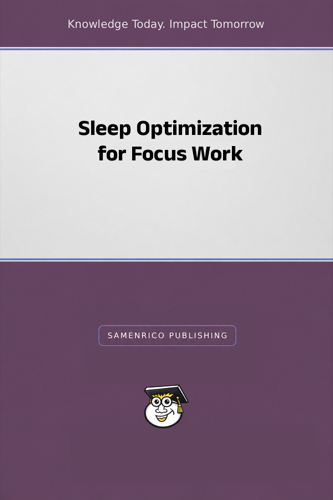
Sleep Optimization for Focus Work eBook
Improve cognitive performance through rest quality
by Heim Exie
Improve cognitive performance through rest quality that directly impacts concentration.
Formats
Free sample
Chapter 1: The Focus Paradox--–- The email arrived at 11:47 PM on a Tuesday. Sarah, a 34-year-old product manager at a fast-growing tech company, had been staring at her screen for fourteen hours. Three monitors glowed with Slack notifications, Jira tickets, and a half-finished requirements document. Her coffee mug, the fourth of the day, sat cold and forgotten. She had stopped feeling tired around 8 PM—a dangerous milestone her body had learned to ignore.
Now she felt nothing but a dull, buzzing pressure behind her eyes and the familiar weight of falling behind.She typed another sentence, deleted it, retyped it, then closed her laptop in frustration. The screen went black, and in that sudden darkness, the silence of her apartment became deafening. Her mind, freed from the demands of work, immediately filled with everything else: the presentation tomorrow, the performance review next week, the conversation with her partner she had been avoiding, the gym she hadn't visited in months, the dental appointment she had canceled twice.At 1:17 AM, she was still awake. Her body was exhausted—every muscle ached, her eyelids felt like sandpaper—but her brain refused to power down. Thoughts raced in loops: I should have finished that document.
Why can't I focus? Everyone else seems to manage. What's wrong with me?At 2:30 AM, she reached for her phone. Just to check email. Just to make sure nothing urgent came in.
Two hours later, she had watched seventeen Tik Tok videos, ordered a stress-purchase of noise-canceling headphones she didn't need, and read three articles about "how to be more productive in the morning"—all while lying in the dark, phone brightness at minimum, secretly knowing that every minute of screen time was making things worse.At 6:45 AM, her alarm screamed. She had slept, if you could call it that, for perhaps ninety minutes—not in one block, but in fragments: ten minutes here, twenty there, always waking with a jolt, always checking the clock, always doing the math on how much sleep she might still salvage.She dragged herself to the shower. The hot water felt like punishment. She dressed in the dark to avoid waking her partner, who had long ago learned to sleep through her insomnia. At 8:30 AM, she sat down for her first meeting, coffee in hand, and realized she could not remember what the previous day's document was even about.This is not a story about laziness.
This is not a story about poor time management or weak willpower. Sarah was, by every external measure, successful. She had been promoted twice in three years. Her performance reviews praised her dedication. She worked harder than almost anyone on her team.
And she was failing—not because she didn't care, but because she had fallen into a trap that millions of knowledge workers now inhabit.She had become a victim of what this book will call the Focus Paradox.The High-Performance Trap Let us name the enemy. The High-Performance Trap is the cruel arithmetic of modern work: the same behaviors that drive career success—hyper-vigilance, rapid task-switching, constant connectivity, and the glorification of busyness—directly destroy the biological systems required for sustained focus.Consider the math. Every time you check email, your brain releases a small pulse of dopamine—a neurotransmitter associated with reward, motivation, and arousal. Every time you switch from one task to another (which the average knowledge worker does every ninety seconds), your prefrontal cortex—the "CEO" of your brain—must disengage from one context and engage with another, a process that burns metabolic energy and leaves behind a residue of cognitive fatigue. Every time you receive a notification, your sympathetic nervous system—the "fight or flight" branch—activates, releasing cortisol and adrenaline into your bloodstream.These responses are not bugs.
They are features of an ancient nervous system that evolved to survive predators, not to manage Slack channels. Your brain cannot distinguish between a notification from your boss and a rustle in the bushes that might be a lion. Both trigger the same cascade: cortisol rises, heart rate increases, attention narrows, and non-essential systems (like digestion, immune function, and—critically—the ability to fall asleep) are suppressed.The problem is that your brain was designed for intermittent threat detection, not continuous activation. A cortisol spike that lasts thirty seconds is protective. A cortisol spike that lasts thirty minutes is exhausting.
A cortisol spike that lasts fourteen hours—welcome to the modern workplace—is neurotoxic. Chronic cortisol elevation literally shrinks the hippocampus, the brain region responsible for learning and memory. It damages the prefrontal cortex. It prevents the glymphatic system (your brain's waste removal network) from doing its nightly work.But here is the paradox that gives this chapter its name: the very people who most need to escape this trap are the ones least able to see it. High performers have been rewarded for exactly these behaviors.
Your boss praises you for responding to email at 11 PM. Your colleagues respect you for pulling all-nighters before a deadline. Your industry celebrates "hustle culture" and treats exhaustion as a badge of honor. The behaviors that destroy your focus have become the behaviors that define your professional identity.And so you double down. You try harder.
You download another productivity app. You read another time management book. You wake up earlier. You stay up later. You drink more coffee.
And every intervention fails, not because you lack willpower, but because you are fighting the wrong enemy.Poor focus is not a discipline problem. It is a biology problem.The Three-Headed Dragon: Cortisol, Adenosine, and the Glymphatic System To understand why willpower cannot fix what ails you, we must meet three biological systems that operate entirely beneath the level of conscious control.Cortisol: The Alertness Hormone Cortisol is essential for survival. It follows a daily rhythm called the circadian cycle: low at midnight, rising around 3 AM, peaking around 8 AM (to help you wake up), then gradually declining throughout the day, reaching another low at bedtime. This is the healthy pattern.But chronic work stress disrupts this rhythm entirely. Instead of declining in the evening, cortisol remains elevated.
Instead of a gentle morning peak, it spikes erratically throughout the day. Instead of low levels at bedtime, it floods your system just as you are trying to fall asleep.High evening cortisol directly inhibits sleep in three ways. First, it blocks the production of melatonin, the "darkness hormone" that signals your brain that it is time to sleep. Second, it keeps your sympathetic nervous system active, meaning your body remains in "alert" mode rather than shifting to "rest and digest" mode. Third, it fragments the architecture of sleep itself—even if you fall asleep, high cortisol will pull you out of deep sleep and into lighter, less restorative stages.This is why people with chronic stress often report feeling "tired but wired." Your body is exhausted, but your nervous system is trapped in a loop of hyperarousal.Adenosine: The Sleep Pressure Chemical Adenosine is simpler.
It builds up in your brain during every waking moment, like sand accumulating in an hourglass. The longer you stay awake, the more adenosine accumulates. When adenosine binds to its receptors in the…
This is the end of the free sample. Get the eBook to keep going. Buy now
About this book
Details
- Author
- Heim Exie
- Publisher
- SamEnrico
- Language
- English
- Genre
- Non-Fiction, Business Brief, Sleep Science
- Released
- 2026-06-06
- Pages (approx.)
- 153
- Available as
- eBook, Audiobook

Read better in the ZLOADR app
Your eBooks on your phone or tablet. Sign in with your SamEnrico account and start reading.
More by Heim Exie
 Patent Landscape Mapping GuideHeim Exie$11.99
 Hydration for Exam RecallHeim Exie$11.99
 Remote Retreats Investor UpdatesHeim Exie$11.99
 Polish Auschwitz Underground GuideHeim Exie$11.99
 The Last Stand of the Great AukHeim Exie$11.99
 Silent Springs: The Unsung Battle Against the DDT Cover-UpHeim Exie$11.99
 PS Solution ArchitectHeim Exie$11.99
 JEE Speed Calculation GuideHeim Exie$12.99
 Budget Transfer And ReallocationHeim Exie$12.99
 Understanding Christianson–fourie SyndromeHeim Exie$17.99
 How to Start a Pouffe Business (Beginners Guide)Heim Exie$11.99