
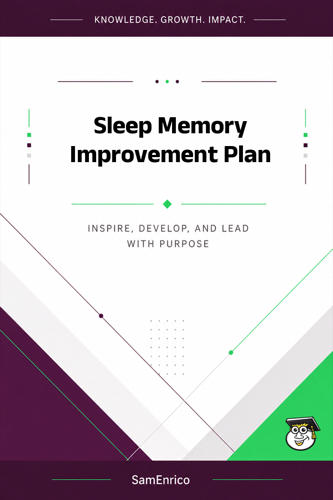
Sleep Memory Improvement Plan eBook
Thirty day program to boost recall through better
Thirty day program to boost recall through better rest.
Formats
Free sample
Chapter 1: The Midnight Librarian...--–- You do not have a bad memory. You have a sleep debt.This single sentence has the power to reshape everything you believe about forgetfulness. For years, you have likely blamed yourself—your age, your genetics, your intelligence, or some vague sense that your brain is simply "worn out." You have tried post-it notes, phone reminders, repeating names three times upon introduction, and perhaps even expensive "brain training" apps. And yet, the forgetting persists. The keys vanish.
The name evaporates. The appointment slips through the cracks of your consciousness like water through a sieve.What if the problem was never your memory at all? What if the issue was not the storage system but the time allocated for filing?Every night, while you lie motionless on a mattress, your brain performs one of the most sophisticated data-management operations in the known universe. It does not rest. It does not power down.
Instead, it becomes a librarian—a tireless, nocturnal archivist who sorts through the day's events, decides what to keep, what to discard, and where to file everything for rapid retrieval tomorrow. This librarian works only during sleep. If you cut your sleep short, you are not simply "resting less." You are firing the only employee capable of organizing your memories.This chapter dismantles the most damaging myth of modern productivity: the idea that sleep is wasted time. Drawing on the combined research of Matthew Walker (Why We Sleep), Lisa Genova (Remember), and the sleep labs of UC Berkeley and Harvard, we will establish the foundational science of memory consolidation. You will take a diagnostic test to measure your current recall baseline—a test you will retake on Day 30 to witness your transformation.
And you will begin your first daily action: the Memory Slip Log, a simple but devastatingly effective tool that will quantify exactly what you have been losing.By the end of this chapter, you will never look at your pillow the same way again.The Three-Step Memory Process: Encoding, Consolidation, Retrieval Before we can fix a problem, we must understand its machinery. Human memory operates in three distinct phases, only one of which has received any meaningful attention from self-help books and productivity gurus.Step One: Encoding Encoding is the moment of learning. It happens when you are awake—reading a book, listening to a podcast, meeting a new colleague, or even noticing where you placed your keys. During encoding, your sensory organs (eyes, ears, skin) convert information into electrical signals that travel to your hippocampus, a seahorse-shaped structure deep in your brain's temporal lobe.Here is what most people get wrong: encoding is not the hard part. Your brain encodes thousands of pieces of information every hour without conscious effort.
You do not need to "try harder" to encode. In fact, trying too hard often backfires, creating anxiety that blocks the encoding process entirely.Step Two: Consolidation Consolidation is the hidden hero of memory—and it is almost entirely invisible to your waking awareness. During consolidation, your brain stabilizes a memory trace, strengthens the neural connections that represent that information, and integrates the new memory with existing knowledge networks. This is the difference between hearing a name and actually owning that name tomorrow morning.Here is the truth that will change your life: Consolidation happens mostly during sleep.I use the word "mostly" carefully, because it matters. Some early, fragile consolidation can occur during quiet wakefulness—a phenomenon we will exploit in Chapter 10 with the Wakeful Rest technique.
But the deep, durable, lifelong consolidation that allows you to recall a fact under pressure, without hesitation, requires sleep. Specifically, it requires two types of sleep: NREM (Non-Rapid Eye Movement) for factual, declarative memory, and REM (Rapid Eye Movement) for emotional and procedural memory.Without sufficient sleep, consolidation fails. You can sit through a four-hour lecture, highlight every page, and still remember almost nothing the next day—not because you are stupid, but because your hippocampus never got permission to save the file.Step Three: Retrieval Retrieval is what most people call "remembering." It is the act of pulling a stored memory back into conscious awareness. Retrieval problems are almost never storage problems. When you cannot remember a name you learned yesterday, the name is still in your brain—somewhere.
The issue is that the consolidation process was weak, so the retrieval pathway is overgrown with neglect, like a hiking trail after a decade without use.Sleep strengthens retrieval pathways. Every hour of deep sleep acts like a maintenance crew, clearing brush, reinforcing bridges, and marking the trail so you can find it again tomorrow.The Midnight Librarian: A Metaphor That Will Change Your Relationship with Sleep Imagine a vast library. This library contains every book you have ever read, every conversation you have ever had, every face you have ever seen, and every fact you have ever learned. The library is enormous—capable of storing virtually unlimited information. Scientists estimate the human brain's storage capacity at approximately 2.5 petabytes, or roughly three million hours of television.But a library without a librarian is chaos.
Books are returned to the wrong shelves. New acquisitions sit in unpacked boxes. Old, irrelevant volumes clutter the aisles, making it impossible to find what you actually need.During the day, you are awake and active. You are checking out books, reading them, and tossing them aside. You are also bringing new acquisitions into the library—every conversation, every email, every observation.
By bedtime, the library is a disaster zone. Books are piled on the floor. New arrivals sit in overflowing carts. There is no system, only accumulation.Then you fall asleep.The moment you drift into NREM sleep, a new employee arrives for work. This is the Midnight Librarian.
Unlike you, the librarian is methodical, ruthless, and efficient. The librarian's job is to take the chaos of your day and transform it into an organized, searchable archive by morning.The librarian performs three critical tasks:Task One: Sorting The librarian reviews every book (memory) from the day and decides which category it belongs to. Declarative memories (facts, dates, vocabulary) go to the cortex for long-term storage. Procedural memories (how to ride a bike, play piano, type on a keyboard) go to the cerebellum and basal ganglia. Emotional memories go to the amygdala.
Without this sorting, all memories remain in the hippocampus—a temporary holding area with very limited space.Task Two: Filing Once sorted, the librarian files each memory in its proper location. This is not a simple process. Filing requires strengthening the synaptic connections between neurons—a biological process that consumes energy and resources. The librarian also integrates new memories with old ones, creating associations that will later allow you to retrieve information through multiple pathways.Task Three: Discarding The librarian is also responsible for deletion. Not every memory deserves permanent storage.
The brain would quickly become overwhelmed if it kept every detail of every day. The librarian identifies which memories are irrelevant—the color of the car that passed you on the highway, the background noise in a coffee shop, the third email in a chain of twenty—and sends them to the trash.This discarding process is…
This is the end of the free sample. Get the eBook to keep going. Buy now
About this book
Details
- Author
- Hillman Zetta
- Publisher
- SamEnrico
- Language
- English
- Genre
- Non-Fiction, Self-Help, 30 Day
- Released
- 2026-06-07
- Pages (approx.)
- 157
- Available as
- eBook, Audiobook

Read better in the ZLOADR app
Your eBooks on your phone or tablet. Sign in with your SamEnrico account and start reading.
More by Hillman Zetta
 Navigating Custody DisputesHillman Zetta$11.99
 Etsy Digital Planner Income Tax GuideHillman Zetta$11.99
 Segmentation Overlay HandbookHillman Zetta$11.99
 Attention Residue Reduction ProtocolHillman Zetta$11.99
 The Olmec Skywatchers: Cosmic Origins in Ancient MesoamericaHillman Zetta$11.99
 The Algorithm King: How a Math Genius Built a $100B EmpireHillman Zetta$11.99
 Recovery Coach Board RoleHillman Zetta$12.99
 Internal Comms Style Guide GlobalHillman Zetta$12.99
 Understanding CholelithiasisHillman Zetta$17.99
 Lead Quality Assurance AnalystHillman Zetta$11.99
 Ultimate Handbook Guide to Philadelphia : (United States) Travel GuideHillman Zetta$11.99
You may also like
 Workplace Esteem ChallengeRife Lolita$11.99
 Jealousy ChallengeMcdougal Caprice$11.99
 Sleep Meditation ChallengeGarrison Florinda$11.99
 Purpose Challenge GuideWhittaker Luis$11.99
 Personal Ing For Success ChallengeCulver Larisa$11.99
 Flow ChallengeOuellette Harriette$11.99
 Creative Block ChallengeAnaya Caroyln$11.99
 Affirmation ChallengeMelvin Dorris$11.99
 Loneliness ChallengeDick Kasie$11.99
 Post Hypnotic ChallengeMcreynolds Rhiannon$11.99
 Divorce ChallengeRoby Mia$11.99
 Improv ChallengeSchell Dusty$11.99