
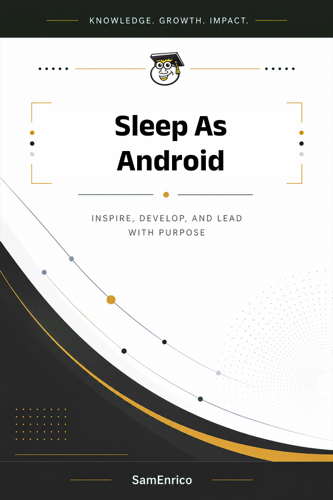
Non-FictionHealth & WellnessAndroid
Sleep As Android eBook
Teaches smart wake up and sleep talk recording.
by Mcgill Sena
Teaches smart wake up and sleep talk recording.
Formats
Free sample
Chapter 1: The Daily Assault--–- The first time you woke up today, you were probably dreaming. Maybe you were flying, or arguing with a high school teacher, or finally figuring out that impossible work problem. Your brain was exactly where it needed to be: in the delicate, restorative architecture of sleep. Then, without warning, an electronic shriek tore through your skull. Your heart rate doubled in three seconds.
Your blood pressure spiked. Your muscles contracted involuntarily. You gasped. And then you did something truly strange: you thanked the device that had just assaulted you.We call this an alarm clock. We call it normal.
We call it necessary.We are wrong on all three counts.The Physiology of Violence Let us walk through what actually happens inside your body when a traditional alarm clock erupts at 6:30 AM. You are, let us assume, in the middle of a sleep cycle. Not the light, dreamy stage where you might be gently floating through a meadow. No, statistically, you are likely in deep sleep—also known as slow-wave or NREM Stage 3 sleep. This is the phase where your brain waves have slowed to a rhythmic delta pattern of approximately one to four cycles per second.
Your body has paralyzed itself to prevent you from acting out dreams. Your blood pressure has dropped by roughly 15 percent. Your cortisol, the stress hormone that keeps you alert during the day, has bottomed out to its lowest level in 24 hours. You are, biologically speaking, closer to a hibernating bear than to a functioning human.Then the alarm fires.Within one second, your reticular activating system—a bundle of nerves at the core of your brainstem responsible for wakefulness—receives a shockwave of acoustic input. Within two seconds, your amygdala, the brain's threat detection center, has classified the sound as a potential danger.
Within three seconds, your sympathetic nervous system floods your body with adrenaline and noradrenaline. Your heart rate jumps from approximately 55 beats per minute to 95 beats per minute or higher. Your blood pressure follows suit. Your pupils dilate. Your muscles, which were paralyzed moments ago, tense for fight or flight.You have just experienced exactly the same physiological cascade as someone who heard a gunshot or a breaking window in the middle of the night.This is not an exaggeration.
This is not poetic license. A 2015 study from the National Institute of Industrial Health in Japan measured cortisol levels in subjects woken by standard alarms versus gradual, light-based wake systems. The standard alarm group showed cortisol spikes averaging 74 percent above baseline. The gradual wake group showed spikes of only 12 percent. And here is the detail that should terrify you: the cortisol elevation lasted for more than two hours after waking in the standard alarm group.
You are not just being startled. You are being chemically altered for half your morning.The Myth of the Morning Person We have a cultural script for what happens next. The awakened person groans, squints at the clock, and reaches for the snooze button. They mutter something about not being a "morning person." They blame their genetics, their late-night work habits, or their lack of coffee. But the problem is not their chronotype—the natural preference for evening or morning activity that about half the population inherits.
The problem is that they have been dragged out of the wrong sleep stage.Let us distinguish between two very different states that we conflate under the single word "tiredness."Sleep Inertia is the groggy, disoriented, cognitively impaired state that occurs immediately upon waking from deep or REM sleep. It is not a feeling. It is a measurable neurological condition. Your prefrontal cortex—the part of your brain responsible for decision-making, impulse control, and rational thought—takes anywhere from fifteen minutes to four hours to "boot up" after a deep-sleep awakening. During this period, you are functionally drunk.
Studies using the psychomotor vigilance task, a standard test of reaction time and attention, have shown that people in the throes of sleep inertia perform as poorly as individuals with a blood alcohol concentration of 0.08 percent. You are legally too impaired to drive. And yet you are about to make breakfast, answer emails, and possibly operate heavy machinery.Simple tiredness, by contrast, is the result of insufficient total sleep duration. It feels heavy and slow, but it does not come with the same cognitive whiplash. You can be tired but still think clearly.
You cannot be in sleep inertia and think clearly. The two states require completely different solutions: tiredness requires more total sleep; sleep inertia requires better timing of the wake-up.Here is the brutal truth that sleep labs have known for decades but have failed to communicate effectively: most people who believe they are "bad at mornings" are actually waking from the wrong sleep stage. Their chronotype may be perfectly average. Their total sleep time may be adequate. But their alarm clock is a blunt instrument that fires at a fixed time regardless of what is happening in their brain.
And their brain, being a biological system that does not care about meeting schedules, is often in deep sleep at that fixed time.The Paradox of the Snooze Button The snooze button is one of the most brilliantly deceptive inventions in human history. It feels like mercy. It feels like a gentle negotiation with reality. In truth, it is a torture device that fragments the most important sleep of the night.Let us understand what happens when you hit snooze. Your alarm wakes you, likely from deep or REM sleep.
You experience the full cortisol spike described above. You reach for the button. The alarm stops. You close your eyes. And then, because your brain is desperate for restoration, it attempts to return to the sleep stage it was just violently expelled from.
This takes approximately five to seven minutes—just in time for the next alarm to fire nine minutes after the first.You are not getting an extra nine minutes of rest. You are getting an extra nine minutes of neurological chaos. Each snooze cycle forces your brain to attempt re-entry into deep sleep, then rips it out again. The result is a phenomenon called sleep fragmentation, which has been linked to increased inflammation markers, impaired memory consolidation, and elevated risk of cardiovascular events. A 2019 study from the University of Notre Dame analyzed the sleep patterns of over 450 adults and found that those who used the snooze button reported significantly more sleep inertia, fatigue, and irritability than those who did not—even when total sleep time was identical.The snooze button does not give you more sleep.
It gives you worse sleep. And it trains your brain to associate the sound of your alarm with a negotiable threat, which paradoxically makes each subsequent alarm feel more jarring.How the Top One Percent Wake Up If traditional alarms are a public health hazard and snooze buttons are self-deception, how do the people who absolutely cannot afford morning dysfunction wake up? How do neurosurgeons preparing for a twelve-hour operation wake up? How do Olympic gymnasts competing at 8:00 AM wake up? How do air traffic controllers managing hundreds of flights per shift wake up?The answer…
This is the end of the free sample. Get the eBook to keep going. Buy now
About this book
Details
- Author
- Mcgill Sena
- Publisher
- SamEnrico
- Language
- English
- Genre
- Non-Fiction, Health & Wellness, Android
- Released
- 2026-06-06
- Pages (approx.)
- 129
- Available as
- eBook, Audiobook

Read better in the ZLOADR app
Your eBooks on your phone or tablet. Sign in with your SamEnrico account and start reading.
More by Mcgill Sena
 Mnemonic Name Recall GuideMcgill Sena$11.99
 Etsy Vintage Hoarding HelpMcgill Sena$11.99
 Dance Partner Nonverbal LeadMcgill Sena$11.99
 Body Scan for Trauma RecoveryMcgill Sena$11.99
 Podcast Deep DiveMcgill Sena$11.99
 Homicide Prosecution GuideMcgill Sena$11.99
 Presentation Skills CourseMcgill Sena$11.99
 The Forgotten Titan: Wavell Wakefield and the Birth of Modern RugbyMcgill Sena$11.99
 The Lost Excalibur: A Knight’s Quest Through TimeMcgill Sena$11.99
 A Collector's Handbook to the Simca 1300Mcgill Sena$11.99
 How to Produce Advertising BoardsMcgill Sena$11.99
 US LLC Formation Cost BreakdownMcgill Sena$12.99
You may also like
 Hong Kong Handover 1997Dunn Johnnie$11.99
 Zumba For Postnatal Recovery CourseNeal Christian$11.99
 Zumba for BeginnersLadner Nikia$11.99
 YouTube Comment Mining GuideHumes Pandora$12.99
 Worry Box MeditationCarlin Rudy$11.99
 Workplace Stress MeditationNguyen Lynn$11.99
 Workplace Stress and Sleep RepairHawley Ivory$11.99
 Workplace Perfectionism CureDelaney Jeffry$11.99
 Workplace Injustice Anger GuideWallen Isabelle$11.99
 Work Addiction and Burnout LinkGreenwood Ester$11.99
 Women in Yoga and WellnessBeattie Galina$11.99
 Women in Stand Up ComedyChun Evangeline$11.99