
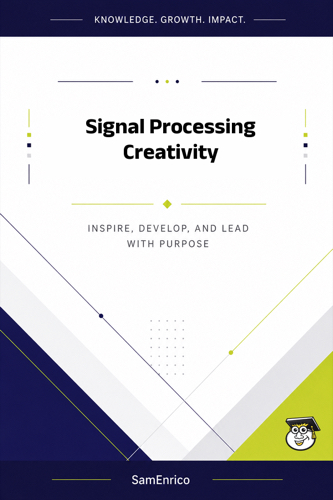
Signal Processing Creativity eBook
Extract novel insights from noisy data using creat
by Marble Mendy
Extract novel insights from noisy data using creative filtering.
Formats
Free sample
Chapter 1: The Filtering Paradox--–- Every morning, you perform a miracle of signal processing. You wake to the sound of an alarm—perhaps birdsong, perhaps a beep, perhaps a child's voice. Your ears receive thousands of frequencies simultaneously: the hum of a refrigerator, the distant rush of traffic, the rustle of sheets, the pulse of blood in your own temples. Yet within milliseconds, your brain isolates the one sound that matters and elevates it to consciousness. The rest becomes noise.
Discarded. Forgotten.You do this without thinking. You do it perfectly. And then you walk into your office and completely forget how to do it at all.Consider the evidence. The average knowledge worker receives 124 emails per day, attends 3.5 hours of meetings, switches tasks every 10.5 minutes, and reports feeling "overwhelmed by information" more than 80% of the time.
Yet the same person can walk into a crowded cocktail party and hear their name spoken across a room of two hundred people. The same brain that effortlessly filters the auditory world drowns in the digital one. Why?The answer is both simple and devastating: we have never been taught to filter. We have been taught to gather, analyze, store, and retrieve. We have been taught critical thinking, creative brainstorming, and data analysis.
We have been taught to produce more ideas, collect more evidence, and build more complex models. But no one has ever taught us the single most important cognitive skill for the twenty-first century: what to ignore, when to ignore it, and how to recognize that today's noise might be tomorrow's signal.This book is that education.The Accidental Breakthrough History's most transformative insights share a strange family resemblance: almost all of them were initially dismissed as noise.In 1928, Alexander Fleming returned from vacation to find that a mold had contaminated his bacterial cultures. His colleagues told him to throw out the ruined samples. Standard protocol would have filtered the contamination as noise—a failed experiment, a waste of materials, a lesson in laboratory hygiene. Instead, Fleming saw a weak signal: the mold appeared to be killing the bacteria.
He had discovered penicillin.In 1947, a young engineer at Bell Labs named Claude Shannon was tasked with improving telegraph communication. His colleagues focused on sending clearer signals—more power, better wires, less interference. Shannon instead became obsessed with a question everyone else had dismissed: What if we studied the noise itself? His resulting paper, "A Mathematical Theory of Communication," founded the entire field of information theory and made possible every digital device you now use. He won his Nobel Prize equivalent not by amplifying the signal, but by understanding the noise.In 2004, a Stanford graduate student named Larry Page had an idea that his faculty advisors called "noise." He proposed ranking web pages not by their content, but by their links—essentially, by what other people thought was important.
His professors told him it was statistically unsound, computationally infeasible, and academically unserious. Page and his partner Sergey Brin ignored the feedback. They had detected a weak signal that everyone else had filtered out. That signal became Google.Every field has its Fleming, its Shannon, its Page. Every breakthrough was once a weak signal buried in noise.
But for every celebrated success, there are thousands of weak signals that died—not because they were false, but because someone filtered them out too early. Someone said "that's just an outlier," "we don't have time to investigate that," "if it were important, we would have noticed it already." Someone over-filtered. Someone killed a breakthrough before it could breathe.This book is designed to ensure that you are not that someone.The Two Ways to Fail All creative failure in the face of noise reduces to one of two errors. Neither is a failure of intelligence, effort, or good intentions. Both are failures of filtering.Error One: Over-Filtering (The Type I Filtering Error)Over-filtering is the premature discarding of weak signals as noise.
It is the researcher who deletes outliers from their dataset because they "don't fit the model." It is the executive who dismisses a customer complaint as "just one person" without asking what it represents. It is the team that rejects a novel idea in the first thirty seconds of a meeting because "we've already tried something like that."Over-filtering feels efficient. It feels decisive. It feels like good judgment. And it is the single greatest predictor of incremental thinking, missed opportunities, and organizational decline.Consider the case of Kodak.
In 1975, a young engineer named Steven Sasson invented the first digital camera. His managers at Kodak saw the prototype and asked him to hide it. Not because it didn't work—it worked beautifully. But because digital photography was a weak signal that threatened Kodak's core business of selling film. The company filtered out the signal.
They called it "cute" and "not ready for prime time." By the time they realized the signal was real, it was too late. Kodak filed for bankruptcy in 2012. The weak signal they killed had become a tidal wave.Over-filtering is not a failure of perception. It is a failure of temporal calibration—judging a weak signal by its current amplitude rather than its potential future impact. The seed does not look like the tree.
The baby does not look like the adult. The weak signal does not look like the breakthrough. But the seed, the baby, and the signal all contain the same potential. Over-filtering destroys potential by mistaking present weakness for permanent irrelevance.Error Two: Under-Filtering (The Type II Filtering Error)Under-filtering is the failure to discard noise, leading to analysis paralysis, burnout, and the inability to distinguish signal from noise. It is the entrepreneur who chases every trend because they fear missing the one that matters.
It is the analyst who builds increasingly complex models to account for every possible variable. It is the manager who attends every meeting, reads every email, and responds to every request—then wonders why they never have time for strategic thinking.Under-filtering feels thorough. It feels responsible. It feels like due diligence. And it is the single greatest predictor of exhaustion, mediocrity, and decision avoidance.Consider the case of Blockbuster.
In the early 2000s, the video rental giant was drowning in data: store traffic patterns, inventory turnover, customer demographics, late fee revenue. Their analysts built sophisticated models to optimize every variable. But they filtered out nothing. They were so busy optimizing their existing business that they missed the weak signal that would destroy them: a small startup called Netflix that was mailing DVDs to customers' homes. Blockbuster had data on everything except the future.
Under-filtering had blinded them to the one signal that mattered.Under-filtering is not a failure of attention. It is a failure of selective attention—the inability to distinguish between the urgent and the important, the loud and the significant, the noisy and the meaningful. The brain has limited processing capacity. Every email you read is a weak signal you did not investigate. Every meeting you attend is an anomaly you did not hunt.
Every decision you defer is a hypothesis you did not test. Under-filtering spreads attention so thin that nothing penetrates.The Paradox at the Heart of…
This is the end of the free sample. Get the eBook to keep going. Buy now
About this book
Details
- Author
- Marble Mendy
- Publisher
- SamEnrico
- Language
- English
- Genre
- Non-Fiction, Self-Help, Signal Processing
- Released
- 2026-06-10
- Pages (approx.)
- 134
- Available as
- eBook, Audiobook

Read better in the ZLOADR app
Your eBooks on your phone or tablet. Sign in with your SamEnrico account and start reading.
More by Marble Mendy
 Blue Zone Superfoods ListMarble Mendy$11.99
 Rheumatoid Arthritis PracticeMarble Mendy$11.99
 Cold Calling for WholesalersMarble Mendy$11.99
 Holidays After Baby LossMarble Mendy$11.99
 Weekly Hour Audit MethodMarble Mendy$11.99
 Anger Restructuring for AddictionMarble Mendy$11.99
 Gaming and Work PerformanceMarble Mendy$11.99
 The Ghosts of Pythagoras: Numbers That Haunt the AgesMarble Mendy$11.99
 Gwythyr and Creiddylad: The Everlasting Feud of the Welsh OtherworldMarble Mendy$11.99
 A Collector's Handbook to the Alfa Romeo Alfetta 2.0 GtvMarble Mendy$11.99
 How to Produce Reptile and Amphibian Habitat Heating and LightingMarble Mendy$11.99
 How to Produce Fabric RefreshersMarble Mendy$11.99