
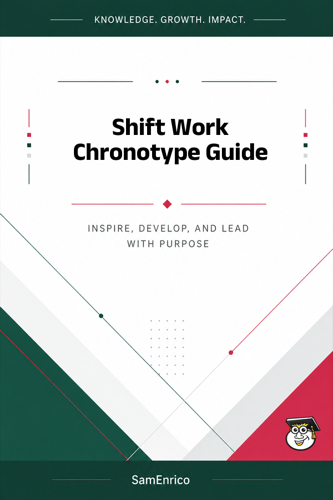
Shift Work Chronotype Guide eBook
Matches shift assignment to genetic sleep tendenci
by Vega Crystal
Matches shift assignment to genetic sleep tendencies.
Formats
Free sample
Chapter 1: The War Inside--–- The alarm screams at 4:47 AM. You have been awake for exactly eleven seconds, and already your body is staging a rebellion. Your eyelids feel like sandbags. Your brain is wrapped in cotton wool. Your stomach lurches at the thought of coffee, even though you know you will drink it anyway.
And somewhere deep in your chest, a voice whispers the same question it whispers every single day: What is wrong with me?The short answer is nothing. The longer answer—the one that fills the next three hundred pages—is that you have been fighting a war you were never designed to win. The enemy is not your lack of willpower, your poor attitude, or your failure to "just get more sleep." The enemy is time itself. Or more precisely, the enemy is the collision between your ancient biological clock and a modern economy that demands you ignore it.Every shift worker knows this war intimately. The nurse who drags herself through a sixteen-hour night shift, only to lie awake at noon with her heart pounding and her mind racing.
The factory worker who has rotated from days to nights to afternoons so many times that he no longer remembers what "well-rested" feels like. The truck driver who mainlines energy drinks and tells himself he is fine, even as his eyelids droop at seventy miles per hour. The young parent working the swing shift, who kisses sleeping children goodbye and returns home to find them already gone to school, wondering if they will remember their face.These are not failures of character. They are failures of alignment. And the first step toward fixing that alignment is understanding exactly what you are fighting against.The Invisible Conductor Deep inside your brain, tucked behind your eyes and buried in a region called the hypothalamus, there is a cluster of approximately twenty thousand neurons no larger than a grain of rice.
Its scientific name is the suprachiasmatic nucleus, but you can think of it as your body's master conductor. Every second of every day, this tiny cluster of cells sends out rhythmic signals that orchestrate a symphony of biological processes—your temperature, your hormone levels, your digestion, your immune response, your alertness, your sleepiness, even the rate at which your cells repair damage and divide.This conductor does not take requests. It does not care about your deadlines, your bills, your family obligations, or your desire to be productive. It operates on a schedule that was refined over hundreds of millions of years of evolution, long before humans invented electricity, let alone the night shift. Its rhythm is not twenty-four hours exactly.
In most people, the natural cycle runs slightly longer—about twenty-four hours and eleven minutes. That eleven-minute discrepancy is why your bedtime creeps later if you let yourself sleep without an alarm. It is also why shift work feels like swimming against a current that never stops flowing.The conductor's primary tool is a hormone called melatonin. About two hours before your body expects to sleep, the pineal gland begins releasing melatonin into your bloodstream. You do not "feel" this release as a sensation, but you experience its effects: your core body temperature drops slightly, your metabolism slows, your brain waves begin to shift from the fast beta rhythms of alertness to the slower alpha and theta rhythms of drowsiness.
By the time melatonin peaks, you are ready to sleep—not because you have decided to, but because your biology has decided for you.Then, about two hours before your body expects to wake, something remarkable happens. The melatonin release stops. Your adrenal glands begin producing cortisol, the alertness hormone. Your core body temperature starts rising. Your metabolism kicks back into gear.
You wake up not because of the alarm clock, but because your body is chemically pushing you toward consciousness. This is why people who are well-aligned with their natural rhythm wake up feeling alert, even before coffee. Their conductor has already done the work.But here is the problem that defines the shift worker's existence: the conductor cannot be reasoned with. It cannot be bribed. It cannot be trained.
It can be shifted—slowly, painfully, and only within certain limits—but it cannot be reprogrammed. When you ask your body to sleep at 8 AM and work at 2 AM, you are not asking for a minor adjustment. You are asking for a fundamental violation of a biological system that has been optimized for a million years of sunrise and sunset.The Myth of the Morning Person For decades, shift workers have been told a simple, seductive lie. The lie takes many forms, but it always boils down to the same core message: If you just tried harder, you could adapt. Get blackout curtains.
Maintain a consistent sleep schedule. Avoid caffeine before bed. Practice good sleep hygiene. These are not bad suggestions, as far as they go. But they assume something that is not true: that all human bodies are fundamentally the same, and that failure to adjust is a failure of effort.This is the willpower myth, and it is one of the most destructive ideas in the history of occupational health.The reality, which we will explore in depth in Chapter 2, is that human beings are born with deeply ingrained sleep tendencies that are as heritable as height or eye color.
Some people are biologically programmed to wake early and peak in the morning hours. These are the larks. Others are programmed to stay up late and peak in the evening or nighttime hours. These are the owls. And most people—about sixty to eighty percent of the population—fall somewhere in the middle, with a natural preference that leans slightly one way or the other.These tendencies are not choices.
They are not habits. They are encoded in your DNA, written into the sequence of your clock genes, expressed in the very architecture of your brain. A lark who tries to work nights is not being lazy or weak-willed when she struggles to stay alert at 3 AM. She is asking her body to do something it was never designed to do. An owl who drags himself out of bed for a 6 AM shift is not failing at self-discipline.
He is fighting a genetic programming that wants him to be asleep for another three hours.The willpower myth persists because it is convenient. It allows employers to blame workers for exhaustion that is actually caused by poorly designed schedules. It allows society to moralize about sleep without understanding the biology that governs it. And it allows shift workers to internalize their struggles as personal failings, adding shame to the already crushing weight of fatigue.Here is the truth: no amount of willpower can override a genetic mismatch. You cannot meditate your way out of a circadian rhythm disorder.
You cannot positive-think your way through melatonin release. You can force your body to stay awake through sheer adrenaline and caffeine—millions of shift workers do it every night—but you cannot force it to be healthy while doing so. The cost always comes due.Social Jet Lag: The Debt You Cannot Repay There is a phenomenon that sleep…
This is the end of the free sample. Get the eBook to keep going. Buy now
About this book
Details
- Author
- Vega Crystal
- Publisher
- SamEnrico
- Language
- English
- Genre
- Non-Fiction, Health & Wellness, Chronotypes
- Released
- 2026-06-08
- Pages (approx.)
- 137
- Available as
- eBook, Audiobook

Read better in the ZLOADR app
Your eBooks on your phone or tablet. Sign in with your SamEnrico account and start reading.
More by Vega Crystal
 The Amends Letter Writing GuideVega Crystal$11.99
 Plateau Self CompassionVega Crystal$11.99
 IBS For Women GuideVega Crystal$11.99
 Purpose Through NatureVega Crystal$11.99
 Radical Responsibility ShiftVega Crystal$11.99
 Parent of Special Needs ChildVega Crystal$11.99Parent of Special Needs ChildVega Crystal$11.99
 Elizabeth Privy Council ManagementVega Crystal$11.99
 The Druid Queen of Eriu: Love and Legends of the Celtic DawnVega Crystal$11.99
 Cosmic Jellyfish: The Glowing Guardians of the DeepVega Crystal$11.99
 How to Produce ToysVega Crystal$11.99
 Portfolio Career Income GoalsVega Crystal$12.99
You may also like
 Napping for Night OwlsBourque Jolyn$11.99
 Night Owl Survival GuideHolden Elnora$11.99
 Chronotype Child Sleep GuideShank Cherlyn$11.99
 Nap for Early Risers GuideNorwood Rachell$11.99
 Nap Chronotype GuideDayton Delisa$11.99
 Chronotype Quiz and TypesLavoie Kasie$11.99
 Nap for Night Owls GuideRaney Reda$11.99
 Early Lark Survival GuideFairley Daisey$11.99