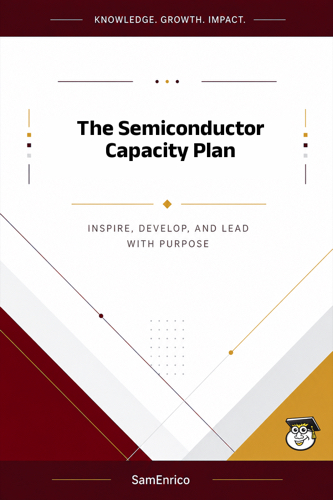
Semiconductor Capacity Allocation eBook
Directs capital to fabs, advanced packaging, and c
Directs capital to fabs, advanced packaging, and chip design automation.
Formats
Free sample
Chapter 1: The Fragile Machine--The $2 part that stopped a $50,000 truck.On the morning of May 18, 2021, the Ford Michigan Assembly Plant in Wayne, Michigan, fell silent. Seven thousand workers clocked in, walked to their stations, and then stood idle. The massive robots that normally weld and stamp with surgical precision hung motionless. The assembly line that typically produces an F-150 truck every fifty-three seconds did not move for ten consecutive hours.The cause was not a strike. Not a power outage.
Not a blizzard or a flood or a cyberattack. The cause was a single semiconductor component that costs approximately two dollars. It was a humble microcontroller responsible for a seemingly unglamorous function: the anti-lock braking system. Without that two-dollar chip, Ford could not legally sell an F-150. And without F-150s—the single most profitable vehicle line in the history of the automobile—Ford would lose an estimated $2.5 billion in revenue over the course of the shortage.But here is the detail that the news headlines missed.
It was not that the chip did not exist. It was that the chip was in the wrong place. Thousands of miles away, in a sprawling facility in Hsinchu, Taiwan, that exact microcontroller sat in a finished wafer lot, already tested, already singulated, already ready for shipment. It had been allocated to a different customer—a smartphone manufacturer whose order had been placed eighteen months earlier, under a long-term agreement that gave them priority over Ford's last-minute spot purchase.The capacity existed. The allocation was the problem.This book is about that problem.
It is about the trillion dollars that will be spent over the next decade to build the machines that make the machines that power the modern world. It is about the mathematics, politics, and human judgment that determine which chips get built, for whom, and at what price. And it is about the central insight that the semiconductor industry has only recently begun to accept: that the shortage of the 2020s was not a shortage of fabs. It was a shortage of the systems that decide what those fabs produce.The New Physics of Capital For fifty years, the semiconductor industry operated according to a relatively simple rule: build smaller transistors, pack more of them onto a wafer, and the cost per transistor will reliably fall. Gordon Moore's 1965 observation—that the number of transistors on a chip would double approximately every two years—became not a prediction but a mandate.
Companies that kept pace survived. Companies that fell behind disappeared.This cadence created a predictable capital allocation model. Every two to three years, a new node would emerge. The industry would collectively spend tens of billions of dollars on new lithography tools, new fab buildings, new chemical delivery systems. The logic was linear: more transistors, more capacity, more revenue.
Capital allocation was essentially an exercise in extrapolation.That world is dead.The death of Moore's Law as an economic certainty—not as a physical limit but as a cost-reduction engine—has shattered the old allocation model. Today, the cost per transistor at leading-edge nodes (3nm, 2nm, and beyond) is no longer declining. In some cases, it is rising. A single High-NA EUV lithography machine costs more than $300 million—the price of a small commercial jetliner. A leading-edge fab now requires fifteen to twenty such machines, plus supporting equipment, plus a building that can house a city block's worth of vibration-sensitive, temperature-controlled manufacturing cells.
The total price tag for a single 2nm fab: $20 billion to $30 billion.Twenty billion dollars. For one factory.And yet, the demand for chips has never been higher. The artificial intelligence revolution that began with the public release of Chat GPT in November 2022 triggered a demand spike unlike anything the industry had seen since the dawn of the smartphone era. In 2023 and 2024, NVIDIA, the primary beneficiary of AI demand, saw its quarterly data center revenue grow from $3.8 billion to over $18 billion—a nearly fivefold increase in eighteen months. That demand translated directly into capacity pressure on TSMC, the sole manufacturer of NVIDIA's most advanced AI accelerators.The result is a trillion-dollar capital allocation challenge that will define the semiconductor industry for the next decade.
According to industry forecasts from Mc Kinsey, SEMI, and the Semiconductor Industry Association, cumulative capital expenditures from 2023 through 2030 will exceed $1 trillion. That figure includes new fab construction (the headline-grabbing "megafabs" in Arizona, Ohio, Germany, and Japan), advanced packaging lines (the forgotten half of the industry that has become the binding constraint), and the materials and substrate supply chains that most executives still treat as someone else's problem.But the trillion-dollar figure is misleading. It suggests that the industry's problem is one of magnitude: we need more money. That is not the problem. The problem is allocation.The Three Diagnoses That Are Really One Before proceeding, this book must resolve a contradiction that has confused the semiconductor industry for years.
Ask three executives why capacity allocation is broken, and you will receive three different answers.The first executive, usually from a foundry or IDM, will say: "The problem is misallocation between logic, memory, and packaging. We are spending too much on leading-edge logic and not enough on the packaging that actually delivers the final product." This executive will point to the fact that advanced packaging currently receives only 15% of leading-edge Cap Ex, despite being the bottleneck for AI accelerators like NVIDIA's H100 and AMD's MI300.The second executive, often from a fabless design house or an equipment supplier, will say: "The problem is the cost curve. Beyond 5nm, the cost per transistor stops falling. We are building fabs that will never achieve the economic returns of previous generations." This executive will cite the brutal math of High-NA EUV: each machine costs $300 million, each fab requires fifteen to twenty of them, and the resulting wafers cost $20,000 or more—up from $5,000 per wafer at 28nm.The third executive, usually from an OSAT or a substrate supplier, will say: "The problem is underinvestment in packaging and materials. You can have all the leading-edge logic you want, but without ABF substrates and TSV interposers and hybrid bonding tools, you cannot assemble a final product." This executive will remind you that in 2021 and 2022, ABF substrate lead times stretched to fifty weeks or more—longer than the lead times for EUV lithography machines.These three diagnoses are not alternatives.
They are a causal chain.Here is the unified framework that resolves the confusion: Rising leading-edge costs (diagnosis two) make monolithic design economically unsustainable. This forces the industry toward chiplets—multiple smaller dies assembled into a single package (diagnosis three). But chiplets require advanced packaging, which has been chronically underinvested relative to logic. Therefore, capital must be reallocated from pure logic expansion toward packaging infrastructure (diagnosis one). The three problems are not separate.
They are the same problem viewed from different points in the value chain.This insight is the foundation of the entire book. Every subsequent chapter—from the mathematics of advanced planning and scheduling to the geopolitics of regionalization to the economics of digital twins—will return to this causal chain. The leaders of the next decade will be those who see the chain, not just the link in front of them.The Great…
This is the end of the free sample. Get the eBook to keep going. Buy now
About this book
Details
- Author
- Hammons Carman
- Publisher
- SamEnrico
- Language
- English
- Genre
- Non-Fiction, Forecast & Outlook, Microelectronics
- Released
- 2026-06-05
- Pages (approx.)
- 120
- Available as
- eBook, Audiobook

Read better in the ZLOADR app
Your eBooks on your phone or tablet. Sign in with your SamEnrico account and start reading.
More by Hammons Carman
 Affirmations For Decision Making GuideHammons Carman$11.99
 Stress And Chemo BrainHammons Carman$11.99
 Remote Review Calibration GuideHammons Carman$11.99
 Nightmare and Sleep TriggersHammons Carman$11.99
 The Tactical Genius of Mahmoud El-Gohary: Egypt's Football RevolutionHammons Carman$11.99
 How to Start a Investigation Service BusinessHammons Carman$11.99
 Employment LawHammons Carman$11.99
 Retail and Consumer Goods ESG ComparisonHammons Carman$12.99
 Mid Career Mentor LinkedIn GuideHammons Carman$12.99