
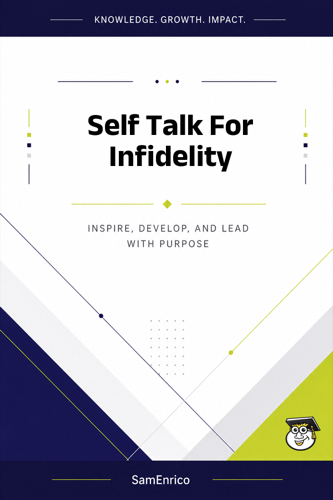
Self Talk For Infidelity eBook
Replace I wasn't enough for them with I am enough,
Replace I wasn't enough for them with I am enough, and they made a harmful choice.
Formats
Free sample
Chapter 1: The Earthquake Echo...--The discovery arrives in a shape you never expected. Perhaps it was a text message that lit up at 11:47 PM, a credit card receipt for a hotel you never visited, a sudden defensiveness about a “work friend” whose name kept appearing in stories that didn’t quite add up. Or maybe it was worse: a confession, offered like a grenade with the pin already pulled, leaving you to hold the wreckage. However it came, one thing is certain. In that instant, time split.
There is a Before and there is an After, and the space between them is measured not in minutes but in the force of an earthquake that has leveled every assumption you built your life upon.This chapter is not about the affair itself. It is not about the other person, the timeline of betrayals, or the logistics of who knew what and when. Those details will consume you for a time, and that is normal. But this chapter is about something more fundamental, something that, if you can grasp it now, will determine whether this earthquake becomes a permanent crater or the foundation of a different kind of life. This chapter is about the echo.The echo is the repetitive, looping thought that begins in the seconds after discovery and does not stop.
It has a rhythm, a pulse, a maddening consistency. I wasn’t enough. I wasn’t enough. I wasn’t enough. It may vary slightly—If I had been prettier, thinner, funnier, more successful, more attentive, more sexual, less needy—but the melody is the same.
The echo is a verdict delivered by your own voice, and it sounds like truth because it is coming from inside your own head. But the echo is not the truth. The echo is a trauma response dressed up as self-knowledge. And the first step toward reclaiming your worth after betrayal is learning to hear the echo for what it is: a survival mechanism that has outlived its usefulness.The Earthquake: What Actually Happens in the First 72 Hours Before we can address the echo, we must understand the earthquake. Post-Infidelity Stress Disorder, or PISD, is a term that has gained increasing recognition among trauma clinicians, though it is not yet formally listed alongside PTSD in diagnostic manuals.
The symptoms, however, are unmistakable and debilitating. In the immediate aftermath of discovering infidelity, the betrayed partner often experiences intrusive imagery—unwanted, vivid flashbacks of imagined scenes between the unfaithful partner and the other person. These are not memories; they are the brain’s attempt to construct a narrative out of incomplete and threatening information. The brain would rather have a painful story than an unknown one, because a story, even a terrible one, feels like it can be prepared for.Hypervigilance follows closely behind. You may find yourself checking phone records, tracking location data, scanning receipts, or monitoring social media activity.
This is not paranoia in the clinical sense; it is a threat-detection system operating at maximum capacity. Your nervous system has received a signal that your environment is not safe, and it is now scanning every input for additional threats. This is exhausting, and it is also entirely normal. The problem is not the hypervigilance itself but the belief that if you just gather enough data, you can prevent future pain. You cannot.
That is not a failing on your part; it is a limitation of data gathering as a strategy for emotional safety.Emotional numbness is another common symptom. You may feel nothing at all, or you may swing between sobbing and a strange, detached calm. This is the brain’s way of preventing overwhelm. There is only so much emotional information the system can process at once, and numbness is the circuit breaker. It is not a sign that you did not love them or that you are handling this “well.” It is a sign that your nervous system has temporarily shut down non-essential functions to preserve core operations.
Breathing, sleeping, eating, and basic survival take priority. Feeling everything all at once would be fatal to your functioning, so the brain parcels out the pain in doses you can tolerate.Fractured sense of time is perhaps the most disorienting symptom. You may find yourself unable to remember what you did yesterday, or you may feel as though the discovery happened both seconds ago and years ago. The “Before” feels like a different life, one that belonged to a different person. That is because, in a very real sense, it did.
The self that existed before the earthquake operated under a set of assumptions that have now been proven false: that your partner was honest, that your relationship was secure, that you could trust your own perception of reality. When those assumptions collapse, the self that was built on them also collapses. You are not going crazy. You are experiencing a fundamental reorganization of your sense of reality.The Echo: Why Your Brain Defaults to “What Is Wrong with Me?”Of all the symptoms of PISD, the echo is the most persistent and the most corrosive. Within minutes of discovery, sometimes within seconds, the brain asks a specific question: What did I do wrong?
This question arrives as though it were the most natural thing in the world, as though it were simply the next logical step in processing information. But it is not logical. It is a survival mechanism, and understanding that mechanism is the single most important insight you will gain from this chapter.The human brain is wired to seek control, especially under threat. When something bad happens, the brain’s default response is to ask, “Did I cause this?” Because if you caused it, then you can prevent it. If you caused the affair by being insufficient in some way, then you can become sufficient and the affair will not happen again.
This is not a rational calculation; it happens far below the level of conscious thought. It is an ancient neurological shortcut designed to preserve a sense of agency in a chaotic world. The problem is that this shortcut is catastrophically misapplied to infidelity.Consider what the brain is actually doing. In the face of evidence that your partner chose to deceive you, the brain could ask, “What is wrong with them?” That question leads to a terrifying conclusion: you have no control over their behavior. You cannot make someone honest through your own actions.
You cannot love someone into integrity. The only person whose behavior you can control is yourself. So the brain, seeking to preserve the illusion of control, defaults to the question that keeps control within your grasp: “What is wrong with me?” It is a lie, but it is a lie that feels safer than the truth. The truth is that you were betrayed by someone who made a series of harmful choices, and you had no power to prevent those choices because they were not yours to make.This is the cognitive illusion that runs throughout the entire experience of infidelity trauma. It appears in the echo (Chapter 1), in the protective function of shame (Chapter 2), and in the desperate hope that if…
This is the end of the free sample. Get the eBook to keep going. Buy now
About this book
Details
- Author
- Zarate Georgene
- Publisher
- SamEnrico
- Language
- English
- Genre
- Non-Fiction, Self-Help
- Released
- 2026-06-08
- Pages (approx.)
- 145
- Available as
- eBook, Audiobook

Read better in the ZLOADR app
Your eBooks on your phone or tablet. Sign in with your SamEnrico account and start reading.
More by Zarate Georgene
 Gambling Addict ChildhoodZarate Georgene$11.99
 The Gacy Media CircusZarate Georgene$11.99
 Cocaine and Alcohol CombinedZarate Georgene$11.99
 LTC Insurance For Same Sex CouplesZarate Georgene$11.99
 Sleep for Driving SkillsZarate Georgene$11.99
 Breath Awareness for Hospice CareZarate Georgene$11.99
 The Relapse Recovery PlanZarate Georgene$11.99
 TM For Decision MakingZarate Georgene$11.99
 The Sky That Fell: The Day the Stars DiedZarate Georgene$11.99
 Scharnhorst: The Architect of Prussian PowerZarate Georgene$11.99
 The Clockwork Dreamer: The Untold Story of Nikola Tesla’s Forgotten InventionsZarate Georgene$11.99
 The Dancer's Guide to Formation DanceZarate Georgene$11.99
You may also like
 Hong Kong Handover 1997Dunn Johnnie$11.99
 Zumba For Postnatal Recovery CourseNeal Christian$11.99
 Zumba for BeginnersLadner Nikia$11.99
 YouTube Comment Mining GuideHumes Pandora$12.99
 Worry Box MeditationCarlin Rudy$11.99
 Workplace Stress MeditationNguyen Lynn$11.99
 Workplace Stress and Sleep RepairHawley Ivory$11.99
 Workplace Perfectionism CureDelaney Jeffry$11.99
 Workplace Injustice Anger GuideWallen Isabelle$11.99
 Work Addiction and Burnout LinkGreenwood Ester$11.99
 Women in Yoga and WellnessBeattie Galina$11.99
 Women in Stand Up ComedyChun Evangeline$11.99