
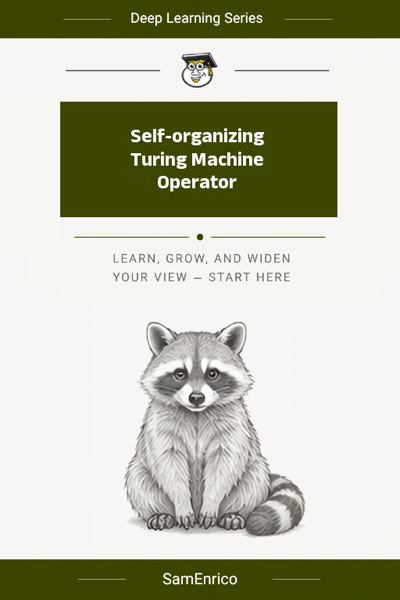
Self-organizing Turing Machine Operator Audiobook
A Coursebook on Self-organizing Turing Machine Ope
A Coursebook on Self-organizing Turing Machine Operator
Formats
Free sample
Chapter 1: The Last Instruction--– In the summer of 1936, a young mathematician named Alan Turing asked a question that would shape the next hundred years of human civilization. He asked: what is a machine? Not any specific machine—not a steam engine, not a loom, not a difference engine. He asked: what is the essential nature of computation itself? His answer, now known as the Universal Turing Machine, was a masterpiece of radical simplification.
An infinite tape divided into squares, each containing a symbol. A read-write head that moves left or right, reading symbols and writing new ones. A finite table of rules that tells the head what to do next based on the symbol it sees and the internal state it is in.That was it. No gears. No wires.
No electricity. Just the barest skeleton of what it means to compute. And yet Turing proved that this machine—this impossibly simple abstraction—could simulate any conceivable computation. Any algorithm. Any program.
Any sequence of logical steps that could be written down. Every digital computer that has ever been built, from the room-sized ENIAC to the smartphone in your pocket, is at its core a Turing Machine. Faster, yes. Smaller, yes. But not fundamentally different.The instructions are still fixed.
The rules still do not change.And that is the problem.The world changes. The environment shifts. Novel situations arise that no programmer anticipated. A Mars rover encounters a dust storm whose behavior was not modeled in any simulation on Earth. A financial trading algorithm confronts a market crash that bears no resemblance to any historical precedent.
A medical diagnosis system sees a patient with symptoms that do not match any entry in its meticulously curated database. In each case, the classical Turing Machine—the laptop, the server, the embedded system—does exactly what it was programmed to do. It follows its fixed rules. It does not adapt. It does not improvise.
It does not, because it cannot, rewrite itself.This book is about the machine that can.This book is about the Self-organizing Turing Machine Operator.The Wall That Turing Built The Halting Problem is one of the most famous results in computer science, and also one of the most misunderstood. Turing proved that no general algorithm can determine, for an arbitrary program and an arbitrary input, whether that program will eventually stop running or run forever. The proof is elegant and…
This is the end of the free sample. Get the Audiobook to keep going. Buy now
About this book
Details
- Author
- Parham Elfrieda
- Publisher
- SamEnrico
- Language
- English
- Genre
- Non-Fiction, Informative, Educational
- Released
- 2026-05-11
- Pages (approx.)
- 157
- Available as
- eBook, Audiobook

Listen in the VoxFlicks app
Audiobooks and audio dramas wherever you go. Sign in with your SamEnrico account and press play.
More by Parham Elfrieda
 Tesla Status Symbol TrapParham Elfrieda$11.99
 Remote Company Retreats For Distributed Customer SupportParham Elfrieda$11.99
 The Vitamin D Memory GuideParham Elfrieda$11.99
 Faron Young Hillbilly HeartParham Elfrieda$11.99
 Burnout Prevention Music TherapyParham Elfrieda$11.99
 Virginia Woolf and the Bloomsbury Revolution: How a Group of Radical Thinkers Changed LiteratureParham Elfrieda$11.99
 How to Become a Polishing-machine OperatorParham Elfrieda$11.99
 Shea Export Insurance GuideParham Elfrieda$12.99
 Korean Study Abroad PartnersParham Elfrieda$12.99
 Understanding Short Bowel SyndromeParham Elfrieda$17.99