
Non-FictionSelf-Help / Teamwork
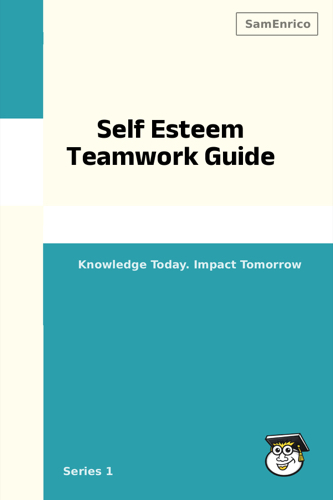
Self Esteem Teamwork Guide eBook
Builds confidence to contribute in team settings a
by Blair Marian
Builds confidence to contribute in team settings and rely on others.
Formats
Free sample
Chapter 1: The Contribution Trap--–- Most people believe they have a confidence problem. They do not. They have a calculation problem.Let me explain. Over the past decade, I have worked with hundreds of professionals across technology, healthcare, finance, and nonprofit sectors. I have sat in on thousands of team meetings, brainstorming sessions, post-mortems, and strategy offsites.
I have watched quiet people remain quiet and loud people remain loud. I have seen brilliant ideas die in the space between a person’s brain and their lips because someone decided—in less than a second—that speaking up was not worth the risk.And here is what I have learned that will change how you read every subsequent page of this book: The difference between people who contribute in teams and people who do not is almost never about their actual competence. It is about their risk-reward calculation.The person who stays silent during a brainstorming session is not less intelligent than the person who speaks. The person who refuses to ask for help is not more capable than the person who raises their hand. The person who withdraws from conflict is not more thoughtful than the person who engages.
In almost every case, the silent person has simply run a mental calculation that came out differently than the vocal person’s calculation.“If I speak, I might look stupid. If I stay quiet, I am safe.”That is the calculation. It happens in milliseconds. It feels like instinct. But it is not instinct.
It is a learned algorithm, and like any algorithm, it can be rewritten.This chapter introduces what I call The Contribution Trap: the systematic miscalculation that convinces smart, capable people to remain silent in team settings while simultaneously convincing less capable but more confident people to dominate the conversation. The Contribution Trap is why teams routinely fail to surface the best ideas. It is why the loudest voice in the room—not the wisest—usually wins. And it is why you, reading this book, have almost certainly stayed quiet at least once this week when you had something valuable to add.By the end of this chapter, you will understand exactly why your brain overestimates the danger of speaking and underestimates the danger of silence. You will learn two distinct types of fear that block contribution.
And you will complete a diagnostic that will tell you, with uncomfortable precision, which type is keeping you stuck.But first, we need to talk about the single most dangerous word in teamwork.The Most Dangerous Word in Teamwork The word is “just.”Listen to how people preface their contributions in meetings:“I just think that maybe…”“This is just an idea, but…”“I’m just wondering if…”“Just to play devil’s advocate…”The word “just” is not a filler word. It is a retreat. Every time you say “just,” you are signaling to everyone in the room that you are about to say something you do not fully believe in, that you are apologizing in advance, that you are ready to withdraw your idea at the first sign of resistance. “Just” is the verbal equivalent of taking a step backward while trying to move forward.I once coached a senior product manager named Priya. She was brilliant—genuinely one of the sharpest strategists I had ever met.
She could see around corners. She could predict market shifts six months before anyone else on her team. But in meetings, she was invisible. Her colleagues described her as “thoughtful” and “reserved,” which is corporate code for “she never says anything.”When I sat in on one of her team’s weekly planning sessions, I watched Priya have an insight that would have saved her team forty hours of work. I could see it on her face—the slight lean forward, the parted lips, the flicker of excitement.
She opened her mouth and said:“I just… I mean, this is probably obvious, but what if we just… never mind.”She retreated. The meeting continued. The team spent the next two weeks building something that Priya had already realized was wrong. When I asked her later why she didn’t speak, she said: “I didn’t want to sound stupid. And I wasn’t sure enough to commit.”This is the Contribution Trap in action.
Priya’s brain calculated:Cost of speaking: Potential embarrassment, being wrong, losing status.Cost of silence: None visible in the moment.Her brain was wrong. The actual costs were massive: forty hours of wasted team time, a delayed product launch, and the slow erosion of Priya’s own sense of value. But because those costs were invisible and delayed, and the potential embarrassment was immediate and vivid, her brain chose silence.This is not a personality flaw. This is a feature of how the human brain processes risk. And understanding that feature is the first step to overriding it.The Two Types of Fear That Block Contribution Most books about self-esteem treat fear as a single thing.
They tell you to “be more confident” or “believe in yourself” as if confidence were a light switch you could simply flip. This is worse than useless—it is actively harmful, because when you fail to flip that switch, you conclude that something is wrong with you.Nothing is wrong with you. You are experiencing one of two distinct types of fear, and they require different solutions.Type 1: Social Self-Esteem Fear Social self-esteem is your sense of belonging and worth in a group. It answers the question: “Do these people accept me?”When social self-esteem is low, you hesitate to speak because you are afraid of rejection, judgment, or exclusion. You worry that if you say the wrong thing, your teammates will think less of you.
You may even worry that they will stop liking you altogether.Social self-esteem fear sounds like:“What if they think my idea is stupid?”“What if I say something obvious and everyone rolls their eyes?”“I’m the newest person on the team. I shouldn’t speak until I’ve earned the right.”This type of fear is about relationships. It is triggered when you perceive that your social standing is at risk.Type 2: Intellectual Self-Efficacy Fear Intellectual self-efficacy is your trust in your own ideas and problem-solving ability. It answers the question: “Am I even right?”When intellectual self-efficacy is low, you hesitate to speak because you doubt the quality of your own thinking. You worry that your idea is incomplete, poorly reasoned, or just plain wrong.
Unlike social self-esteem fear, which is about what others think, intellectual self-efficacy fear is about what you think of yourself.Intellectual self-efficacy fear sounds like:“I haven’t fully thought this through yet.”“Someone else probably already considered this.”“I need to do more research before I’m ready to share.”This type of fear is about competence. It is triggered when you perceive that your knowledge or reasoning is insufficient.Why This Distinction Matters Here is what most people get wrong: they assume that quiet people have low social self-esteem. They think silence equals shyness. But in my work, I have found that intellectual self-efficacy fear is just as common—especially among high-achievers.The smartest people…
This is the end of the free sample. Get the eBook to keep going. Buy now
About this book
Details
- Author
- Blair Marian
- Publisher
- SamEnrico
- Language
- English
- Genre
- Non-Fiction, Self-Help / Teamwork
- Released
- 2026-06-06
- Pages (approx.)
- 143
- Available as
- eBook, Audiobook

Read better in the ZLOADR app
Your eBooks on your phone or tablet. Sign in with your SamEnrico account and start reading.
More by Blair Marian
 Carson UC Santa Cruz CollegeBlair Marian$11.99
 Safety Stock Optimization AIBlair Marian$11.99
 Bipolar Neuroimaging GuideBlair Marian$11.99
 Public Speaking for ArchitectsBlair Marian$11.99
 The Thyroid and Metabolism GuideBlair Marian$11.99
 Parent Terminal Illness GriefBlair Marian$11.99
 Improv for EngineersBlair Marian$11.99
 The Windward Kings: How the Dutch Ruled the WavesBlair Marian$11.99
 The Opium Wars of Chinatown: The Rise of the Hong Kong Triads in VancouverBlair Marian$11.99
 Boston Terriers: The American GentlemanBlair Marian$11.99
 How to Produce Outdoor SofasBlair Marian$11.99
 How to Produce Concrete MoldsBlair Marian$11.99
You may also like
 Hong Kong Handover 1997Dunn Johnnie$11.99
 Zumba For Postnatal Recovery CourseNeal Christian$11.99
 Zumba for BeginnersLadner Nikia$11.99
 YouTube Comment Mining GuideHumes Pandora$12.99
 Worry Box MeditationCarlin Rudy$11.99
 Workplace Stress MeditationNguyen Lynn$11.99
 Workplace Stress and Sleep RepairHawley Ivory$11.99
 Workplace Perfectionism CureDelaney Jeffry$11.99
 Workplace Injustice Anger GuideWallen Isabelle$11.99
 Work Addiction and Burnout LinkGreenwood Ester$11.99
 Women in Yoga and WellnessBeattie Galina$11.99
 Women in Stand Up ComedyChun Evangeline$11.99