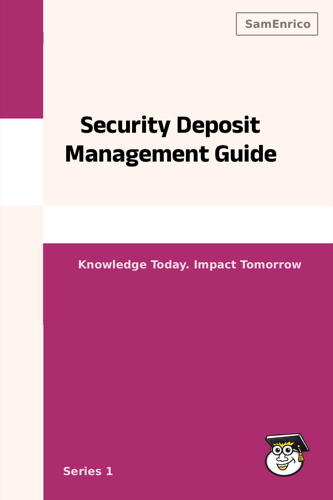
Security Deposit Management Guide
Collects, holds, and returns funds legally.
Collects, holds, and returns funds legally.
Formats
About this book
Free sample
Chapter 1: The Fiduciary Trap--–- The check arrives in your hand, crisp and promising. A new tenant, a signed lease, and a security deposit that feels like a cushion against risk. You deposit it into your operating account, pay a few bills, and breathe easier. This is what nearly every landlord does. And nearly every landlord is wrong.This chapter is not about the mechanics of collecting a deposit.
It is about unlearning a dangerous instinct: treating someone else’s money as your own. The security deposit is not income. It is not an advance payment. It is not a slush fund for future repairs. It is a fiduciary trust asset, and the moment you confuse it with operating cash, you have stepped into a legal trap that has bankrupted small landlords and triggered six-figure judgments against large property managers.Before we discuss caps, deadlines, or itemized statements, we must establish the single non-negotiable foundation of all security deposit management: the deposit belongs to the tenant until you prove otherwise, and you hold it as a trustee, not an owner.
This chapter will define the legal nature of the deposit, dismantle common misconceptions, establish the federal and state frameworks that govern it, and introduce the penalty matrix that will follow you through every subsequent chapter. By the end, you will understand why compliance begins not at move-out, but before you even cash the check.The Legal Nature of a Security Deposit What It Is A security deposit is a sum of money a tenant provides to a landlord at the start of a tenancy, held as collateral for two and only two purposes: (1) covering unpaid rent, and (2) paying for repairs to damage caused by the tenant that exceeds normal wear and tear. That is the exhaustive list. In every state that has adopted the Uniform Residential Landlord and Tenant Act (URLTA) or similar common-law principles, these are the sole permissible uses.The deposit creates a bailment relationship in some jurisdictions and an express trust in others. Regardless of the label, the core duty is identical: the landlord must preserve the…
This is the end of the free sample. Get the eBook to keep going. Buy now
Contents
- Chapter 1
- Chapter 2
- Chapter 3
- Chapter 4
- Chapter 5
- Chapter 6
- Chapter 7
- Chapter 8
- Chapter 9
- Chapter 10
- Chapter 11
- Chapter 12
Details
- Author
- Bautista Alisa
- Publisher
- SamEnrico
- Language
- English
- Genre
- Non-Fiction, Business Brief, Property Law
- Released
- 2026-06-07
- Pages (approx.)
- 145
- Available as
- eBook, Audiobook

Read better in the ZLOADR app
Your eBooks on your phone or tablet. Sign in with your SamEnrico account and start reading.
More by Bautista Alisa
 Caregiver Stress Physical SymptomsBautista Alisa$11.99
 Self Hypnosis for Irritable BowelBautista Alisa$11.99
 Seed vs Series A TermsBautista Alisa$11.99
 Late Night ExitBautista Alisa$11.99
 The Pediatric ER Doctor StressBautista Alisa$11.99
 Hayloft Hay Bale RestBautista Alisa$11.99
 MBSR for Work Life BalanceBautista Alisa$11.99
 Your Inner Critic TamedBautista Alisa$11.99
 The Last Broadcast: The Final Hours of Radio SawaBautista Alisa$11.99
 The Battle of Khalkhin Gol: The Sky War That Saved StalinBautista Alisa$11.99
 Neon Mirage: The AI That Redefined DemocracyBautista Alisa$11.99
 Prompting for Economic Scenario ModelingBautista Alisa$11.99